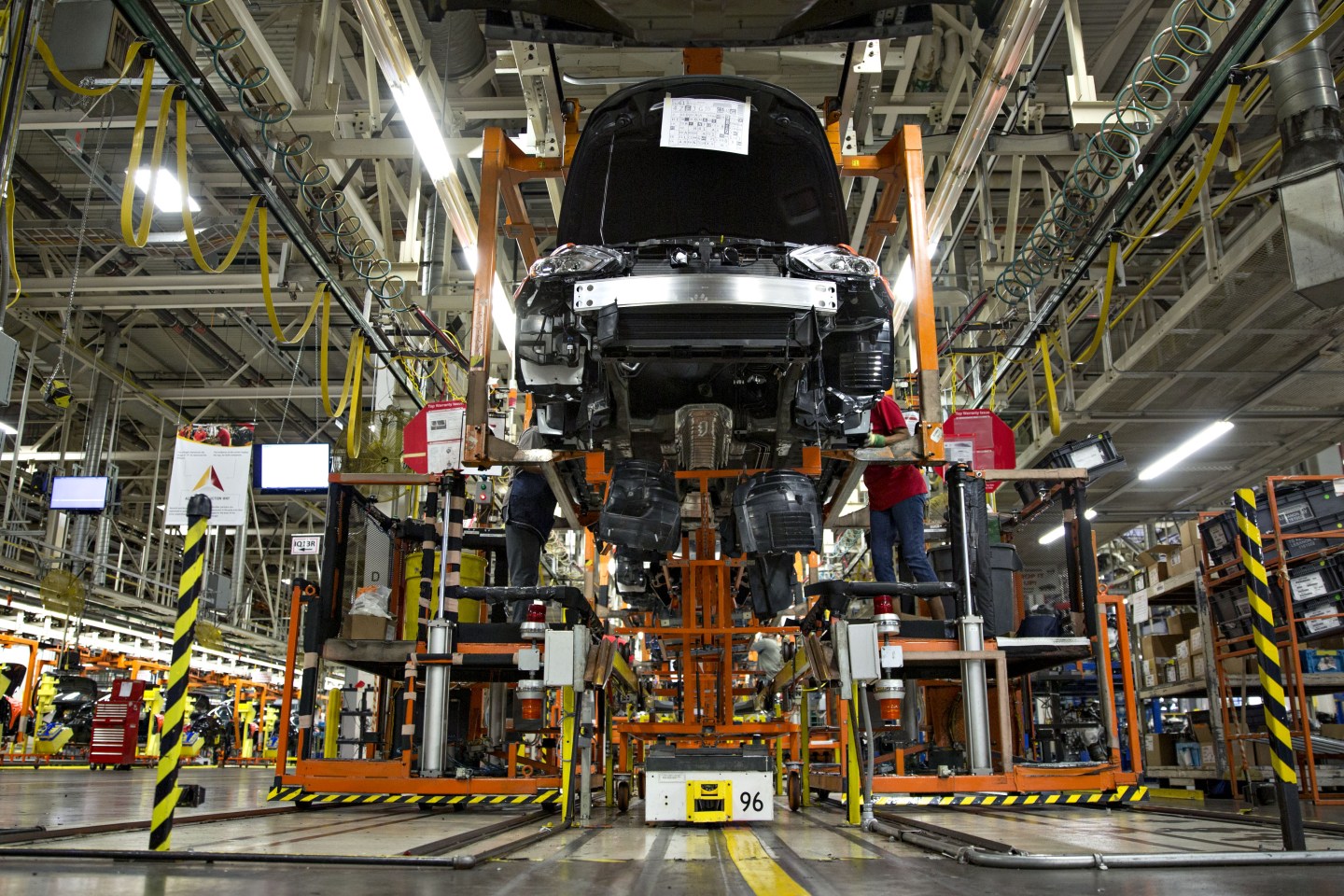
A surprise move by Ford on Tuesday to kill a planned $1.6 billion auto plant in Mexico and move that work instead to Michigan may be a sign that business leaders have listened to President-elect Donald Trump, who has blasted U.S. companies for shipping jobs overseas. A big question is whether tech giants like Apple, IBM and Microsoft, all of whom rely heavily on foreign manufacturers, will follow Ford’s (F) lead.
To be fair, while Trump tends to take credit for saving all these jobs—he had threatened Ford with a 35% tariff on Mexican-built vehicles sold in the U.S.— Ford chief executive Mark Fields told CNN that the company “didn’t cut a deal with Trump. We did it for our business.”
Whether you believe Ford’s move was due to Trump himself, or to a growing belief among voters that the country needs to maintain its own manufacturing capabilities, or that it just makes financial sense, as Fields argued, it is noteworthy.
Last month, telecommunications company Sprint and satellite provider OneWeb announced plans to hire 5,000 U.S. workers. Although Trump claimed credit for those jobs, they were, in fact, part of a planned $50 billion U.S. investment by SoftBank Group founder Masayoshi Son before Trump’s election victory. SoftBank owns stakes in both Sprint and OneWeb.
About 3,000 of those jobs would be at a new Florida factory where OneWeb says it will build low-cost satellites.
It was unclear how many of the other jobs would be in manufacturing, but the fact that two tech companies committed so publicly to investing in American workers was noteworthy. And it was also great public relations since SoftBank also wants to revive a Sprint (S) merger with T-Mobile (TMUS)that was proposed in 2014 but dropped in the face of U.S. regulatory resistance. SoftBank/Sprint might have better luck getting approval of the deal in a Trump administration.
Apple, criticized by Trump in the past for its outsourced manufacturing, is a bellwether for tech stalwarts. Apple (AAPL) has talked with Foxconn and Pegatron, two Asian contract manufacturers that build iPhones, to move some of their work stateside, according to unconfirmed reports.
Furthermore, Apple CEO Tim Cook, along with his Microsoft and IBM counterparts Satya Nadella and Ginni Rometty respectively, attended Trump’s tech summit in New York last month. Creating U.S. jobs was one hot topic of the event.
In an emailed statement, an Apple spokesman said the company:
is responsible for creating more than two million jobs across the United States, from engineers, retail and call center employees to operations and delivery drivers. We work with over 8,000 suppliers from coast to coast and are investing heavily in American jobs and innovation.
Get Data Sheet, Fortune’s technology newsletter.
In a blog posted the day after the election, Microsoft president Brad Smith pointed out the need for more highly educated workers. He cited research showing that the U.S. economy added 35 million jobs over the last 25 years, but that the number of jobs held by those without a high school diploma fell 13% to 7.3 million while jobs for those with four-year degrees doubled.
He stressed the need for private-public sector collaboration to boost jobs and innovation in the U.S. and elsewhere. But Smith made no mention of whether the company Microsoft would start making its Surface tablets in the U.S. or push its Asian manufacturing partners to open facilities here.
For more on Ford’s factory move, watch:
IBM’s Rometty, likewise, stated a need for companies to work with the U.S. government to improve the climate for job creation. In an open letter to Trump in November, she spoke about a need to train people for skilled jobs that don’t require two- or four-year college degrees.
But again, there was little in the way of specifics and no mention of moving any services or manufacturing work to the U.S. from elsewhere.
Fortune contacted Microsoft (MSFT) for comment about its U.S. job plans and will update this article as needed. An IBM spokesman responded to reiterate the company’s plan, announced last month to add 25,000 U.S. jobs over the next four years.
Toni Sacconaghi, senior research analyst with Bernstein Research said he hasn’t heard much from tech players about bringing jobs—manufacturing or otherwise—to the U.S. from abroad. And, Rometty’s plans, as spelled out in her letter, are “tough to interpret,” he said in an email.
He cited IBM’s employee turnover as one complicating factor. Because IBM has 80,000 to 90,000 U.S. employees, and if annual turnover is hypothetically 10%, IBM would need to hire 8,000 to 9,000 people to replace those departing workers. That replacement number alone would surpass the 25,000 jobs mentioned.
IBM responded that it expects employee headcount will be higher in 2020 than now, but it did not provide further details.
Thus far, SoftBank affiliates Sprint and OneWeb seem to be the only tech companies that have promised specific action on the domestic jobs front in the near term. The rest of the tech community has remained silent, at least publicly, about bringing manufacturing jobs back to the U.S.
But then again, it’s early.
One thing is certain, says Jeff Matthews, managing partner for RAM Partners, a Naples, Florida-based hedge fund, via email: “Every company I talk to is thinking about how to do more in America. I’m not sure that they will, but it is now something that’s on everybody’s radar, which can’t hurt.”
Jan. 4, 2017 (3 pm): This story was updated to add IBM’s response and to add more context from Bernstein Research analyst Toni Sacconaghi.
Jan. 5, 2017 (4 p.m.) This story was updated to add more details about IBM’s hiring plans.