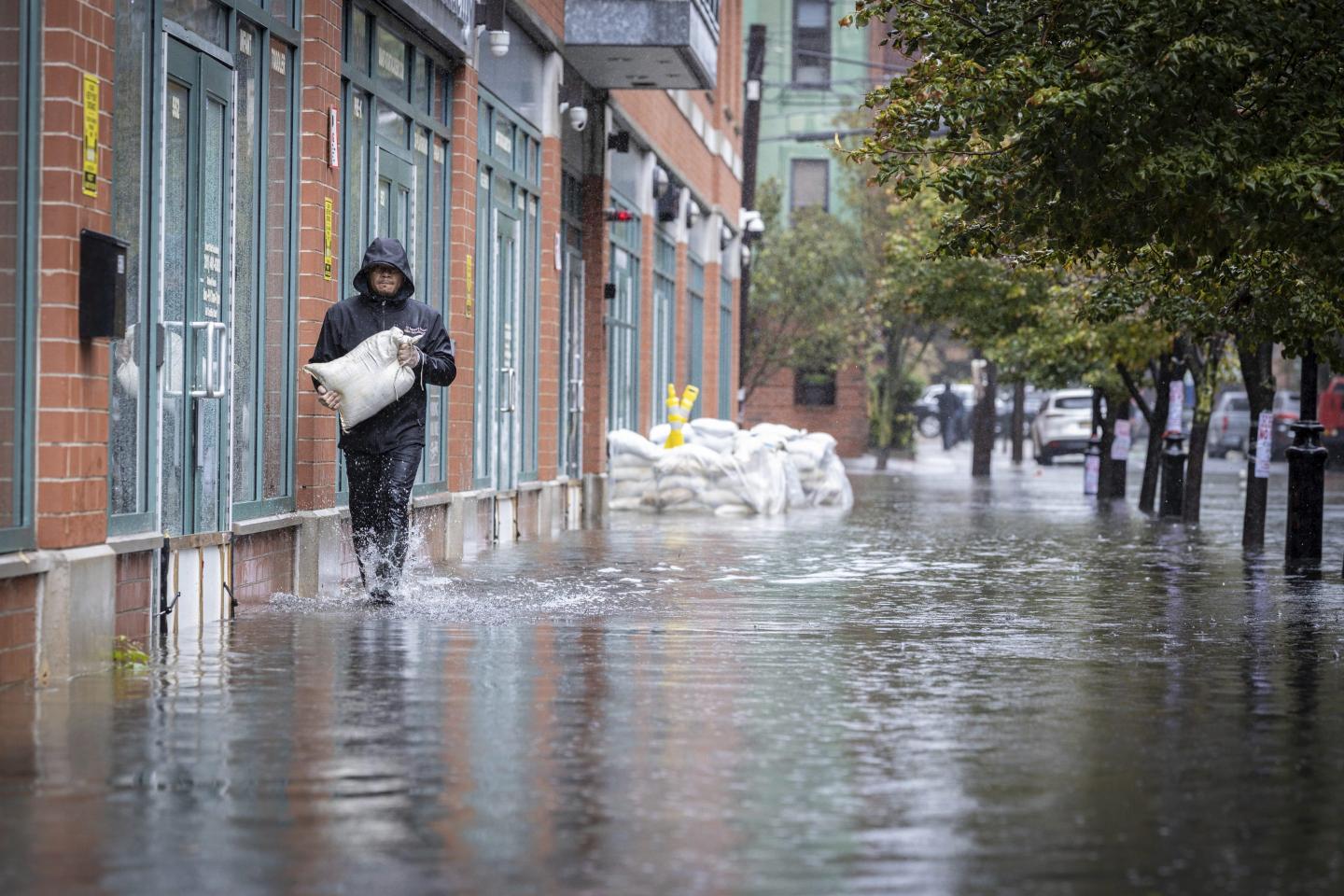
Revved-up climate change now permeates Americans’ daily lives with harm that is “already far-reaching and worsening across every region of the United States,” a massive new government report says.
The National Climate Assessment, which comes out every four to five years, was released Tuesday with details that bring climate change’s impacts down to a local level.
Overall, it paints a picture of a country warming about 60% faster than the world as a whole, one that regularly gets smacked with costly weather disasters and faces even bigger problems in the future.
Since 1970, the Lower 48 states have warmed by 2.5 degrees (1.4 degrees Celsius) and Alaska has heated up by 4.2 degrees (2.3 degrees Celsius), compared to the global average of 1.7 degrees (0.9 degrees Celsius), the report said. But what people really feel is not the averages, but when weather is extreme.
With heat waves, drought, wildfire and heavy downpours, “we are seeing an acceleration of the impacts of climate change in the United States,” said study co-author Zeke Hausfather of the tech company Stripe and Berkeley Earth.
And that’s not healthy.
Climate change is ”harming physical, mental, spiritual, and community health and well-being through the increasing frequency and intensity of extreme events, increasing cases of infectious and vector-borne diseases, and declines in food and water quality and security,” the report said.
Compared to earlier national assessments, this year’s uses far stronger language and “unequivocally” blames the burning of coal, oil and gas for climate change.
The 37-chapter assessment includes an interactive atlas that zooms down to the county level. It finds that climate change is affecting people’s security, health and livelihoods in every corner of the country in different ways, with minority and Native American communities often disproportionately at risk.
In Alaska, which is warming two to three times faster than the global average, reduced snowpack, shrinking glaciers, thawing permafrost, acidifying oceans and disappearing sea ice have affected everything from the state’s growing season, to hunting and fishing, with projections raising questions about whether some Indigenous communities should be relocated.
The Southwest is experiencing more drought and extreme heat – including 31 consecutive days this summer when Phoenix’s daily high temperatures reached or exceeded 110 degrees – reducing water supplies and increasing wildfire risk.
Northeastern cities are seeing more extreme heat, flooding and poor air quality, as well as risks to infrastructure, while drought and floods exacerbated by climate change threaten farming and ecosystems in rural areas.
In the Midwest, both extreme drought and flooding threaten crops and animal production, which can affect the global food supply.
In the northern Great Plains, weather extremes like drought and flooding, as well as declining water resources, threaten an economy dependent largely on crops, cattle, energy production and recreation. Meanwhile, water shortages in parts of the southern Great Plains are projected to worsen, while high temperatures are expected to break records in all three states by midcentury.
In the Southeast, minority and Native American communities — who may live in areas with higher exposures to extreme heat, pollution and flooding — have fewer resources to prepare for or to escape the effects of climate change.
In the Northwest, hotter days and nights that don’t cool down much have resulted in drier streams and less snowpack, leading to increased risk of drought and wildfires. The climate disturbance has also brought damaging extreme rain.
Hawaii and other Pacific islands, as well as the U.S. Caribbean, are increasingly vulnerable to the extremes of drought and heavy rain as well as sea level rise and natural disaster as temperatures warm.
Brown University climate scientist Kim Cobb, who wasn’t part of the assessment team, said, “at the center of the report are people — across every region of the country – who have escalating risks associated with climate change as well as clear opportunities for win-win climate action.”
The United States will warm in the future about 40% more than the world as a total, the assessment said. The AP calculated, using others’ global projections, that would slate America to get about 3.8 degrees (2.1 degrees Celsius) hotter by the end of the century.
Hotter average temperatures means weather that is even more extreme.
“The news is not good, but it is also not surprising,” said University of Colorado’s Waleed Abdalati, a former NASA chief scientist who was not part of this report. “What we are seeing is a manifestation of changes that were anticipated over the last few decades.”
The 2,200-page report comes after five straight months when the globe set monthly and daily heat records. It comes as the U.S. has set a record with 25 different weather disasters this year that caused at least $1 billion in damage.
“Climate change is finally moving from an abstract future issue to a present, concrete, relevant issue. It’s happening right now,” said report lead author Katharine Hayhoe, chief scientist at the Nature Conservancy and a professor at Texas Tech University. Five years ago, when the last assessment was issued, fewer people were experiencing climate change firsthand.
Surveys this year by The Associated Press-NORC Center for Public Affairs Research show that.
In September, about 9 in 10 Americans (87%) said they’d experienced at least one extreme weather event in the past five years — drought, extreme heat, severe storms, wildfires or flooding. That was up from 79% who said that in April.
Hayhoe said there’s also a new emphasis in the assessment on marginalized communities.
“It is less a matter … of what hits where, but more what hits whom and how well those people can manage the impacts,” said University of Colorado’s Abdalati, whose saw much of his neighborhood destroyed in the 2021 Marshall wildfire.
Biden administration officials emphasize that all is not lost and the report details actions to reduce emissions and adapt to what’s coming.
Americans on every level of government are “stepping up to meet this moment,” said White House science adviser Arati Prabhakar. “All of these actions, taken together, give us hope because they tell us that we can do big things at the scale that’s required, at the scale that the climate actually notices.”
By cleaning up industry, how electricity is made and how transport is powered, climate change can be dramatically reduced. Hausfather said when emissions stops, warming stops, “so we can stop this acceleration if we as a society get our act together.”
But some scientists said parts of the assessment are too optimistic.
“The report’s rosy graphics and outlook obscure the dangers approaching,” Stanford University climate scientist Rob Jackson said. “We are not prepared for what’s coming.”
___
Borenstein reported from Kensington, Maryland, and Webber from Fenton, Michigan.
___
Associated Press climate and environmental coverage receives support from several private foundations. See more about AP’s climate initiative here. The AP is solely responsible for all content.