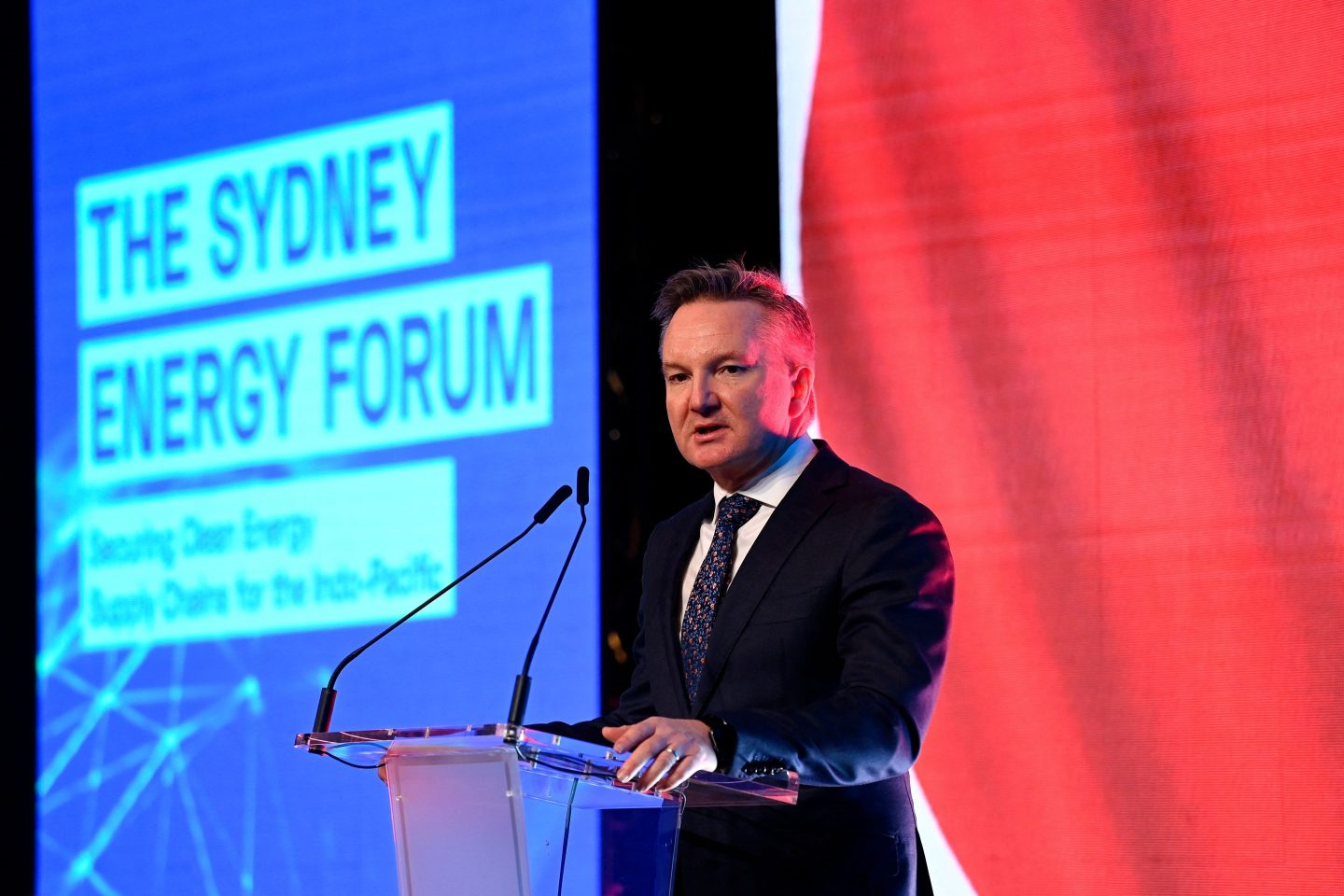
China, the world’s largest producer of wind turbines and solar panels, was a notable absence from the Sydney Energy Forum convened by Canberra and the International Energy Agency (IEA) this week. But the country’s exclusion was by design.
The forum was, for all intents and purposes, part of a renewed push by the strategic Quad security alliance of India, Australia, the U.S., and Japan to minimize China’s influence in the Asia Pacific region. Much of the conversation at the summit centered on how to topple China’s monopoly in the global green energy market.
“For the entire world to rely on one single country for a technology we all need is something we need to think about from an energy security perspective,” said Faith Birol, the IEA’s executive director, reiterating the thrust of a landmark report the IEA published last week that my colleague Yvonne Lau covered in fantastic detail.
Over the past 20 years, China has established itself as the global lynchpin in solar panel production, securing control over 80% of the market. China’s investment has also helped drive the costs of renewable energy to a point below coal, making wind and solar viable economic alternatives to fossil fuels.
Yet, in the wake of Russia’s invasion of Ukraine, which launched a frantic reassessment of Europe’s reliance on Russian gas, foreign leaders are recognizing a looming security threat in China’s successful cornering of the green energy market. Obtaining “energy security” has returned to the fore of policy planning.
“I worry that China has bigfooted a lot of the technology and supply chains that could end up making us vulnerable if we don’t develop our own supply chains,” U.S. energy secretary Jennifer Granholm said during the Sydney forum.
“Therefore, from an energy security point of view, it is imperative that nations that share the same values, develop our own supply chains, not just for the climate, which of course is very important, but for our own energy security,” Granholm said.
The Quad’s late awakening to China’s monopoly on green energy could prove a vital accelerant for the shift to a net-zero economy. Western countries and their allies will need to increase investment in renewable tech if they want to counter China and diversify supply chains. Increased competition could drive renewable energy prices even lower.
Conversely, attempting to break China’s monopoly on green energy could fatally stall the West’s own transition to a low-carbon economy. In the U.S., Congress has still yet to approve the $52 billion funding promised in the CHIPS for America act, which it passed last year to counter another perceived threat from China.
The path to Net Zero demands swifter action than that.
Eamon Barrett
– eamon.barrett@fortune.com
@eamonbarrett88
CHANGE THE WORLD
Fortune is preparing to publish its annual Change the World list, recognizing outstanding companies that are doing well by doing good. The list isn't in praise of corporate philanthropy but a showcase of businesses that are using the creative tools of industry to help the planet and tackle society’s unmet needs—all while earning a profit by doing so. If you'd like to nominate a company for this year's list, you can do so here. The deadline for applications this year is Friday, July 29, and the list will be published in mid-October. To see who made it to last year's list, you can check here. For all further questions, email changetheworld@fortune.com.
CARBON COPY
Kirk out
Stuart Kirk, HSBC’s former head of responsible investing who caused a furor in May after delivering a speech that appeared to downplay the threat of climate change, has left the bank. HSBC, which had approved Kirk’s speech before he delivered it at the FT Moral Money summit, suspended the banker following public backlash. Last week the veteran banker announced he had resigned, calling out “the bank’s behavior” for making his position “unsustainable” and warning of a pervasive “cancel culture.” LinkedIn
Fossil Tok
Last week, oil major Shell began recruiting for a TikTok Channel Manager to help the brand produce content targeting the platform’s predominantly Gen-Z user base. Shell’s push onto the buzziest entertainment platform comes as rival fossil fuel giants seize on the global energy crisis to ramp up spending on ad campaigns that highlight national energy security. In the U.K., BP spent more on Facebook ads in the past month than any other group, in the area of “political or social issues. FT
Methane needs more money
A new report from the Climate Policy Initiative says the world needs to increase spending on curbing methane emissions tenfold, pooling $110 billion globally each year, to limit the rise in global temperatures to 1.5C. Money spent on cutting methane leaks has “one of the highest ratios of global warming benefit per dollar of capital invested,” the think tank said but currently only 2% of global climate funding is invested in the sector. Bloomberg
Scrubbers
Given the choice between polluting the sea or the sky, the shipping industry chose the sea. In 2020, the International Maritime Organization issued the global shipping industry a directive to slash the volume of sulfur spewed into the air by ship exhausts sevenfold. Shippers could have invested in low-sulfur fuels to meet the stringent target, but cleaner petrols are expensive. Instead, thousands of ships opted for installing “scubbers,” that reduce atmospheric sulfur pollution by filtering a ship’s exhaust through the ocean. Guardian
IN CASE YOU MISSED IT
To solve the water crisis, companies are increasingly turning to A.I. by Tony Lystra
Vladimir Putin ‘most likely’ to permanently cut off Europe’s gas by Sophie Mellor
There’s a huge problem for the clean energy shift and it comes from China, unprecedented IEA report says by Yvonne Lau
Texas Bitcoin miners are getting paid to shut down and give electricity back to the power grid by Eamon Barrett
Japan is trying to avoid power blackouts during a scorching heat wave by setting ACs to 82 degrees and turning off heated toilet seats by Eamon Barrett
CLOSING NUMBER
30C
As heat waves bake swathes of Europe, the U.K. federation of trade unions, the Trade Unions Congress (TUC), is calling on the government to legislate a maximum acceptable workplace temperature, beyond which companies will be legally obligated to send employees home. TUC is proposing the government set that heat ceiling at 30 degrees Celsius, or 86 Fahrenheit. Estimates for the proportion of office space in the U.K. that have air conditioning range between 40% and 60%, which leaves the country’s service economy ill-prepared for increasingly grueling heat waves—not to mention how the millions of laborers who work outdoors can cope with current 32C heat.
Sign up for the Fortune Features email list so you don’t miss our biggest features, exclusive interviews, and investigations.