• Home
  • Latest
  • Fortune 500
  • Finance
  • Tech
  • Leadership
  • Lifestyle
  • Rankings
  • Multimedia
CommentarySustainability

Your supply chain is the secret to sustainability success

By
Rich Lesser
Rich Lesser
Down Arrow Button Icon
By
Rich Lesser
Rich Lesser
Down Arrow Button Icon
June 22, 2021, 8:23 AM ET
The production line at a BMW factory in Shenyang, China. BMW is one of a growing number of manufacturers that have set highly ambitious supply chain decarbonization targets, writes BCG CEO Rich Lesser.
The production line at a BMW factory in Shenyang, China. BMW is one of a growing number of manufacturers that have set highly ambitious supply chain decarbonization targets, writes BCG CEO Rich Lesser.Pan Yulong—Xinhua/Getty Images

This story is part of The Path to Zero, a series of special reports on how business can lead the fight against climate change. This quarter’s stories go in depth on sustainability in supply chains.

Consider the average car that a consumer will buy at the end of this decade. It will cost around $35,000. It will be made of about one metric ton of steel, 400 kilograms of plastic, 400 kilograms of aluminum, and batteries that will be significantly heavier than those we have today. Now imagine that the same car is built with materials produced with net-zero impact. It would have to cost a small fortune, right? 

Actually, no. According to modeling we’ve done at BCG, the incremental costs to make a net-zero car would add less than 2% to the final price—about what it would cost for leather upholstery, heated seats, or a fancier sound system. 

When I saw these numbers for the first time several months ago, I was sure they couldn’t be right. How could the added cost be so low? In fact, the shift to net zero would substantially raise the costs of the steel, plastic, aluminum and batteries. But the essential point is that those costs make up only a small fraction of the total price that the consumer is paying. 
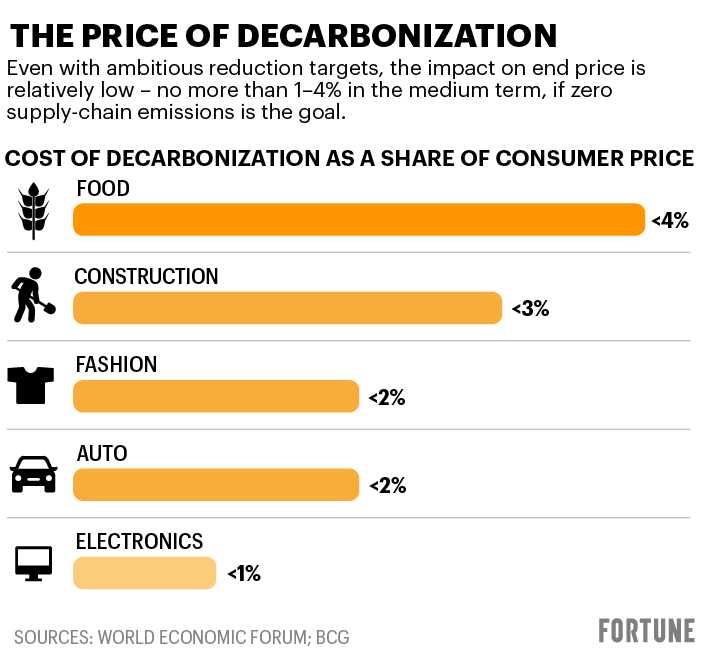
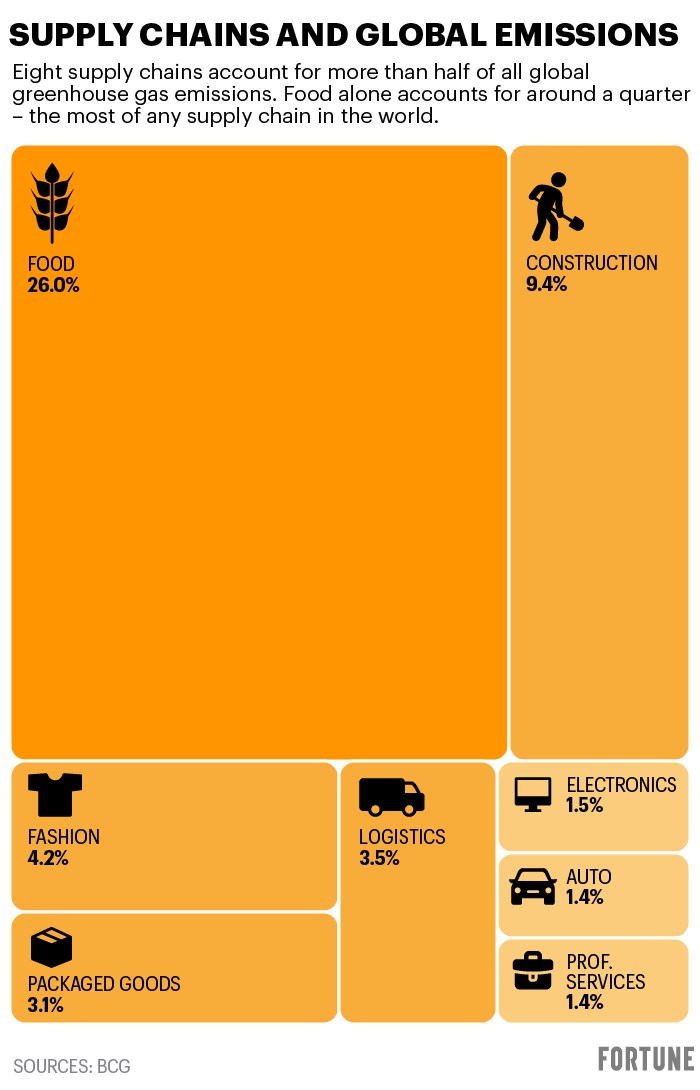
This same observation holds true in supply chain after supply chain, whether it’s in fashion, auto, electronics, professional services, fast-moving consumer goods, food, or freight. Analysis suggests that when you take an end-to-end supply chain view, it’s possible to reduce about 40% of the emissions across the eight major global supply chains for less than $12 per ton of carbon dioxide (CO2) equivalents, only marginally affecting product price. And going all the way to net zero would increase the end price across a vast range of products by only 1% to 4%. That’s less than $600 extra for that car, $3 for a smartphone, and $1 for a pair of jeans. 

And that fact—that decarbonization adds only modest costs to the end of any value chain—presents the biggest opportunity for business to make a real mark in the battle against climate change. 

Of course, the upstream producers of agricultural and heavy industrial inputs, which account for the vast majority of the emissions embedded in the products we use every day, can’t be expected to fund a net-zero transition alone. But end-consumer companies—which often have higher margins and a more engaged consumer base—can collaborate across company boundaries and country borders to decarbonize their end-to-end supply chains.

Tackling the supply chain challenge

With the potential for huge impact at manageable cost, why has the supply chain sustainability agenda not yet been launched at scale? Many company leaders are eager to cut supplier emissions, but it’s a daunting proposition. 

While they are getting increasingly adept at tracking and measuring their own emissions, it’s much more challenging for leaders to have the same clarity about their suppliers’ product-specific emissions—especially for companies with tens of thousands of product components and a constantly changing supplier base. They face obstacles in data and analytics, tracking and measuring, procurement, certification, and more. 
To manage these problems, companies need to gain a clear picture of the emissions from upstream activities by building a comprehensive database that uses supplier-specific data where possible. This can serve as a basis for defining, aligning on, and committing to clear reduction targets for the years ahead. 

It’s also important, where it can be done, to redesign products and business models for “circularity,” incorporating sustainability into material selection, feature development, and more. Companies should also engage with their suppliers on emissions standards, adding sustainability metrics to procurement standards and offering better terms to those that show progress. 

Priority actions are company- and supply-chain specific. If you are a fast-moving consumer goods company, your initial focus might be on ensuring a circular model for your packaging or redesigning your products to use ingredients with a lower environmental impact. A construction company is likely to push suppliers to implement processes for creating lower-carbon cement and to invest in carbon capture technologies (a longer-term and more expensive proposition). In professional services, we must switch to renewable energy and heat in our offices and help fund the scale-up of sustainable aviation fuels.
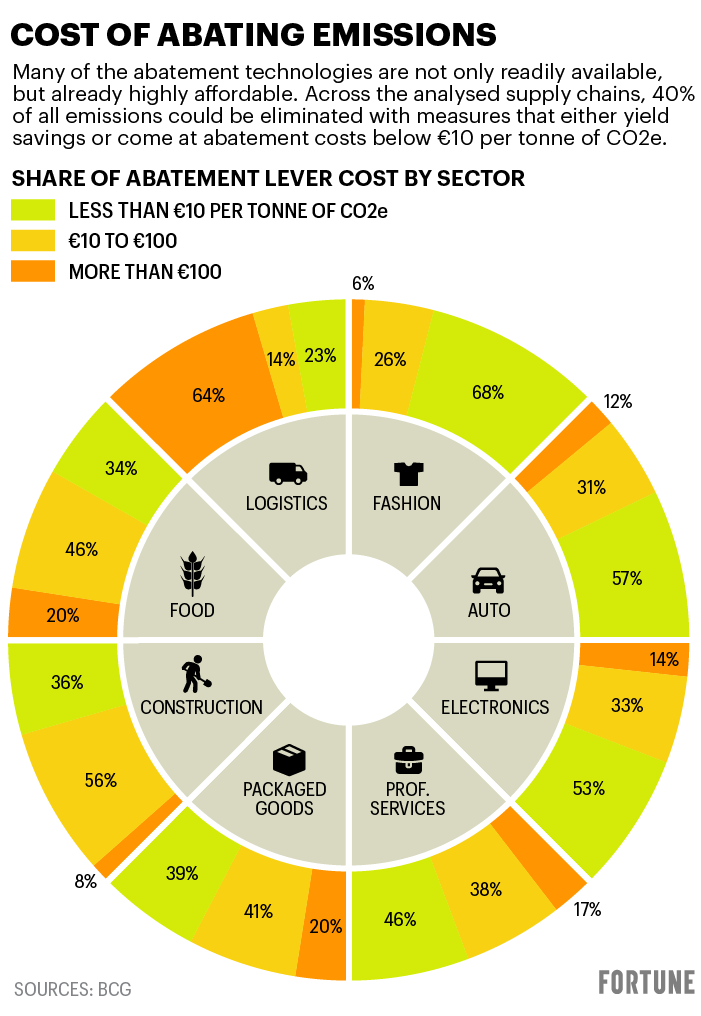
Of course, governments could, and must, make it easier—by putting a price on carbon, catalyzing investment in innovation, incentivizing companies to change, and protecting those that do change from competitors that don’t. But alongside government support—or even absent it in the short term, if necessary—business can be a powerful partner in drastically cutting back on upstream emissions and increasing climate impact. 

Getting on track for Paris compliance

A handful of companies have already made progress in this arena. BMW, for example, has adopted a highly ambitious supply chain CO2 reduction target—even tying management compensation to achieving its goal.

Ikea is also deepening its sustainable supply chain reach, investing in resources critical for the company’s long-term development, such as sustainable energy, wood, and recycled materials. The company now owns and directly manages about 243,000 hectares of forests in the U.S. and Europe. 

And Apple has expanded its sustainability commitments, promising to be net zero across its entire business, product life cycle, and manufacturing supply chain by 2030. The company is involved in the development of low-carbon aluminum, the first batch of which will be used in certain MacBooks.

To get on track for a Paris Agreement–compliant world, we need to see collaboration across supply chains at a huge scale. Of course, government action will be critical to set the world on a net-zero path. But with so much at stake and the necessary technologies largely available to us, I urge my fellow CEOs to seize the supply chain opportunity. 

Rich Lesser is CEO of Boston Consulting Group.

Some of the companies mentioned in this article are BCG clients.

Subscribe to Fortune Daily to get essential business stories straight to your inbox each morning.

About the Author
By Rich Lesser
See full bioRight Arrow Button Icon

Latest in Commentary

Finance
Lorem ipsum dolor sit amet, consectetur adipiscing elit, sed do eiusmod tempor incididunt ut labore et dolore magna aliqua. Ut enim ad minim veniam
By Fortune Editors
October 20, 2025
Finance
Lorem ipsum dolor sit amet, consectetur adipiscing elit, sed do eiusmod tempor incididunt ut labore et dolore magna aliqua. Ut enim ad minim veniam
By Fortune Editors
October 20, 2025
Finance
Lorem ipsum dolor sit amet, consectetur adipiscing elit, sed do eiusmod tempor incididunt ut labore et dolore magna aliqua. Ut enim ad minim veniam
By Fortune Editors
October 20, 2025
Finance
Lorem ipsum dolor sit amet, consectetur adipiscing elit, sed do eiusmod tempor incididunt ut labore et dolore magna aliqua. Ut enim ad minim veniam
By Fortune Editors
October 20, 2025
Finance
Lorem ipsum dolor sit amet, consectetur adipiscing elit, sed do eiusmod tempor incididunt ut labore et dolore magna aliqua. Ut enim ad minim veniam
By Fortune Editors
October 20, 2025
Finance
Lorem ipsum dolor sit amet, consectetur adipiscing elit, sed do eiusmod tempor incididunt ut labore et dolore magna aliqua. Ut enim ad minim veniam
By Fortune Editors
October 20, 2025

Most Popular

Finance
Lorem ipsum dolor sit amet, consectetur adipiscing elit, sed do eiusmod tempor incididunt ut labore et dolore magna aliqua. Ut enim ad minim veniam
By Fortune Editors
October 20, 2025
Finance
Lorem ipsum dolor sit amet, consectetur adipiscing elit, sed do eiusmod tempor incididunt ut labore et dolore magna aliqua. Ut enim ad minim veniam
By Fortune Editors
October 20, 2025
Finance
Lorem ipsum dolor sit amet, consectetur adipiscing elit, sed do eiusmod tempor incididunt ut labore et dolore magna aliqua. Ut enim ad minim veniam
By Fortune Editors
October 20, 2025
Finance
Lorem ipsum dolor sit amet, consectetur adipiscing elit, sed do eiusmod tempor incididunt ut labore et dolore magna aliqua. Ut enim ad minim veniam
By Fortune Editors
October 20, 2025
Finance
Lorem ipsum dolor sit amet, consectetur adipiscing elit, sed do eiusmod tempor incididunt ut labore et dolore magna aliqua. Ut enim ad minim veniam
By Fortune Editors
October 20, 2025
Finance
Lorem ipsum dolor sit amet, consectetur adipiscing elit, sed do eiusmod tempor incididunt ut labore et dolore magna aliqua. Ut enim ad minim veniam
By Fortune Editors
October 20, 2025
Fortune Secondary Logo
Rankings
  • 100 Best Companies
  • Fortune 500
  • Global 500
  • Fortune 500 Europe
  • Most Powerful Women
  • Future 50
  • World’s Most Admired Companies
  • See All Rankings
Sections
  • Finance
  • Fortune Crypto
  • Features
  • Leadership
  • Health
  • Commentary
  • Success
  • Retail
  • Mpw
  • Tech
  • Lifestyle
  • CEO Initiative
  • Asia
  • Politics
  • Conferences
  • Europe
  • Newsletters
  • Personal Finance
  • Environment
  • Magazine
  • Education
Customer Support
  • Frequently Asked Questions
  • Customer Service Portal
  • Privacy Policy
  • Terms Of Use
  • Single Issues For Purchase
  • International Print
Commercial Services
  • Advertising
  • Fortune Brand Studio
  • Fortune Analytics
  • Fortune Conferences
  • Business Development
About Us
  • About Us
  • Editorial Calendar
  • Press Center
  • Work At Fortune
  • Diversity And Inclusion
  • Terms And Conditions
  • Site Map
Fortune Secondary Logo
  • About Us
  • Editorial Calendar
  • Press Center
  • Work At Fortune
  • Diversity And Inclusion
  • Terms And Conditions
  • Site Map
  • Facebook icon
  • Twitter icon
  • LinkedIn icon
  • Instagram icon
  • Pinterest icon

Latest in Commentary

putin
CommentaryRussia
Exclusive analysis: we looked at the 400 western firms still in Russia. Their paltry size strips Putin’s bluff bare naked
By Jeffrey Sonnenfeld, Stephen Henriques, Jake Waldinger and Giuseppe ScottoFebruary 27, 2026
21 hours ago
roth
CommentaryLeadership
The AI resource reallocation challenge: How can companies capture the value of time?
By Erik RothFebruary 27, 2026
23 hours ago
will
CommentaryAdvertising
I’m one of America’s top pollsters and I’ve got a warning for the AI companies: customers aren’t sold on ads
By Will JohnsonFebruary 27, 2026
1 day ago
the pitt
CommentaryDEI
‘The Pitt’: a masterclass display of DEI in action 
By Robert RabenFebruary 26, 2026
2 days ago
david booth
CommentaryMarkets
3 lessons from investing’s ‘moneyball’ moment
By David BoothFebruary 25, 2026
3 days ago
CommentaryCulture
Gen Z’s enthusiasm for all things touchable is resurrecting the analog economy—and costing parents
By Luba KassovaFebruary 24, 2026
4 days ago

Most Popular

placeholder alt text
Innovation
An MIT roboticist who cofounded bankrupt robot vacuum maker iRobot says Elon Musk’s vision of humanoid robot assistants is ‘pure fantasy thinking’
By Marco Quiroz-GutierrezFebruary 25, 2026
3 days ago
placeholder alt text
Success
Japanese companies are paying older workers to sit by a window and do nothing—while Western CEOs demand super-AI productivity just to keep your job
By Orianna Rosa RoyleFebruary 27, 2026
19 hours ago
placeholder alt text
Commentary
'The Pitt': a masterclass display of DEI in action 
By Robert RabenFebruary 26, 2026
2 days ago
placeholder alt text
Economy
It’s more than George Clooney moving to France: America is becoming the ‘uncool’ country that people want to move away from
By Nick LichtenbergFebruary 27, 2026
1 day ago
placeholder alt text
Success
Walmart exec says U.S. workforces needs to take inspiration from China where ‘5 year-olds are learning DeepSeek’
By Preston ForeFebruary 27, 2026
1 day ago
placeholder alt text
Law
China's government intervenes to show Michigan scientists were carrying worms, not biological materials
By Ed White and The Associated PressFebruary 26, 2026
2 days ago

© 2026 Fortune Media IP Limited. All Rights Reserved. Use of this site constitutes acceptance of our Terms of Use and Privacy Policy | CA Notice at Collection and Privacy Notice | Do Not Sell/Share My Personal Information
FORTUNE is a trademark of Fortune Media IP Limited, registered in the U.S. and other countries. FORTUNE may receive compensation for some links to products and services on this website. Offers may be subject to change without notice.










