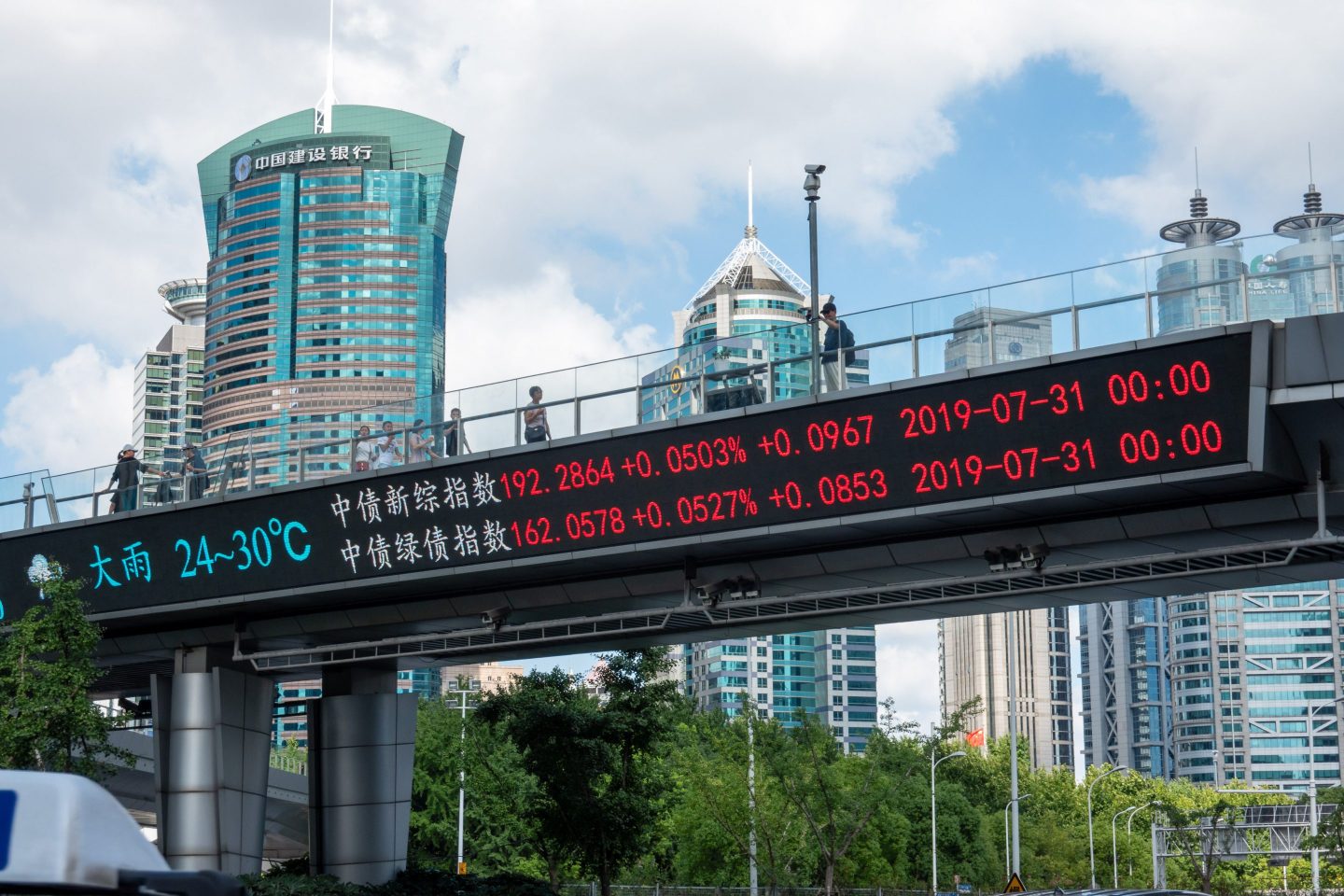
The world knows that China’s GDP growth rate has recently fallen (although some are more worried about it than others). But what the world may not know is that while the U.S. capital markets have steadily grown for the past decade (see chart below), the Chinese markets have been essentially flat.

These are two sovereign nations with different economic and political philosophies—and dramatically different economic performances. It is a stunning and underappreciated story.
This is how it begins: During George W. Bush’s two terms as president of the United States, the U.S. economy recovered from the bursting of the 1990’s Tech Bubble, got slammed again, and then revived after the al Qaeda attacks in September 2001. After rising steadily, the U.S. economy slumped again in mid-2007 as the financial crisis deepened. Bush’s term in office ended during the worst collapse of the U.S. stock exchange since the 1930s.
It was a period of drama in China as well. The Chinese markets, as represented by the Shanghai Composite Index, had also been falling in the final years of President Jiang Zemin. Three years after Hu Jintao became China’s President, the Shanghai Composite tripled. Then, as always after a spike driven by over-buying, some of it caused by massive investment stimulus by the Chinese government and corporations that it controlled, a sharp collapse followed. This collapse foreshadowed the implosion of the U.S. market, which followed a year or so later.
Soon after, in 2009, the S&P 500 started a steady march to its present level. The Shanghai Composite did not follow this course. It went up, and then fell—hard. It rose again shortly after President Xi took office, and then collapsed again, and since 2015, has not recovered. The Yuan has also wobbled. Meanwhile the S&P 500 continued its reasonably steady march—with a pause or two, and some increased volatility during the early Trump years—to the present level.
The U.S. press has fixated for years over the ascendency of China, and its increasingly entrepreneurial economy. If it is ascending, why does the stock market show little sustainable progress over the past decade? Further, how can China have such a vibrant entrepreneurial economy, while the market itself is flagging?
The simple answer is, it cannot.
What is growing in China, and growing at a heady rate, is innovation. The problem is that China’s growing innovation, or more accurately China’s growing commitment to research and development (R&D), is not leading to entrepreneurship, and therefore not leading to the benefit of the Chinese people. While innovation is often an essential ingredient in entrepreneurship, it is not the only ingredient in entrepreneurship.
As much as one hears about the progress China has made, the country is a long way from overtaking the U.S. For example, the U.S. generates around $125,000 of GDP per worker; China generates about $16,000. And while the U.S. generates approximately $187,500 of market cap per worker; China generates an estimated $11,200.
The issue is not that China doesn’t spend money on R&D, it does. In 2016, China spent, in purchasing power parity terms, 88% of what the U.S. spent—up from approximately 66% in 2012, with a significant portion of that in basic R&D.
Neither is the issue that China lacks entrepreneurs. There’s Jack Ma (of Alibaba), Huateng Ma (of Tencent), Robin Li (of Baidu), William Ding (of NetEase), Richard Liu (of JD.com), Tang Xiao’ou (of SenseTime), and a dozen or more other extraordinary entrepreneurs.
China does not lack venture capitalists, either. Consider Neil Shen, Kui Zhou, and Steven Ji (Sequoia Capital China), Xiaojun Li (IDG Capital)—among others. Of course, there are many foreign venture capitalists investing directly in China as well, including Masayoshi Son, CEO of SoftBank, the Japanese holding company.
What’s more, last year China invested almost $105 billion in venture capital, according to Bloomberg, but venture capital spending and deal volume dropped significantly in the first half of 2019. Clearly, something that was working has stopped working.
The country has likewise seen a decade of dramatic technological advances in many fields including A.I., computing and super-computing, data processing, electric vehicles, internet (including crypto, 5G, and cyber), rare earths, robots, semiconductors, and even some areas of health care. China has also been supportive of technology development or attempts to have investors profit from those investments. Just last month, for example, the Chinese government initiated the STAR market, as a new securities exchange market in China focused on providing market liquidity to entrepreneurial firms. Starting with 25 new entrepreneurial companies, with another 125 or so are pending, the market exploded on its first active day.
The error of the Chinese government has been to confuse, or conflate, the meanings of innovation and entrepreneurship. The terms are related but quite different. The essence of innovation is creativity—thinking of something new (the root word of innovation is nova, Latin for “new”), often by finding previously unknown associations among different fields. On the other hand, the essence of entrepreneurship (which comes from the French word meaning “to undertake”) is (under) taking risk. Innovation brings the concept of newness to an economy but does not necessarily involve taking risks. Undertaking risk, however, is the job of the entrepreneur.
It appears that the Chinese government has largely reserved the right to undertake risk to itself rather than delegate to independent individuals. That is to say it appears that the Chinese government seeks to directly control the pace of economic development in China, including the pace of development (or growth) of the capital markets. In pursuit of this goal, the Chinese government acts as a major investor, the major regulator, the issuer and trader of currency, a major banker, and the judge in all major disputes.
The record of the Shanghai and S&P markets show that that system has not been working for the past decade to produce internationally competitive growth and returns for investors, including for both Chinese investors and the Chinese people.
If that is the case, it is a major difference between Chinese and Western economic systems. Had an investor decided to make a pairs trade in 2009—going long on the S&P 500 and shorting the Shanghai Composite—the investor would have earned an annual compounded return in excess of 25% annually each year of the past decade (albeit with some risk, of course).
The differences between the Chinese and Western approaches to the capital markets is likely a primary cause of the dramatic differences one sees between the economic performances of the two countries over the past decade. The current economic battles between President Trump and President Xi are certainly adding to the effect, but the cause is independent of the current battle.
Richard N. Foster is an Emeritus Senior Partner of McKinsey & Company. He is the author of The Attackers’ Advantage and Creative Destruction. He has been traveling frequently to China since 1986.
More opinion in Fortune:
—How Japan became a model for economic revival
—Bernie Sanders: America is drowning in student debt. Here’s my plan to end it
—Ex-Apple CEO John Sculley: Why sensors are the future of health care tech
—Most states still enforce noncompete agreements—and it’s stifling innovation
—Why recent antitrust regulation isn’t really about consumer protection
Listen to our audio briefing, Fortune 500 Daily











