
One year into Kohl’s (KSS) three-year turnaround plan, the department store is deploying new tools to sustain its fragile return to growth: much smaller stores that will cater to customers both in less populous areas and in dense urban centers, and outlet stores.
A year ago, to kickstart growth after a string of lackluster quarterly sales reports, the retailer launched its so-called “Greatness Agenda,” a roadmap to add $2 billion in annual sales by the end of 2017 to a total of $21 billion. The plan included, among other things, a loyalty program and greater use of tech to bolster its e-commerce.
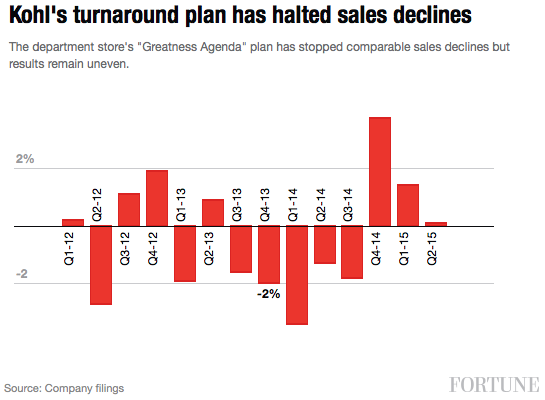
Kohl’s has since experienced three quarters of comparable sales (sales at stores open at least a year, plus online sales) growth, including a stellar holiday season last year, putting an end to a five-quarter losing streak.
But the quarterly growth rates have become successively smaller, including a 0.1% gain in the most recent quarter. That has raised worries on Wall Street about the durability of Kohl’s comeback, and sent the company’s shares down about 45% from the 52-week high of $79.60 that they hit in April.
Kohl’s Chief Executive Kevin Mansell brushes aside those concerns, saying his is a long-term plan and that his company is right where it should be at this early stage.
Still, to give Kohl’s renewed momentum, the retailer will open between five and 10 smaller stores of 35,000 square-feet each, or just under half the size of a regular Kohl’s store, under a new format being launched next year and likely to be rolled out further. The retailer will also launch a new chain of outlet stores.
“There are a whole bunch of markets that are completely underserved by Kohl’s,” Mansell told Fortune in an exclusive interview.
That includes small markets that can’t accommodate a typical 80,000 foot-square Kohl’s store, as well as city centers that may include New York and Chicago. (The moves echo efforts by indirect rivals like Walmart (WMT) and Target (TGT) as they look to become less reliant on suburban shoppers.)
While competitors like J.C. Penney (JCP) and Macy’s (M) have been closing stores, Mansell says the size of his 1,166-store fleet is appropriate. (No store closing program is planned.) He also argues that adding physical stores will help the company’s e-commerce efforts, especially in untapped markets. “There’s a massive percentage of our growing e-commerce business that gets picked up in a store,” he says.
Building on its first Off-Aisle By Kohl’s outlet store opened in the spring, which exclusively sells returned items, Kohl’s will add two new stores in 2016 that will likely also include clearance items and special orders.
Kohl’s will also open 10 to 15 outlet mall stores under the Fila name to showcase that brand (for which Kohl’s stores have the U.S. exclusive rights to its sports line), a first step towards operating shops that would each solely sell one of Kohl’s private label or exclusive brands. Many of those are prominent enough to stand on their own without being in a Kohl’s-branded store, Mansell says. While Kohl’s won’t say which name might be next, the retailer’s big in-house brands include Croft & Borrow, Apt. 9, and the billion-dollar Sonoma brand.
These efforts come amid a consumer environment that has stacked the deck against department stores. In recent months, U.S. consumer spending is shifting away from department store staples, most notably apparel, to things like electronics and home repair. So it’s fair to wonder how much of a lift these actions will give Kohl’s.
Edward Jones analyst Brian Yarbrough says Kohl’s is making a lot of right moves, including a reset in the last year of its beauty sections—launching the Yes2You Rewards loyalty program that anyone can join, not just Kohl’s card holders—and beefing up its e-commerce to offer services consumers now expect everywhere, such as in-store pick up of online orders. But he wonders whether that will be enough.
“Kohl’s is doing everything in its power, but the difficulties of selling apparel are overshadowing everything,” Yarbrough says. “It used to be a matter of problems of Kohl’s own doing, now it’s industrywide.”
Mansell says he knows it’s tough going for retailers but that those challenges are built into the “Greatness Agenda’s” projections. And he says he intends to use all levers at his disposal to reach his goal.
For example, Kohl’s plans to make use of the data it receives from members of the Yes2You program, including 24 million new ones in the last year. (It’s now up to 34 million members in all.) That will allow the retailer to reach more new customers and convince some to sign up for the Kohl’s store card.
The company also aims to increase the number and size of transactions by making sales pitches based on a customer’s actual shopping patterns, something more efficient than mass marketing, much of which Mansell said is wasted.
Another major goal is to give each individual store, including the small stores to come, the ability to adapt its product assortment to local needs, rather than taking a regional approach. A store in a suburb with a lot of young moms could double up on kids’ apparel and give that category more shelf space, while a Kohl’s that is more urban might have more active wear. That would have the added benefit of less unsold merchandise.
“It’s important because customers want to have relevant merchandise,” Mansell says.
And being relevant is getting to be a bigger challenge for all retailers, not just Kohl’s.