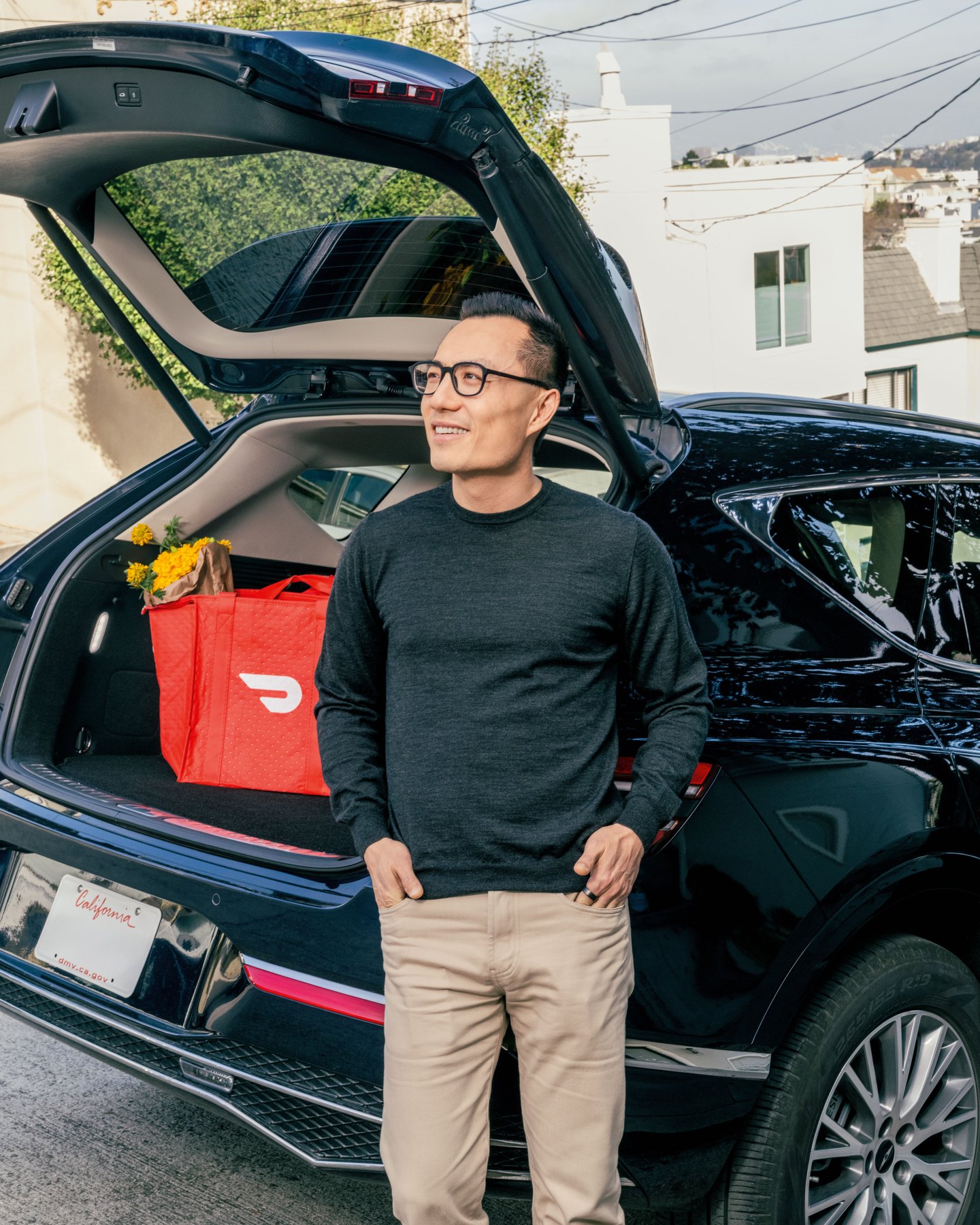
The delivery guy’s legs were propelling him toward the parked car I was in at a pace that registered somewhere between “I’m training for my neighborhood 5K” and “Grab the keys, start the ignition, let’s bail!”
The scene might have posed some cause for concern if not for the identity of the man barreling toward me: It was Tony Xu, cofounder and CEO of DoorDash, the $85 billion delivery company that has experienced a meteoric rise over the past five years.
But on this mild fall day in downtown San Francisco, Xu was not playing the role of Fortune 500 CEO. Instead he was spending the afternoon as a “Dasher” for DoorDash—zooming around San Francisco in a staffer’s white Audi SUV (his own car was cluttered with his kids’ car seats, he told me) to deliver fried chicken salads and Mediterranean bowls. It wasn’t his first time; as a cofounder of the company, he was one of the company’s first Dashers—and all U.S. salaried employees must do four delivery shifts a year. (At one point he pulled a mid-street U-turn that impressed even this New York City native.)
A short while earlier, Xu had accepted four orders from the same ghost kitchen (industry vernacular for a takeout-only restaurant). “This is what I call playing the game on extra hard mode,” Xu said. “I’ve never done a quadruple batch.”
Now, Xu wanted to demonstrate a feature on the DoorDash app’s interface for Dashers. “The order’s not ready yet but look, I want to show you something cool,” Xu told me as he neared the Audi, which he had parked in a questionably legal spot on a narrow two-way side street in San Francisco’s SoMa neighborhood. “You see that? It just popped up like 10 seconds ago.”
Xu thrust his iPhone toward my face to read the alert: “Would you like to unassign from the order?” I was a bit stumped.
“Because it knows the order’s going to be extra late and knows our first two orders are at risk,” Xu explained excitedly. “So it doesn’t want to punish me. In the interest of time, I’m going to say, ‘Yes, unassign me.’”
This algorithmically determined triage is just the kind of hyper-focused approach that Xu has built his company on. Sounding now like a geekedout startup entrepreneur, Xu rattled off other seemingly tiny operational improvements that DoorDash has rolled out, including desserts being highlighted for Dashers because they are most likely to be forgotten. He showed me how DoorDash’s mapping technology, built in-house, advises Dashers on everything from the best location to park near a customer’s door, to the specific entrance they should use in large corporate or residential buildings.
These are details that might save only minutes or seconds on a delivery run like ours—but company leaders believe that together they add up to the key difference between success and failure in the most intensely fought battle in the on-demand economy: the delivery app war.
“[With] all of this data, we are trying to build the catalog for the physical world,” Xu told me. “This repository of information does not exist on Google Maps. It doesn’t exist on ChatGPT. We are compiling it all for the first time.” Amazon, UPS, FedEx, and even the U.S. Postal Service may make different claims to mastering the “last mile” of delivering physical products or parcels. But DoorDash is striving to go a layer deeper. It wants to, in Xu’s words, “master the last 100 feet.”
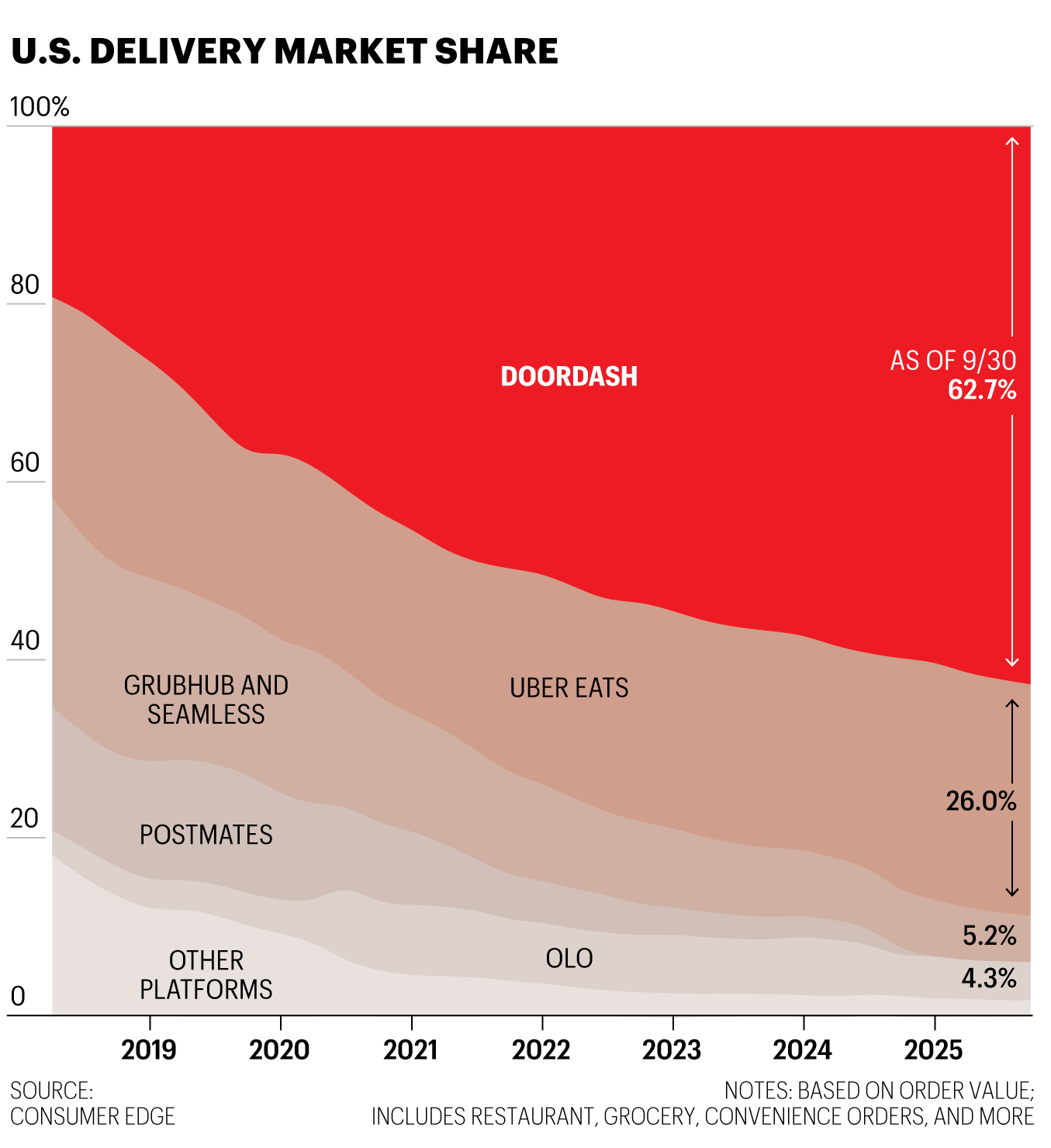
If it can, the business opportunities will feel endless. Twelve years after its founding, DoorDash has separated itself from the pack in the U.S. restaurant delivery industry, on track to generate more than $13 billion in annual revenue in 2025 while owning around 60% market share—more than double the size of its nearest competitor, Uber Eats. Grubhub, which along with its subsidiary Seamless once dominated the third-party restaurant delivery business in the U.S., now stands a distant third with less than 10% market share.
That trajectory should serve as a cautionary tale for DoorDash, though: No lead is safe in food delivery. DoorDash is pursuing expansions—both in new retail categories as well as geographies—that could prove prescient or disastrously distracting. An economic downturn or crash could also be an existential risk if cash-strapped customers give up the convenience of food delivery, with its fees and meal markups. And DoorDash could of course be displaced by a competitor like Uber—or an AI-native company that may not yet even exist.
“We’re operationally grind-y, for lack of a better business term.”
Fuad Hannon, Head of New Delivery Verticals, DoorDash
There’s plenty of risk, but also a huge opportunity: If the company’s meticulous strategy continues to be effective, and if it can stay ahead of its competitors, it’s possible that the company’s current market cap will soon seem ridiculously small.
“Delivery happened to be where we got started,” Xu told me, “but for a restaurant or retailer, our aspiration is to be your first phone call, for any business issue.”
Among Xu’s admirers is Mark Zuckerberg. The CEO of Meta told Fortune that Xu, who serves as a director on Meta’s board, has been a “great advisor” who has modeled an approach to business success antithetical to that of many Silicon Valley entrepreneurs. “There’s a lot of people in the Valley who talk about big ideas that in the abstract seem appealing, but in practice have all these nuances that don’t quite work out,” he said, adding that Xu is more “realistic.”
Indeed, the key to success, Xu believes, is detail-obsessed forward motion. “If you’re in technology and you are not making improvements, you are actually decaying,” the CEO told me. “Until it’s over all of a sudden.”
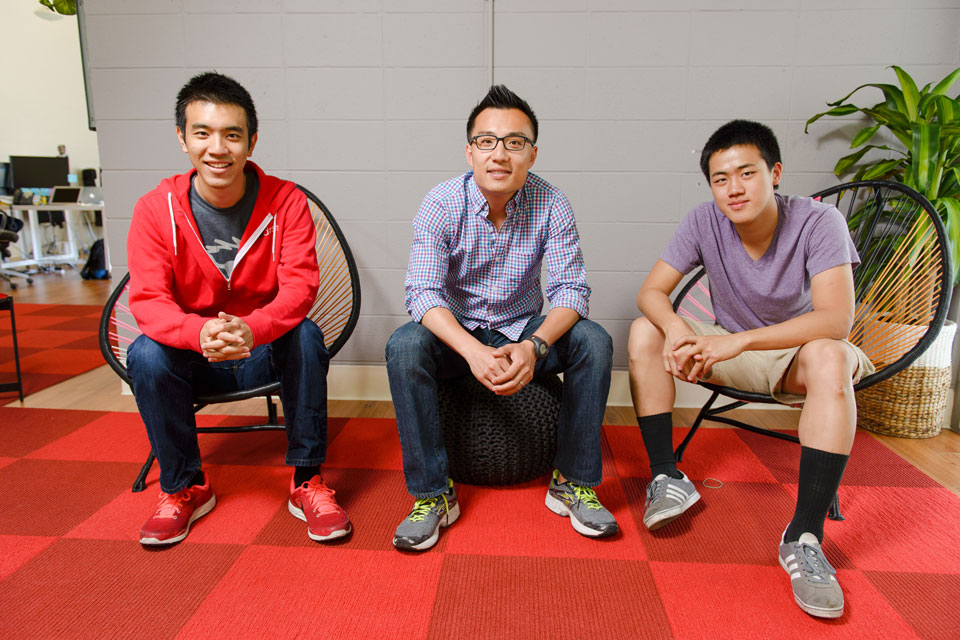
The possibility of doom has rarely been far from Xu’s perception since he and three fellow Stanford students came up with the idea for DoorDash in 2012. A year later, they launched it into the growing race for delivery app dominance, plunging into a gut-it-out battle among startups that would feature near-death experiences, whiplashing morale, cutthroat business decisions, and investor blindsides en route to a hard-won victory.
Indeed, DoorDash almost crashed before making it off the ground. Xu now enjoys telling the story of the Stanford football game that made, and then promptly broke, the new startup in the fall of 2013. Overwhelmed with orders from student fans, Xu and his then-tiny team delivered every meal late—some dramatically so. The right thing to do was to refund every customer. But those refunds would cost the startup 40% of its bank account, leaving them with less than $30,000. They did it anyway, and then stayed up all night to bake cookies that they handed out to the customers the next day as an added mea culpa. It’s hard to know exactly how many customers would have returned without the we’re-sorry sweets, but the move cemented what the founders say was a core value of the startup: customer obsession.
If the incident had been the startup’s death knell, no one outside of Palo Alto would have noticed. DoorDash already had plenty of competition. There were young enterprises including Postmates and Caviar that went on to become established brands. Others, such as Munchery, SpoonRocket, Maple, and Sprig, tried to differentiate by making and delivering their own in-house meals, rather than acting as a middleman for existing restaurants. They all failed.
And there was one 800-pound gorilla in the sector already: Grubhub and Seamless had merged earlier that same year. Chicago-based Grubhub was by then almost a decade old, and New York City’s Seamless was a few years older than that.
But Grubhub and Seamless were just ordering platforms and worked only with restaurants that employed their own delivery people.
Xu and his cofounders saw things differently. The rise of smartphones had allowed for so-called gig workers to accept and complete orders in basically real time. Companies like Taskrabbit, Uber, and Instacart had proven this model out. They saw that by creating a network of contract delivery people who worked on-demand, not only would the company avoid the overhead costs of full-time staff, but it also would drastically expand the number of restaurants that could offer delivery even if they didn’t employ their own delivery staff.
DoorDash began listing menus on its app, even for restaurants that hadn’t signed up as partners. To make it work, DoorDash delivery workers would place the customer’s order themselves, often paying with a DoorDash-funded debit card. Since the company wasn’t getting a cut of the sale, it would sometimes pay itself by marking up the restaurant’s prices in addition to charging customers a delivery fee.
Others used the same delivery model, with variations. One, another Bay Area startup, Postmates, had built a network of gig workers willing to fetch just about anything from any store. Its meal delivery component had started to take off.
Then came Uber. In 2015, the Travis Kalanick–led startup launched the dedicated Uber Eats app in Toronto to immediate explosive growth. At the time, the company was only a few years old but already doing about $1 billion in gross sales from its core ride-hailing business. Within three years, Eats was in 42 countries. Along the way, Uber reached as much as 33% market share for meal delivery in the U.S., at a time when DoorDash was only about half as big.
At the time, DoorDash looked unlikely to catch up. The narrative in Silicon Valley around DoorDash was that its cash-burning ways were killing the company and its promise in the eyes of investors. With each new market that the company launched, DoorDash would spend heavily on marketing: advertisements, steep discounts for first-time customers, and hiring on-the-ground staff to sign up merchants and couriers.
Within the company, morale was flagging, Xu told Fortune: “I would…show this graph of our bank account going like this,” he recalled, pointing his fingers downward. He told his staff he wouldn’t blame them if they wanted to look for work elsewhere. Some took him up on it.
The situation got so bad that Sequoia Capital’s Alfred Lin, who had led the company’s Series A investment round, had to persuade his own partners to lead the Series C round in 2016. To get it done, DoorDash had to accept a lower valuation than the one accompanying its previous round of fundraising. “We were less than a month from running out of money,” Lin told Fortune.
In Silicon Valley, the word was essentially that DoorDash was on death’s door. Uber, for one, was basking in its rival’s troubles. “I was feeling pretty good,” a former Uber leader told Fortune.
But 2017 had other plans for Uber: The high-flying startup underwent a cultural implosion following accusations of rampant sexual harassment and a brutally toxic culture, leading to the resignation of Kalanick and the hire of the well-respected but more financially conservative Dara Khosrowshahi, who had the unenviable task of cleaning up the company’s image, as well as its balance sheet, to prepare it for a not-too-far-off IPO.
As a result, Uber Eats, which was burning around $500 million a year to fuel growth, according to the former company leader, was instructed to cut its win-at-all-costs spending. The desire to rehabilitate Uber’s image also meant the Eats team couldn’t engage in one of DoorDash’s more controversial practices: listing restaurant menus on its app without a restaurant’s permission. While such a move was often a hit with diners, it also created ill will with some restaurants that were peeved by the inflated prices DoorDash sometimes charged to offset the lack of commission fees from the restaurants, as well as a loss of control over their customers’ experience and frequent confusion during pickup at the front of their stores. The burger chain In-N-Out even sued DoorDash for such practices in 2015. (The case was quickly settled out of court, and DoorDash stopped delivering from the burger chain.)
Eventually, some cities moved to outlaw the practice of adding restaurants without their permission, and DoorDash didn’t fight it, having already profited for many years from its first-mover advantage. This caused some resentment: “[DoorDash] did it, got escape velocity, and then pulled the ladder up on everyone else,” said another delivery industry entrepreneur.
As Uber Eats was taking its foot off the gas in marketing spend to acquire new customers, DoorDash smelled blood. The company ramped up its marketing and poached several key executives between late 2018 and early 2019 from Uber Eats, in part by offering lucrative pay packages.
Adding insult to injury, the funding for DoorDash’s spending blitz came from an investor quite familiar to Uber leaders: SoftBank, the Japanese funding giant, was the largest Uber backer at the time. SoftBank led what would become a kingmaking $535 million round for DoorDash in March 2018. Some Uber leaders were miffed that a key minority shareholder of theirs was funding one of their rivals. “We were like, WTF,” the former Uber leader said. (SoftBank did not respond to requests for comment.)
In any case, DoorDash was off to the races, expanding from around 1,500 cities and towns in North America at the start of 2018 to around 6,000 by the end of 2019.
Competitors jeered at this dizzying expansion as a cash incineration machine. But Xu and team were swinging for the fences, continuing to prioritize suburbs and mid-tier metro areas that their rivals had neglected. They viewed these geographies as green fields that would reap bountiful harvests with the right attention and financial nurturing, and the company’s analysis of customer data showed that new markets would turn profitable in time thanks to strong retention.
“If you’re in technology and you are not making improvements, you are actually decaying. Until it’s over all of a sudden.”
Tony Xu, CEO, DoorDash
Yes, some food establishments like pizzerias and Chinese restaurants commonly offered delivery pre–gig economy, but so many others didn’t. And consumers of all types were becoming increasingly used to ultra-convenience powered by smartphones, no matter if they lived on the 52nd floor of a New York City high-rise or a mile from their nearest neighbor down a dirt road in rural Kansas.
“There was a behavioral change that’s really benefited this company, and this company has fed that behavioral change, too,” said Mark Mahaney, head of internet research at Evercore ISI.
Along the way, Grubhub, the once-dominant app, continued to lose market share. By early 2019, DoorDash had surpassed Grubhub in sales for the first time.
Doordash’s longtime focus on the suburbs was part necessity and part strategic. City delivery was a crowded market, with players from Grubhub to Seamless to Postmates and later Uber. It would be hard to make a long-term dent going head-to-head with so many combatants so early on.
But strategically, the suburbs also offered a cocktail of opportunity. DoorDash leadership theorized that orders would be larger in areas that were attractive to families with disposable income, and where the geography offered limited delivery options. Suburbs were also home to well-known, big-name chain restaurants that customers already loved but which typically weren’t set up for delivery. As DoorDash inked partnerships with national giants including Buffalo Wild Wings and Cheesecake Factory, it also benefited from the marketing efforts of those companies to advertise their new delivery offering, helping to make DoorDash a household name.
Even so, some DoorDash competitors scoffed at its suburban investment. Matt Maloney, cofounder and former CEO of Grubhub, remembers thinking that the expense of building out a restaurant delivery network in the suburbs—recruiting restaurants, Dashers, and customers—made no financial sense for a startup. Rumors that DoorDash was struggling to raise new funding in 2019 offered its competitors some hope that its end was near. But venture capitalists, and then SoftBank and others, kept funding it—plowing over a billion more into the company and its big suburban bet.
Then the pandemic hit, sending many well-off families fleeing to the suburbs. With lockdowns decimating restaurant traffic, and working from home taking over, food delivery demand surged by nearly 100%. DoorDash was perfectly positioned to handle the flood of orders and to welcome hordes of new customers.
The company’s massive suburban expansion, so recently mocked, had paid off handsomely. DoorDash’s business more than tripled in 2020 alone. While DoorDash considered buying or merging with both Postmates and Uber Eats in 2019, according to Lin, the company no longer needed to do so. Instead, Uber bought Postmates in late 2020 after serious talks to acquire Grubhub fell through earlier that year.
Recalling DoorDash’s pandemic triumph, Maloney of Grubhub marvels aloud. “I kind of view their whole long bet on suburban delivery as, ‘Holy shit, I had a front row seat to witness this miracle,’” he told me. “It was a Hail Mary pass in the fourth quarter of the Super Bowl.”
It also caused some soul-searching for others in the sector. “What we did wrong was we massively underestimated the suburbs,” the former Uber leader told Fortune. “They attacked us where we didn’t have distribution.”
Xu, for his part, dismisses many industry views on why DoorDash blew away the competition in the U.S. as too simplistic. The idea that the suburban bet or the decision to onboard restaurants without official partnerships was a deciding factor? “I don’t believe I’m way smarter than anyone,” Xu said. “Everyone else plays in the suburbs, everyone else cares about selection—and so it can’t just be a better strategy we had. Something else has to be true.”
It’s a somewhat unexpected stance: Xu acknowledges that these strategies contributed to his company’s success—his own investors and employees talk them up, and he has credited the suburban approach as a major factor in the past—but he seems to want to focus more on DoorDash nailing the details. “I think it’s less about, ‘Did we choose this particular strategy or that?’” he explained. “It’s the consistent execution over time that has made the difference.”
Xu, who has taken up jujitsu as a hobby in recent years—yes, he has “rolled” with Zuckerberg of Meta— compares his company’s approach to the grappler who trudges to the gym even on days they’d rather not.
He rattled off the components of what he referred to alternately as “execution” or “operational excellence”: a focus on continuous improvement. Maxims like “customer obsession” and “bias for action.” And a willingness, always and forever, to execute at an extremely detailed level and never become content with the status quo.
“We’re operationally grind-y, for lack of a better business term,” said Fuad Hannon, DoorDash’s head of new delivery verticals. “We see one of our values as being 1% better every day.”
There’s also some ruthless competitiveness at play. In high-volume delivery geographies, winning a delivery war can come down to capturing and locking down the most popular restaurant by making an exclusive deal that cuts out other delivery apps. Uber has also alleged in an antitrust lawsuit that DoorDash uses its dominant market share to pressure the largest restaurant chains in the country to cut exclusive or preferred deals for DoorDash’s white-label services, which use DoorDash’s tech and Dashers to power deliveries made through a restaurant’s own website or app.
Xu waved off the lawsuit, which is still in the discovery phase, when I asked him about it. “At the end of the day, customers are going to buy in and choose what they want,” he said. “I’m much more focused on the innovation, the customer piece, than litigation.
Having seemingly vanquished its rivals in many parts of the U.S., DoorDash’s ambition has grown well beyond U.S. restaurant delivery. Xu has been talking since the early years about his vision of creating a modern-day FedEx.
Part of that ambition falls under the “new verticals” division, run by longtime exec Hannon, which has partnered with liquor stores, pharmacy chains, florists, pet shops, plus sports and party supplies retailers—even setting up their own warehouses and stocking them with partner retailers’ inventory so they can deliver them in areas where the retailer may not have a physical presence. Perhaps most ambitiously, the company is aggressively expanding into grocery delivery, the most frequent and consistent type of purchase by consumers everywhere.
Sequoia’s Lin says he was at first skeptical of the move into the grocery delivery business because of its brutal economics. But if the company was to commit to its founder’s vision, there really was no choice.“Tony’s vision is to power local economies,” Lin said. “You cannot power local economies without thinking of food delivery, grocery, convenience, and retail.”
“[Xu’s plan] wasn’t about lofty ideals or silver bullet strategies… it was about very methodical, gritty, competitive approaches.”
Mark Zuckerberg, CEO, Meta
At a media event in September, DoorDash announced its biggest grocery industry partnership to date: a nonexclusive deal with Kroger, the country’s largest grocery company. While Kroger already partners with other third-party services like Instacart and Shipt, the fact that the grocery giant chose to add DoorDash, a company that has never focused exclusively on groceries, is making waves.
Along the way, DoorDash has cut into the lead of Instacart, the leading third-party grocery delivery company, whose U.S. market share has dropped from 70% two years ago to 58% today, according to Wedbush Securities research. While DoorDash is still a distant second, its share has increased during that time to 13.5% of the market.
DoorDash’s investment and M&A activity this year also signals grander ambitions. In June the company spent $175 million to purchase the advertising tech startup Symbiosys, which helps brands and retailers who advertise on the DoorDash app also market to DoorDash customers on other platforms around the web. DoorDash’s in-app ad business crossed $1 billion in annualized revenue in 2024. Online advertising businesses have increasingly become key profit engines for online retailers and marketplaces, and analysts have estimated that DoorDash’s version carries a much larger profit margin than its core delivery business.
DoorDash also spent $1.2 billion for the hospitality company SevenRooms, which makes software products to help restaurants, hotels, and others manage bookings, reservations, and customer relationships. Some of those features have now been integrated into the DoorDash app.
The company is investing in a major international expansion, too. It made a splash in May by inking a nearly $4 billion deal for Deliveroo, the third-largest restaurant delivery service in the U.K. DoorDash now has delivery operations in more than 40 countries, having previously acquired Finland-based Wolt in 2022 for around $8 billion in an all-stock deal. This next phase of expansion will pose fresh challenges, with Uber building a larger delivery business in international markets to date.
What about AI? It seems like no Silicon Valley growth story is possible these days without robots, and sure enough, DoorDash has robots. After partnering with the sidewalk delivery robot company Serve in some markets, DoorDash unveiled its own autonomous delivery robot in September. Already completing orders in Phoenix, the new DoorDash delivery robot—named Dot—can travel as fast as 20 miles per hour along bike lanes, roads, and, at lower speeds, on sidewalks as well. It can carry six large pizzas or 30 pounds of goods. And it’s darn cute, with a red matte finish and large, cartoonish eyes.
For now, DoorDash is leading the pack in U.S. delivery, but the war is not over, and Uber was quick to point out to Fortune that it’s larger globally, “completing millions more deliveries than DoorDash last quarter.” In early November, DoorDash adjusted its earnings forecast downward, citing new investments and tech spending, which led to a market drubbing that erased more than $20 billion in market value. But the company signaled that it is once again playing the long game: “We wish there was a way to grow a baby into an adult without investment, or to see the baby grow into an adult overnight, but we do not believe this is how life or business works,” DoorDash said in its earnings press release. “Instead, we attempt to invest in a way that manages to milestones, allocating the appropriate amount of time and resources at the right stage of development.
Despite all these ambitious plans and nifty innovations, Zuckerberg reminded me of what Xu and DoorDash’s success has really been all about: sweating the small stuff. Little flash. Many near misses. And grinding, day in and day out.
Listening to Xu recently share his long-term vision for DoorDash has Zuckerberg convinced, he told Fortune, that we’ll eventually consider the DoorDash CEO “one of the great business leaders of our time.”
“It wasn’t about lofty ideals or silver bullet strategies that are going to solve everything at once,” Zuckerberg said of Xu’s road map for DoorDash. “It was about very methodical, gritty, competitive approaches.”
It’s not always going to go smoothly, as my hour of delivering DoorDash meals alongside Xu on that early fall day showed. We were able to deliver only two of our four orders on time, and we had to leave one behind altogether—to be delivered, late, by another Dasher.
At the end of the hour or so it took to complete the three other orders, the CEO had earned $19, including tips—which would likely be topped up by the company to comply with minimum pay and mileage requirements in California’s app-based delivery driver law, but is still not a stellar sum considering the cost of living in the Bay Area. If we had delivered all four orders, Xu said, “We would have probably easily cleared $25…I think a Dasher would have been pretty happy about that. I would have been personally happy with that.”
This article appears in the December 2025/January 2026 issue of Fortune with the headline “How DoorDash won the delivery wars.”