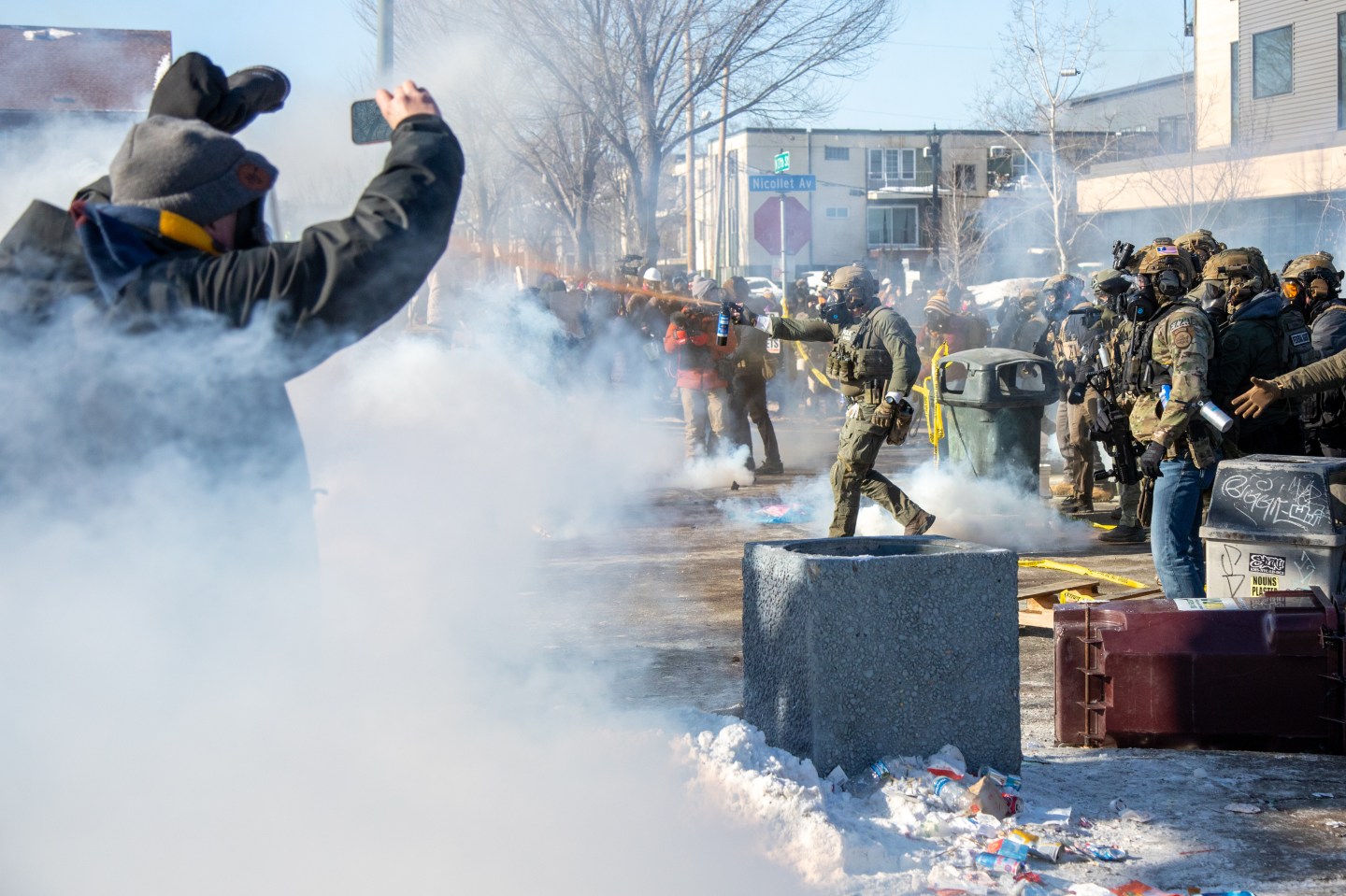
One-third of business leaders say they’re not making a statement about Minneapolis following the fatal shooting of Alex Pretti, a 37-year-old ICU nurse and U.S. citizen, by immigration agents because it is “not relevant to their business,” a CNBC flash survey found.
While leaked internal messages from OpenAI CEO Sam Altman, Apple CEO Tim Cook, and incoming Target CEO Michael Fiddelke show some CEOs are commenting about ICE, many other executives remain undecided about the risks and benefits of making public comments. More than 60 CEOs of Minnesota-based companies signed a letter on Sunday urging “an immediate de-escalation of tensions,” but stopped short of demanding that ICE leave the state, while Democratic state officials, such as Minnesota Gov. Tim Walz and Minneapolis Mayor Jacob Frey, have done so.
CNBC sent the survey to 550 C-suite executives on Monday and Thursday and received 34 responses. Only one of the respondents said their company had spoken publicly about Minneapolis, and more than 70% of respondents said they do business, have offices, or have remote employees in Minnesota.
Nearly 20% of respondents said they are “worried about backlash from the Trump administration,” and 9% said they are “still contemplating” speaking out. About a quarter of respondents said they were “not sure” about their reasons for not commenting on the issue.
Debate about keeping business out of politics
Big Tech CEOs like Altman, Cook, and Anthropic CEO Dario Amodei have built relationships with President Donald Trump and have used their direct access to the president to address their concerns about ICE operations in Minneapolis.
“I love the U.S. and its values of democracy and freedom and will be supportive of the country however I can; OpenAI will too,” Altman wrote in an internal Slack message to OpenAI employees, according to a transcript obtained by the New York Times. “But part of loving the country is the American duty to push back against overreach. What’s happening with ICE is going too far.”
Altman said he spoke with Trump administration officials on Monday. On Tuesday, Apple CEO Tim Cook called for de-escalation in Minneapolis in an internal memo posted to Apple’s website for employees and leaked to Bloomberg.
“I’m heartbroken by the events in Minneapolis, and my prayers and deepest sympathies are with the families, with the communities, and with everyone that’s been affected,” Cook wrote. “I believe America is strongest when we live up to our highest ideals, when we treat everyone with dignity and respect no matter who they are or where they’re from, and when we embrace our shared humanity. This is something Apple has always advocated for.”
Cook also wrote that he spoke with Trump and said he appreciated his openness. The Apple CEO has been called the “Trump whisperer” and built a relationship with the president by making compromises over tax cuts and manufacturing commitments. Apple committed to invest $600 billion in U.S. manufacturing last year.
But speaking out is proving to be a more challenging bet for those who do not have the ear of the president.
A majority of leaders told CNBC commenting about ICE is not an easy call, and more than half said it’s “a lot more challenging” to speak out about political issues today than on previous occasions, like the Black Lives Matter protests in 2020, or the overturning of Roe v. Wade in 2022. Only 12% of respondents said it’s as equally challenging as before, and just 3% said it was easier.
A growing number of CEOs have questioned engaging in activism, a major recalibration following a strong outcry against racism following the murder of George Floyd in Minneapolis in 2020. Many companies struggled to navigate public comments and policies after the Oct. 7, 2023, Hamas attack on Israel and the subsequent two years of war. Web Summit CEO Paddy Cosgrave resigned following backlash from an X post he made suggesting Israel was committing war crimes. Cosgrave returned to Web Summit after six months. Boston Consulting Group CEO Christoph Schweizer apologized to staff for backing the controversial, Israeli-backed Gaza Humanitarian Foundation.
Some respondents told CNBC they think business should be separate from politics. A few respondents wrote their firms have specific policies barring them from commenting on issues related to politics, and one told CNBC they were required to remain neutral on most issues because of the diverse political beliefs of their clients.
“It would be a breach of management’s fiduciary duty to use our business for such tangential political purposes. We do not view our silence as an endorsement of current administration policy, action, or personality,” one executive wrote in the survey. Research has found CEOs risk alienating investors by taking a side that doesn’t align with their beliefs.
Dan Kaplan, managing partner at global executive search firm ZRG Partners, told CNBC companies risk losing trust if their public comments are not backed up by action.
“No one wants to act too fast; no one wants to be reactive,” he said. “To go out and be bold and making requests, demands, proclamations on something you can’t operationalize, something that’s not in your control, is a great way to erode trust.”