
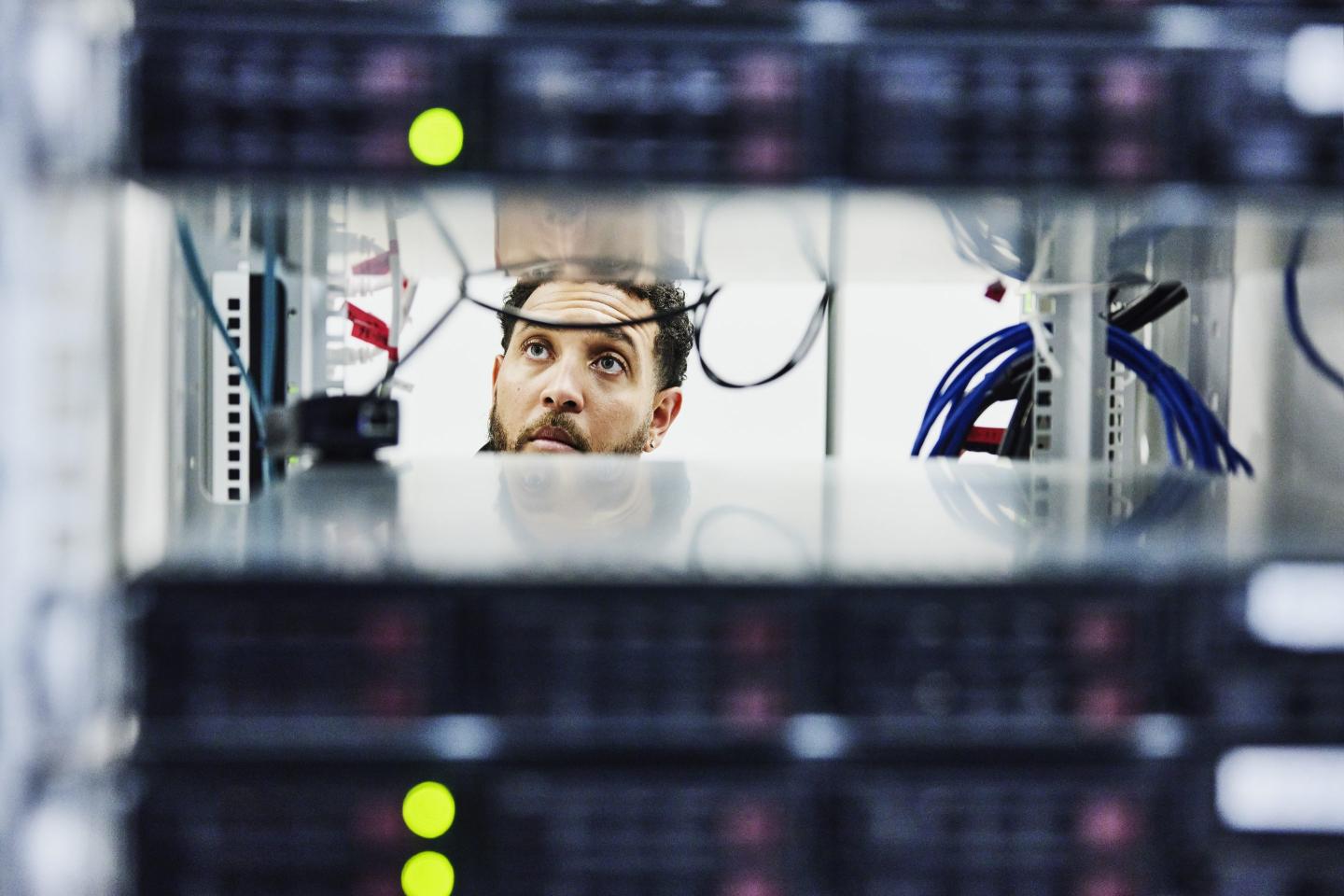
The mighty American consumer may have finally met their match, and it’s a giant hulking rectangular box that hosts very few people inside, but rather a huge nest of servers, storage systems, and networking equipment. Consumer spending in the American services economy is so large it can boggle the mind, representing roughly two-thirds of gross domestic product. To paraphrase the long-running coffee chain Dunkin’, America runs on spending.
But this mighty American consumer has slow seasons, and the summer of 2025 appears to be one of them. There are several interconnected factors, namely, recent jobs growth now appearing much smaller than previously thought and the impact of artificial intelligence on the workforce. But those hulking rectangular boxes, the massive data centers sprouting up across the country, are emerging as a giant magnet for dollars and a dominant driver of the economy.
Giant tech companies have spent so much on data centers in 2025 that their spending is now contributing more to U.S. economic growth than consumer spending, long considered the nation’s economic engine. If you make the reasonable assumption that spending on data centers equates to AI capital expenditures, defined as capital deployed for information processing equipment and software, then the pattern is clear: A ton of money is flowing into one concentrated area, and the outcome of that is uncertain.
Microsoft, Google, Amazon, and Meta are the main players investing at staggering levels to build and upgrade data centers that support the exponential demand for AI computing power, with those four companies alone forecasting a record $364 billion of capital investment in 2025. Combined, the so-called Magnificent Seven tech giants spent more than $100 billion on data center projects in just the past three months, as calculated by the Wall Street Journal’s Christopher Mims.
All this spending has to have an impact on the economy. Analyst estimates from Renaissance Macro Research indicate that so far in 2025, the dollar value contributed to GDP growth by AI data center expenditure surpassed the total impact from all U.S. consumer spending—the first time this has ever occurred.
So far this year, AI capex, which we define as information processing equipment plus software has added more to GDP growth than consumers' spending. pic.twitter.com/D70FX2lXAW
— RenMac: Renaissance Macro Research (@RenMacLLC) July 30, 2025
Or as Rusty Foster, author of the widely read media blog Today in Tabs, puts it: “Our economy might just be three AI data centers in a trench coat.” This recalls the classic comedic device of several children wearing a long jacket, pretending to be an adult, as memorably portrayed in Netflix’s BoJack Horseman, when “Vincent Adultman” successfully maintained the illusion for several dates with Princess Carolyn. But then the bubble popped, or the trench coat came off.
Why is this happening now?
Several forces are driving this unprecedented investment wave. The boom in generative AI and advanced large language models—technologies that require vast amounts of computing resources—has forced tech giants to rapidly increase their physical infrastructure. Data from McKinsey projects that between 2025 and 2030, companies worldwide will need to invest a remarkable $6.7 trillion into new data center capacity to keep up with AI demand.
AI data center spending has grown at least 10-fold since 2022, with the well-known business blogger Paul Kedrosky estimating that it’s nearing 2% of total U.S. GDP by itself. “Honey, AI capex is eating the economy,” he writes, arguing that AI capex is so big that it’s “affecting economic statistics, boosting the economy, and beginning to approach the railroad boom.”
Apollo Global Management’s Torsten Slok, without wading into the data center capex question, has assembled research showing that the AI boom has surpassed the market value of the tech boom of the late ’90s, which became known as the “dotcom bubble” after speculative mania burst and a recession set in.
Kedrosky makes a similar point, contrasting capex booms from throughout financial history, notably the telecom boom of 2020 related to 5G/fiber technology and the railroad boom of the 19th century as the United States embraced a transportation revolution. “Capital expenditures on AI data centers is likely around 20% of the peak spending on railroads, as a percentage of GDP, and it is still rising quickly,” Kedrosky writes. “And we’ve already passed the decades-ago peak in telecom spending during the dotcom bubble.” Noah Smith, a widely read economics Substacker, asks the obvious question: “Will data centers crash the economy?”
The impact on the broader economy
This surge in tech investment has had profound downstream consequences. Without the AI data center building spree, GDP might have actually contracted in the face of uncertain macroeconomic conditions. So data center spending may have staved off—or postponed—a recession.
Money flooding into AI infrastructure is being diverted from other sectors, including venture capital, traditional manufacturing, and even consumer-facing startups. Unlike historical infrastructure booms such as those for railroads or telecom, AI data centers are short-lived, fast-depreciating, and require continuous hardware upgrades—suggesting this pattern of investment may remain volatile and capital-hungry for years to come.
As AI redefines industries, the flow of capital into the physical backbone of this technology—vast data centers—has upended old assumptions about what drives America’s economy. Consumer spending, though still immense in absolute terms, is not keeping up with the extraordinary scale and speed of investment by tech giants determined to lead in the AI era. The trajectory suggests that the U.S. economy in 2025 is being shaped not so much by the purchasing power of its people, but by the relentless arms race for AI compute capacity—an unprecedented, tech-led growth engine.
[This headline was updated to clarify that data-center spending has surpassed consumer spending as a share of GDP growth.]
For this story, Fortune used generative AI to help with an initial draft. An editor verified the accuracy of the information before publishing.