• Home
  • Latest
  • Fortune 500
  • Finance
  • Tech
  • Leadership
  • Lifestyle
  • Rankings
  • Multimedia
CommentaryTech

‘Sovereign AI’ is political branding—the reality is closer to digital colonialism

By
Nathan Benaich
Nathan Benaich
Down Arrow Button Icon
By
Nathan Benaich
Nathan Benaich
Down Arrow Button Icon
June 9, 2025, 10:08 AM ET

Nathan Benaich is the founder of Air Street Capital and author of the State of AI Report.

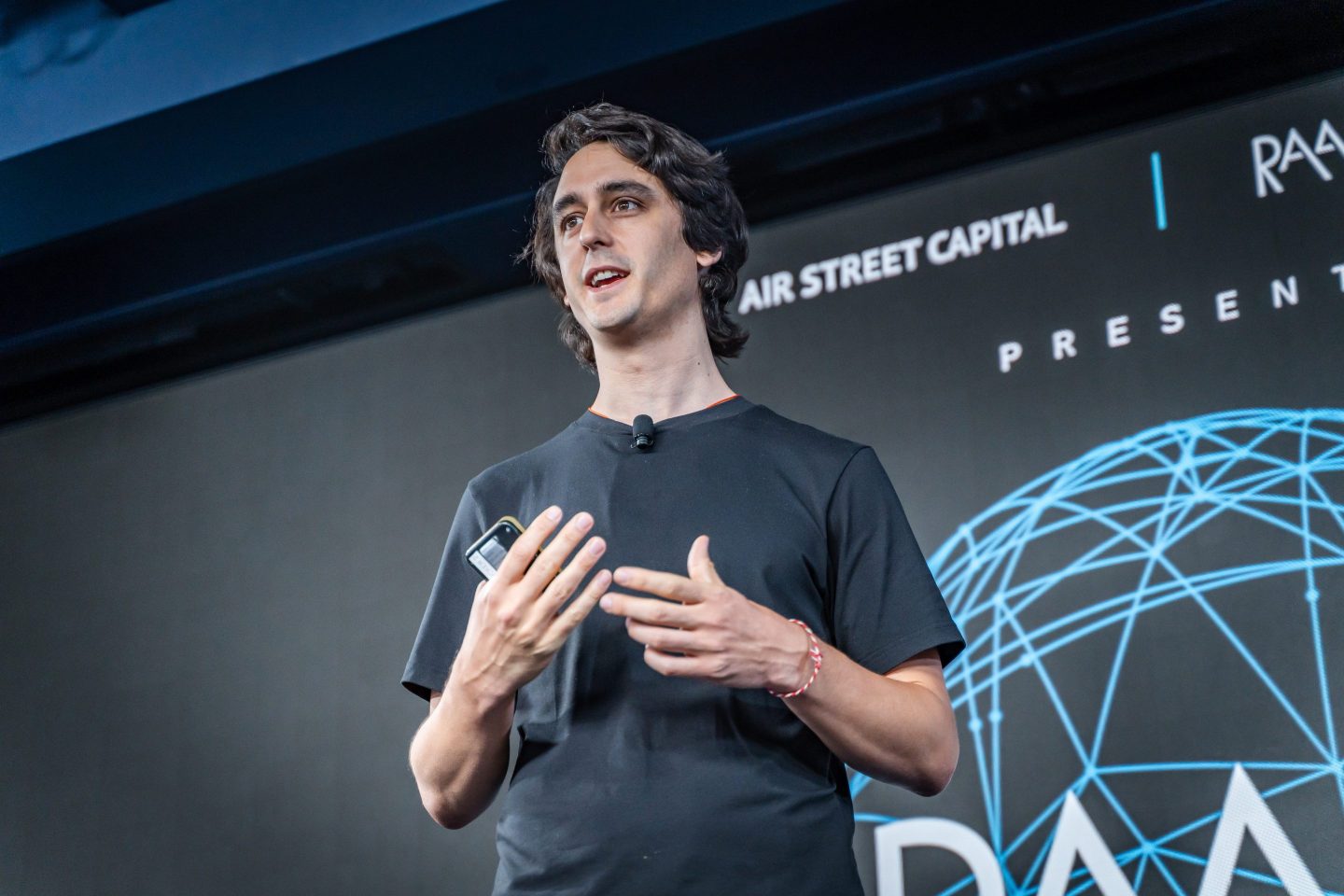
Nathan Benaich, founder of Air Street Capital.
Nathan Benaich, founder of Air Street Capital.courtesy of Air Street Capital

The United Arab Emirates is spending $20 billion on OpenAI’s Stargate UAE. The project is billed as a sovereign AI capability, yet it relies entirely on American chips, software, and infrastructure. This is the sovereign AI paradox: The harder nations push for AI independence, the deeper their dependencies become.

The UAE is not alone. From Paris to New Delhi, governments are pouring billions into so-called “sovereign” frontier models. France backs Mistral. India promotes BharatGPT. Each promises strategic autonomy yet is dependent on a globalized stack.

The term “AI factories,” adopted by Nvidia CEO Jensen Huang, rebrands data centers as strategic infrastructure akin to power plants or shipyards. This is political branding, not technical reality. It aligns AI with the rhetoric of national self-reliance, even as the underlying systems remain foreign-made and globally entangled. Calling any national data center an “AI factory” does not make it sovereign any more than France’s Qwant became a European search engine by wrapping Microsoft Bing.

Model weights, once seen as crown jewels, now update faster than policy cycles. They are versioned, cloned, and surpassed in quarterly releases. What endures is the infrastructure: chips, data pipelines, and labor required to build, deploy, and serve models. Sovereignty at the top of the stack is symbolic if the foundations remain foreign.

France’s Mistral was hailed as a European sovereignty breakthrough, only to be surpassed by more efficient, open-sourced Chinese models like DeepSeek. Now France and the UAE are co-funding what is billed as Europe’s largest AI campus, again built on American infrastructure. These efforts highlight the depth of technological entanglement: Even in pursuit of sovereignty, nations remain dependent across the stack, from chips to data to middleware.

The deepest dependencies lie in the invisible layers. Training data is often annotated by outsourced labor abroad, while pipelines for filtering and tuning rely on proprietary U.S. tools that entrench vendor lock-in. As AI moves into complex fields like law and medicine, demand is shifting toward expert labor in developed markets. Yet owning weights while depending on fragmented global workforces and imported toolchains is hardly sovereignty—it is a repackaged dependency.

This reveals a new kind of digital colonialism. Not one where countries are denied access, but one where they are structurally bound into dependencies across every layer of the AI stack. A European lab may host its own weights on a data center in France, but that center runs on American hardware, software, and middleware. The illusion of control masks a dense web of interdependence.

Strategic leverage today lies not in model authorship, but in owning the connective infrastructure that links data to deployment. That means investing in domestic expert data capacity, security, building open-source engineering stacks, and cultivating chip independence—not to beat Nvidia, but to secure “good enough” alternatives and diversify risk. Countries that fail to grasp this are sleepwalking into vendor lock-in enforced not by licenses, but by geopolitical gravity.

Nations must think in ecosystems, not hero models. A vibrant AI sector will not emerge from a flagship GPT-X, but from an interdependent network of local tools, standards, infrastructure, and governance. The U.S. and China have ecosystems. Europe, as yet, does not.

Sovereign AI reflects a fundamental misunderstanding of modern technology. Unlike oil or steel, AI depends on global flows of data, chips, software, and talent. No country can meaningfully isolate itself. Sovereignty, pursued at the top of the stack, risks becoming a costly illusion.

The choice is clear: Pursue symbolic ownership or invest in strategic infrastructure. The harder nations chase the illusion of AI independence, the deeper their entrenchment in foreign dependencies becomes. At present, most are choosing the former—and will pay for it dearly.

The opinions expressed in Fortune.com commentary pieces are solely the views of their authors and do not necessarily reflect the opinions and beliefs of Fortune.

Read more:

  • Trump has inadvertently shown Europe it needs to build a full-stack AI industry—and avoid a risky reliance
  • Why AI needs the equivalent of the ‘black box’ in aviation—and America should lead the way
  • The AI cost collapse is changing what’s possible—with massive implications for tech startups
  • When AI builds AI: The next great inventors might not be human

Join us at the Fortune Workplace Innovation Summit May 19–20, 2026, in Atlanta. The next era of workplace innovation is here—and the old playbook is being rewritten. At this exclusive, high-energy event, the world’s most innovative leaders will convene to explore how AI, humanity, and strategy converge to redefine, again, the future of work. Register now.
About the Author
By Nathan Benaich
See full bioRight Arrow Button Icon

Latest in Commentary

Sarandos
CommentaryAntitrust
Netflix’s takeover of Warner Brothers is a nightmare for consumers
By Ike BrannonDecember 11, 2025
5 hours ago
student
CommentaryEducation
International students skipped campus this fall — and local economies lost $1 billion because of it
By Bjorn MarkesonDecember 10, 2025
1 day ago
jobs
Commentaryprivate equity
There is a simple fix for America’s job-quality crisis: actually give workers a piece of the business 
By Pete StavrosDecember 9, 2025
2 days ago
Jon Rosemberg
CommentaryProductivity
The cult of productivity is killing us
By Jon RosembergDecember 9, 2025
2 days ago
Trump
CommentaryTariffs and trade
AI doctors will be good at science but bad at business, and big talk with little action means even higher drugs prices: 10 healthcare predictions for 2026 from top investors
By Bob Kocher, Bryan Roberts and Siobhan Nolan ManginiDecember 9, 2025
2 days ago
Google.org
CommentaryTech
Nonprofits are solving 21st century problems—they need 21st century tech
By Maggie Johnson and Shannon FarleyDecember 8, 2025
3 days ago

Most Popular

placeholder alt text
Success
At 18, doctors gave him three hours to live. He played video games from his hospital bed—and now, he’s built a $10 million-a-year video game studio
By Preston ForeDecember 10, 2025
1 day ago
placeholder alt text
Politics
Exclusive: U.S. businesses are getting throttled by the drop in tourism from Canada: ‘I can count the number of Canadian visitors on one hand’
By Dave SmithDecember 10, 2025
1 day ago
placeholder alt text
Economy
‘Be careful what you wish for’: Top economist warns any additional interest rate cuts after today would signal the economy is slipping into danger
By Eva RoytburgDecember 10, 2025
1 day ago
placeholder alt text
Economy
‘Fodder for a recession’: Top economist Mark Zandi warns about so many Americans ‘already living on the financial edge’ in a K-shaped economy 
By Eva RoytburgDecember 9, 2025
2 days ago
placeholder alt text
Success
Netflix–Paramount bidding wars are pushing Warner Bros CEO David Zaslav toward billionaire status—he has one rule for success: ‘Never be outworked’
By Preston ForeDecember 10, 2025
1 day ago
placeholder alt text
Uncategorized
Transforming customer support through intelligent AI operations
By Lauren ChomiukNovember 26, 2025
15 days ago
Rankings
  • 100 Best Companies
  • Fortune 500
  • Global 500
  • Fortune 500 Europe
  • Most Powerful Women
  • Future 50
  • World’s Most Admired Companies
  • See All Rankings
Sections
  • Finance
  • Leadership
  • Success
  • Tech
  • Asia
  • Europe
  • Environment
  • Fortune Crypto
  • Health
  • Retail
  • Lifestyle
  • Politics
  • Newsletters
  • Magazine
  • Features
  • Commentary
  • Mpw
  • CEO Initiative
  • Conferences
  • Personal Finance
  • Education
Customer Support
  • Frequently Asked Questions
  • Customer Service Portal
  • Privacy Policy
  • Terms Of Use
  • Single Issues For Purchase
  • International Print
Commercial Services
  • Advertising
  • Fortune Brand Studio
  • Fortune Analytics
  • Fortune Conferences
  • Business Development
About Us
  • About Us
  • Editorial Calendar
  • Press Center
  • Work At Fortune
  • Diversity And Inclusion
  • Terms And Conditions
  • Site Map

© 2025 Fortune Media IP Limited. All Rights Reserved. Use of this site constitutes acceptance of our Terms of Use and Privacy Policy | CA Notice at Collection and Privacy Notice | Do Not Sell/Share My Personal Information
FORTUNE is a trademark of Fortune Media IP Limited, registered in the U.S. and other countries. FORTUNE may receive compensation for some links to products and services on this website. Offers may be subject to change without notice.