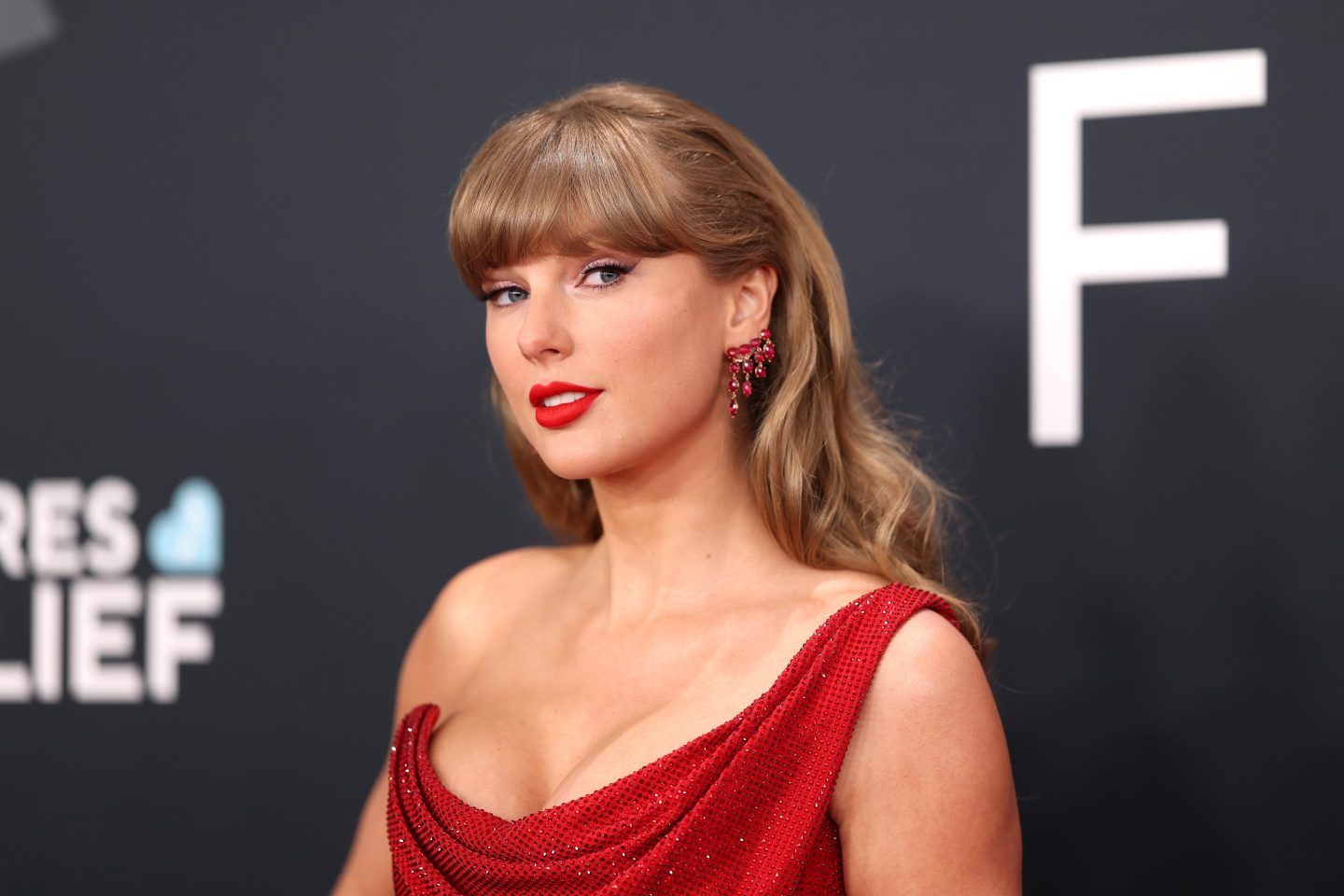
If you had told my younger self that one day I’d not only become a Taylor Swift fan but also write a book about her, I would have laughed. In 2006, when Swift released her debut album, I was a 23-year-old graduate student in film studies, obsessed with Radiohead and European art films. A teenage country-pop singer playing to arenas full of screaming girls? That wasn’t just outside my taste—it felt far outside what I’d considered “serious” music.
That skepticism wasn’t unusual. Swift’s early career was filled with moments where her popularity and success were seen as unearned. Most famously, Kanye West interrupted her acceptance speech at the 2009 VMAs to proclaim, “Beyoncé had one of the best videos of all time.” Translation: Swift wasn’t good enough. After she won Album of the Year at the 2010 Grammys, her shaky performance with Stevie Nicks reignited criticism. “Give an incredibly wretched vocal performance,” the Washington Post wrote, “go on to win the biggest Grammy of 2010 anyway.”
Even now, at the peak of her popularity, the old critiques haven’t vanished. A video of her dancing awkwardly onstage recently went viral, racking up over 17 million views. The caption: “Never realized how bad of a dancer Taylor Swift was.”
For me, it was hard to reconcile Swift’s dominance with what I saw on the surface. She doesn’t have standout physical skills like Adele’s powerhouse vocals or Beyoncé’s commanding dance moves. So how did she become one of the most successful artists of all time?
Part of the answer lies in how success in music, or any culture market, works. It’s not proportional or fair. It follows what network scientists call a power law: A small number of people capture a disproportionately large share of attention, influence, and revenue.
Power laws are especially evident in Swift’s case. In 2023, she alone accounted for 1.7% of the entire U.S. recorded music market—a staggering figure that would be even higher if it included revenue from the Eras Tour and merch sales. Network scientist Albert-László Barabási explained these vast differences in success in his book The Formula: “The currency of success can vary, but what is universal is that there is no upper limit on how much of it a superstar can earn. It’s unbounded.” In other words, talent is finite, but popularity is infinite.
This is why arguments about who “deserves” success often miss the point. In a widely cited study, researchers created a fictional music marketplace where some users could see download counts and others couldn’t. The group exposed to social signals produced wildly unpredictable results. Some mediocre songs became hits. Some great ones flopped. The takeaway? Music markets are not meritocracies—social influence skews everything.
If social influence plays a major role in the success of a superstar—or any product, really—it would be easy to downplay Swift’s achievements as the result of factors beyond her control. But that would be naive. Once I began viewing her career through a strategic lens, I started to see what so many of her fans already understand: Swift doesn’t leave any of this to chance—she engineers it. And that’s exactly what makes her not just an exceptional artist, but a masterful business strategist.
Swift’s strategic instincts were evident early in her career. She deliberately targeted an audience that country music had largely overlooked—teenage girls—and insisted on writing her own songs, infusing her music with an authenticity that deeply resonated with young listeners often dismissed by the broader culture. This strategy played a major role in her rise. She offered a product that was tailored to an underserved audience’s needs, emotions, and experiences. And because no other artist was doing quite what Swift was doing, her fans responded with remarkable fervor and loyalty.
Swift has also shown what a B-school prof would say was a remarkable grasp of her fans’ “job to be done.” Developed by Clay Christensen, a world-renowned business professor and godfather of disruptive innovation, the job-to-be-done theory argues that when we buy something, we’re “hiring” it to do a job for us. It’s not about the physical product; it’s about what we need it to accomplish.
When fans turn to Swift, they’re not just looking for a soundtrack. They’re hiring her to help them navigate breakups, celebrate friendship, cope with loneliness, or feel powerful. Her music—and the larger experience around it—meets emotional needs most pop stars never even consider.
Uncovering your customers’ job to be done might seem simple, but fulfilling customers’ emotional needs is subtly complex. First, it requires a product that fulfills those needs. And, here, we can see why Swift’s understated vocals are perfectly suited for the job. She doesn’t just sing her lyrics—she inhabits them, breathing life into every syllable. The subtleties in her voice, whether it’s cracking with heartbreak or rasping with defiance, make her songs seem intimate, vulnerable, and painfully honest. For listeners willing to lean in, it can feel like being entrusted with a deeply personal secret.
But Swift does more than get the “product” right. She designs immersive experiences around it. From the beginning, she has cultivated a fandom that never seems to sleep, sustaining their attention not just with songs, but with a narrative universe that rewards close reading and constant engagement.
On social media, Swift’s fans dissect the sometimes-hyper-specific personal details in her lyrics like scholars analyze T.S. Eliot’s “The Waste Land” and scrutinize every post and outfit with the intensity of true-crime Redditors chasing a cold case. This level of engagement deepens the emotional connection for superfans, and through personalized algorithms, it also draws in casual listeners. The result is a self-sustaining community centered on Swift: her music, her persona, her evolving story.
This isn’t just savvy marketing. Swift creates products and experiences so attuned to her fans’ inner lives that, as Christensen and his coauthors might say, they’re not likely to be copied—or even comprehended by others.
Swift’s greatest strength isn’t vocal range or dance technique. It’s her understanding of what makes people care about music—and her ability to deliver it, again and again, in ways that feel personal and real.
In an economy where attention is scarce, Swift has built one of the most resilient brands in the world by consistently creating value for her audience. What she demonstrates better than anyone is that emotional resonance isn’t a bonus—it’s the product.
And understanding that has turned me from a skeptic into a superfan.
The opinions expressed in Fortune.com commentary pieces are solely the views of their authors and do not necessarily reflect the opinions and beliefs of Fortune.
Read more:
- Taylor Swift is a business genius, and her new album ‘Midnights’ proves it
- Plans are ‘underway’ at Stanford for a new course on Taylor Swift, led by a rising sophomore
- Taking stock as Taylor Swift’s Eras tour ends, after likely grossing some $2 billion
- Taylor Swift: A C-suite role model