• Home
  • News
  • Fortune 500
  • Tech
  • Finance
  • Leadership
  • Lifestyle
  • Rankings
  • Multimedia
Financenational debt

Larry Fink says Bitcoin could replace the dollar as the world’s reserve currency because of national debt

Eleanor Pringle
By
Eleanor Pringle
Eleanor Pringle
Senior Reporter, Economics and Markets
Down Arrow Button Icon
Eleanor Pringle
By
Eleanor Pringle
Eleanor Pringle
Senior Reporter, Economics and Markets
Down Arrow Button Icon
April 1, 2025, 10:34 AM ET
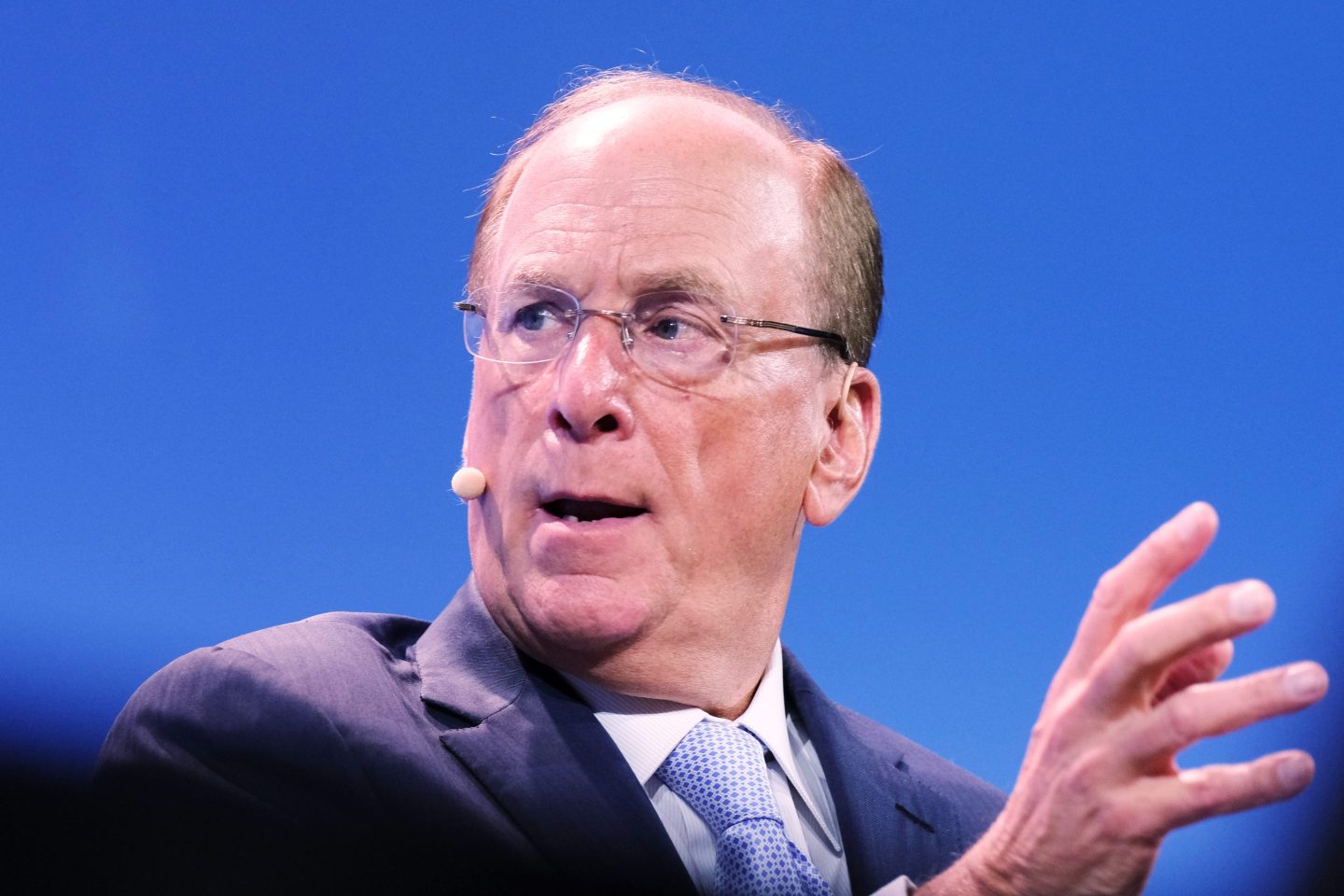
Larry Fink, chief executive officer of BlackRock Inc.
Larry Fink, CEO of BlackRock, said Bitcoin could replace the dollar as a reserve currency because of national debt.F. Carter Smith—Bloomberg/Getty Images
  • BlackRock CEO Larry Fink warns that America’s rising national debt could threaten the dollar’s status as the world’s reserve currency, potentially leading to decentralized assets like Bitcoin taking its place. He and Bridgewater’s Ray Dalio caution that if the U.S. fails to manage its debt, global confidence in U.S. Treasuries may collapse, triggering economic instability and a shift toward alternative financial systems.

With America’s national debt sitting comfortably over the $36.2 trillion mark, BlackRock CEO Larry Fink is warning the burden could one day be the reason the dollar is dethroned as the reserve currency of the world.

Recommended Video

He argues that decentralized currencies like Bitcoin could replace the dollar as worldwide organizations lose faith in national currencies and seek an independent solution.

Fink explained his theory in his 2025 letter to shareholders, writing: “The U.S. has benefited from the dollar serving as the world’s reserve currency for decades. But that’s not guaranteed to last forever.

“The national debt has grown at three times the pace of GDP since Times Square’s debt clock started ticking in 1989. This year, interest payments will surpass $952 billion—exceeding defense spending. By 2030, mandatory government spending and debt service will consume all federal revenue, creating a permanent deficit.

“If the U.S. doesn’t get its debt under control, if deficits keep ballooning, America risks losing that position to digital assets like Bitcoin.”

The benefits afforded to Uncle Sam by the dollar’s dominance in global financial markets are clear, and they form part of the reason why policy out of the White House can afford to be so bullish.

These benefits include allowing the U.S. to ride out foreign exchange fluctuations and achieve lower borrowing costs. Many foreign central banks also hold dollar-dominated assets to weather economic shocks and balance their own currency values.

The majority of this is held in U.S. Treasuries—the very debt that Fink is referring to—with dollar assets making up around 59% of foreign reserves around the world.

But the benefits afforded to America because of the dollar’s dominance have a catch: Foreign governments and central banks must have faith in the currency’s creditworthiness.

If, for example, purchasers of U.S. Treasuries begin to fear the debt wouldn’t be repaid by the American government, they may stop buying them. Instead, as Fink says, they may purchase digital assets that are not subject to the whims of the White House.

This, in turn, would lower the dollar’s value and dismantle some of Uncle Sam’s economic firepower.

As Fink puts it: “To be clear, I’m obviously not anti–digital assets. But two things can be true at the same time: Decentralized finance is an extraordinary innovation. It makes markets faster, cheaper, and more transparent.

“Yet that same innovation could undermine America’s economic advantage if investors begin seeing Bitcoin as a safer bet than the dollar.”

Fink isn’t alone

Billionaire investment titan Fink isn’t the only person concerned about what might happen if America runs out of people to buy its growing debt.

Bridgewater founder Ray Dalio issued a similar warning a few weeks ago, saying the national debt crisis is coming “imminently.”

Speaking at Converge Live in Singapore, the Bridgewater founder explained: “We have a very severe supply and demand problem. Some people think we’ll handle it because we’ve handled it so far. I don’t think they understand the mechanics of debt.

“What do you do when you don’t have an adequate supply and demand balance? 

“There may be restructurings of debt, there may be exerting pressures on countries to buy the debt, to own the debt, political pressures on countries. There may be cutting the payments to some predator countries off for political reasons, there may be monetizations of debt.”

For a situation that seems beyond reality for some economists—a day when America can no longer find anyone to buy its debt—Dalio pointed them to the history books—perhaps not the books of U.S. history but of countries further afield.

“If you look at history and see the repeating of what do countries do when they’re in this kind of situation, there are lessons from history that repeat. Just as we are seeing political and geopolitical shifts that seem unimaginable to most people, if you just look at history, you will see these things repeating over and over again,” Dalio said. 

He added: “We will be surprised by some of the developments that will seem equally shocking as those developments that we have seen.”


Fortune Brainstorm AI returns to San Francisco Dec. 8–9 to convene the smartest people we know—technologists, entrepreneurs, Fortune Global 500 executives, investors, policymakers, and the brilliant minds in between—to explore and interrogate the most pressing questions about AI at another pivotal moment. Register here.
About the Author
Eleanor Pringle
By Eleanor PringleSenior Reporter, Economics and Markets
LinkedIn icon

Eleanor Pringle is an award-winning senior reporter at Fortune covering news, the economy, and personal finance. Eleanor previously worked as a business correspondent and news editor in regional news in the U.K. She completed her journalism training with the Press Association after earning a degree from the University of East Anglia.

See full bioRight Arrow Button Icon

Latest in Finance

RetailConsumer Spending
U.S. consumers are so financially strained they put more than $1 billion on buy-now, pay later services during Black Friday and Cyber Monday
By Jeena Sharma and Retail BrewDecember 5, 2025
11 hours ago
Elon Musk
Big TechSpaceX
Musk’s SpaceX discusses record valuation, IPO as soon as 2026
By Edward Ludlow, Loren Grush, Lizette Chapman, Eric Johnson and BloombergDecember 5, 2025
11 hours ago
data center
EnvironmentData centers
The rise of AI reasoning models comes with a big energy tradeoff
By Rachel Metz, Dina Bass and BloombergDecember 5, 2025
11 hours ago
Personal FinanceLoans
5 ways to use a home equity line of credit (HELOC)
By Joseph HostetlerDecember 5, 2025
11 hours ago
Netflix
InvestingAntitrust
Netflix–Warner Bros. deal sets up $72 billion antitrust test
By Josh Sisco, Samuel Stolton, Kelcee Griffis and BloombergDecember 5, 2025
11 hours ago
Schumer
Politicsnational debt
‘This is a bad idea made worse’: Senate Dems’ plan to fix Obamacare premiums adds nearly $300 billion to deficit, CRFB says
By Nick LichtenbergDecember 5, 2025
11 hours ago

Most Popular

placeholder alt text
Economy
Two months into the new fiscal year and the U.S. government is already spending more than $10 billion a week servicing national debt
By Eleanor PringleDecember 4, 2025
2 days ago
placeholder alt text
Success
‘Godfather of AI’ says Bill Gates and Elon Musk are right about the future of work—but he predicts mass unemployment is on its way
By Preston ForeDecember 4, 2025
2 days ago
placeholder alt text
Success
Nearly 4 million new manufacturing jobs are coming to America as boomers retire—but it's the one trade job Gen Z doesn't want
By Emma BurleighDecember 4, 2025
2 days ago
placeholder alt text
Success
Nvidia CEO Jensen Huang admits he works 7 days a week, including holidays, in a constant 'state of anxiety' out of fear of going bankrupt
By Jessica CoacciDecember 4, 2025
2 days ago
placeholder alt text
Real Estate
‘There is no Mamdani effect’: Manhattan luxury home sales surge after mayoral election, undercutting predictions of doom and escape to Florida
By Sasha RogelbergDecember 4, 2025
2 days ago
placeholder alt text
Economy
Tariffs and the $38 trillion national debt: Kevin Hassett sees ’big reductions’ in deficit while Scott Bessent sees a ‘shrinking ice cube’
By Nick LichtenbergDecember 4, 2025
2 days ago
Rankings
  • 100 Best Companies
  • Fortune 500
  • Global 500
  • Fortune 500 Europe
  • Most Powerful Women
  • Future 50
  • World’s Most Admired Companies
  • See All Rankings
Sections
  • Finance
  • Leadership
  • Success
  • Tech
  • Asia
  • Europe
  • Environment
  • Fortune Crypto
  • Health
  • Retail
  • Lifestyle
  • Politics
  • Newsletters
  • Magazine
  • Features
  • Commentary
  • Mpw
  • CEO Initiative
  • Conferences
  • Personal Finance
  • Education
Customer Support
  • Frequently Asked Questions
  • Customer Service Portal
  • Privacy Policy
  • Terms Of Use
  • Single Issues For Purchase
  • International Print
Commercial Services
  • Advertising
  • Fortune Brand Studio
  • Fortune Analytics
  • Fortune Conferences
  • Business Development
About Us
  • About Us
  • Editorial Calendar
  • Press Center
  • Work At Fortune
  • Diversity And Inclusion
  • Terms And Conditions
  • Site Map

© 2025 Fortune Media IP Limited. All Rights Reserved. Use of this site constitutes acceptance of our Terms of Use and Privacy Policy | CA Notice at Collection and Privacy Notice | Do Not Sell/Share My Personal Information
FORTUNE is a trademark of Fortune Media IP Limited, registered in the U.S. and other countries. FORTUNE may receive compensation for some links to products and services on this website. Offers may be subject to change without notice.