• Home
  • Latest
  • Fortune 500
  • Finance
  • Tech
  • Leadership
  • Lifestyle
  • Rankings
  • Multimedia
CommentaryRussia

Why 1,000 global companies left Russia and won’t return—no matter what Trump and Putin say

By
Jeffrey Sonnenfeld
Jeffrey Sonnenfeld
and
Steven Tian
Steven Tian
Down Arrow Button Icon
By
Jeffrey Sonnenfeld
Jeffrey Sonnenfeld
and
Steven Tian
Steven Tian
Down Arrow Button Icon
February 20, 2025, 12:54 PM ET
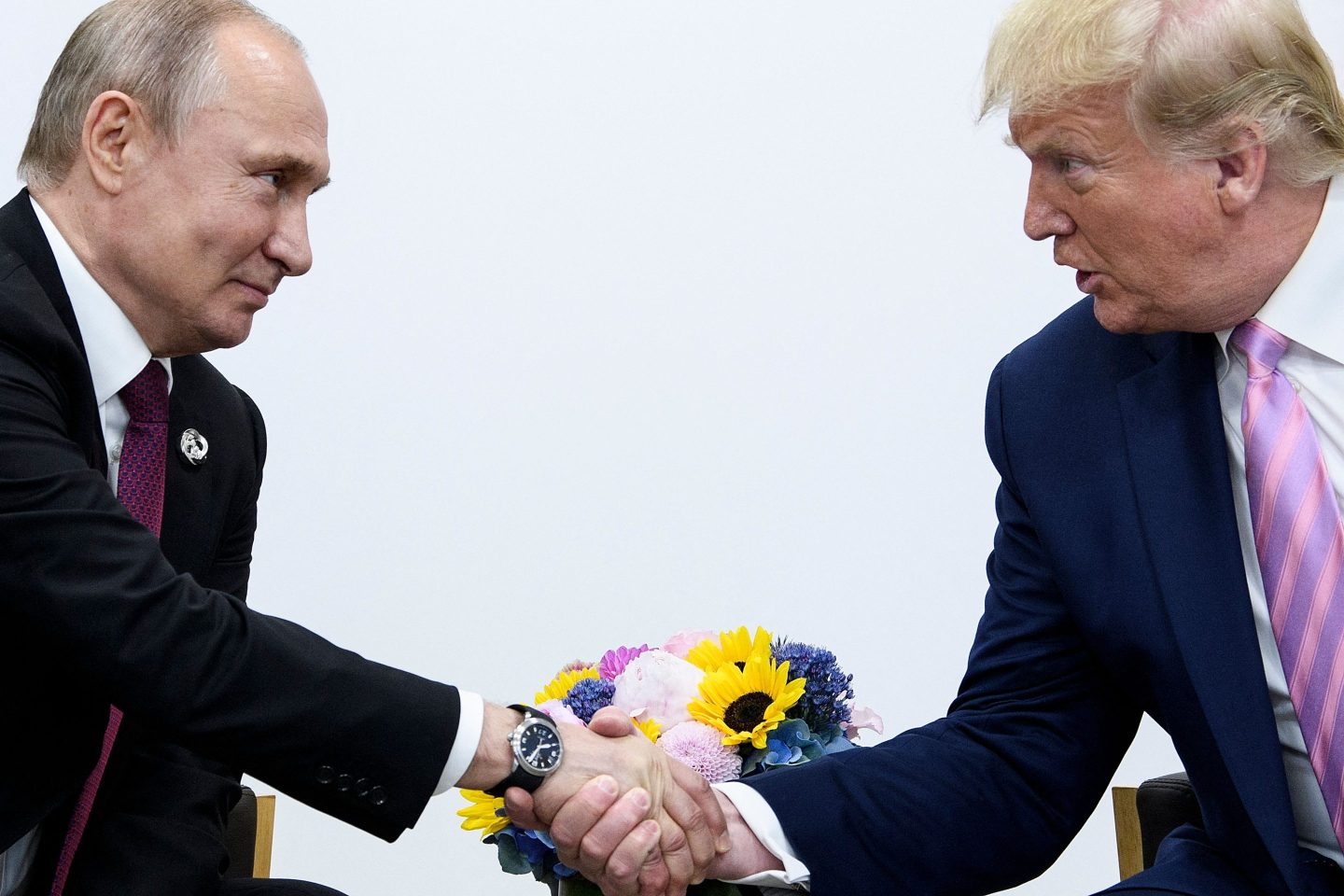
U.S. President Donald Trump and his Russian counterpart Vladimir Putin at the G20 summit in Osaka in 2019.
U.S. President Donald Trump and his Russian counterpart Vladimir Putin at the G20 summit in Osaka in 2019.Brendan Smialowski / AFP) (Photo by BRENDAN SMIALOWSKI/AFP via Getty Images

Amidst President Trump’s apparent pivot toward Russia, Vladmir Putin offered the opportunity for U.S. businesses to re-engage in Russia as one of his primary bargaining chips in peace negotiations, an apparent “concession” to America. Putin will fail at this latest effort just as his imperialistic military plans stalled and his economic puffery has imploded.

“U.S. businesses lost over $300 billion from leaving the Russian market,” deceptively declared Kirill Dmitriev, the head of Russia’s sovereign wealth fund and one of Putin’s lead negotiators, on CNN on Tuesday, referring to the original exit of over 1,000 top companies from Russia in 2022 after Putin’s invasion of Ukraine. “Given such hefty losses, [returning] would be in the interests of the U.S.,” stated Dmitriev. 

Those talking points were parroted by the U.S. negotiating team, with Secretary of State Marco Rubio musing about the “incredible opportunities that exist to partner with the Russians economically.”

There’s just one problem: Those “opportunities to partner with the Russians economically” are non-existent, because we know none of the 1,000-plus companies that left are eager to return to Russia or increase their business there.

We know this firsthand, because we helped catalyze the original exodus in 2022. Immediately after Russian’s invasion of Ukraine, its peaceful sovereign neighbor, our team of 50 expert researchers—with mastery in economics, strategy, and global diplomacy, and fluency in 15 languages—in conjunction with a wiki-style network of 200 sources on the ground in Russia and Europe, began publishing a classification of the Russian business status of 1,400 major global firms. 

Working 24/7, this effort has been widely credited with catalyzing the largest business exodus in history. We remain, in constant contact with the CEOs of the nation’s largest enterprises, advising them on their Russian responses. 

As a general rule, companies seek to invest where there is the rule of law, not the law of rulers. No business wants to invest precious capital into Russia as long as Putin is in power, since they know they could lose the entirety of that investment four years later with the next election, or perhaps even earlier, given the instability of U.S.-Russian relations. 

But even more specifically to Russia, and contrary to Dmitriev’s assertions that U.S. companies lost $300 billion by leaving, the Russian market is lilliputian for American businesses, and economically irrelevant. Even prior to leaving, most companies drew no more than 1% of their revenues from Russia; and whatever revenues they lost by leaving Russia were replaced many times over by large, immediate surges in their valuation as reassured investors welcomed relief from the persistent overhang of regulatory, reputational, and nationalization risk unique to operating in Russia.

No shareholders are clamoring for U.S. companies to do business in Russia, just as no CEOs are, and especially now, since as even President Trump has acknowledged, the Russian economy is in freefall with runaway 20% inflation, mass talent flight (over 1 million Russians having fled), capital flight amounting to $250 billion, and rapidly dwindling foreign exchange reserves with every sector hemorrhaging.

The only thing Russia has of any genuine economic value is its deposits of natural resources. Perhaps Trump’s negotiating team has those in mind—but oil wells, gas fields, and metals mines take significant investment to develop, and no American company needs to take the risk of gambling on Putin when the U.S. is already home to some of the world’s largest, undeveloped deposits of energy and rare earth minerals, all of which are ripe for harvesting. As such, Putin needs U.S. investment much more than U.S. companies need Russian natural resources. 

No matter what Trump and Putin may say, we are confident none of the 1,000-plus companies that left Russia are excited to return. With few companies willing and able to invest in Russia, the “incredible opportunities that exist to partner with the Russians economically” are as nonexistent as Putin’s credibility. There are genuine concessions to be won from the Russians, but significant opportunities for U.S. business are not among them.  

Jeffrey Sonnenfeld is the Lester Crown Professor in Management Practice and Senior Associate Dean at Yale School of Management. Steven Tian is the director of research at the Yale Chief Executive Leadership Institute.

The opinions expressed in Fortune.com commentary pieces are solely the views of their authors and do not necessarily reflect the opinions and beliefs of Fortune.

Read more:

  • Trump and Putin teased ‘enormous economic deals’ in their call—but U.S. companies will experience a very different Russia if they return
  • European leaders meet in response to Trump’s negotiation with Russia, as U.K. raises possibility of ‘troops on the ground’
  • Russia’s ruble is soaring as Trump pushes for an end to the Ukraine war while Europe fears getting sidelined
  • An economic catastrophe is lurking beneath Russia’s GDP growth as Putin ‘throws everything into the fireplace’

Join us at the Fortune Workplace Innovation Summit May 19–20, 2026, in Atlanta. The next era of workplace innovation is here—and the old playbook is being rewritten. At this exclusive, high-energy event, the world’s most innovative leaders will convene to explore how AI, humanity, and strategy converge to redefine, again, the future of work. Register now.
About the Authors
By Jeffrey Sonnenfeld

Jeffrey Sonnenfeld is the Lester Crown Professor in Management Practice and Senior Associate Dean at Yale School of Management.

See full bioRight Arrow Button Icon
By Steven Tian

Steven Tian is the director of research at the Yale Chief Executive Leadership Institute.

See full bioRight Arrow Button Icon

Latest in Commentary

Julian Braithwaite is the Director General of the International Alliance for Responsible Drinking
CommentaryProductivity
Gen Z is drinking 20% less than Millennials. Productivity is rising. Coincidence? Not quite
By Julian BraithwaiteDecember 13, 2025
16 hours ago
carbon
Commentaryclimate change
Banking on carbon markets 2.0: why financial institutions should engage with carbon credits
By Usha Rao-MonariDecember 13, 2025
17 hours ago
Dr. Javier Cárdenas is the director of the Rockefeller Neuroscience Institute NeuroPerformance Innovation Center.
Commentaryconcussions
Fists, not football: There is no concussion protocol for domestic violence survivors
By Javier CárdenasDecember 12, 2025
2 days ago
Gary Locke is the former U.S. ambassador to China, U.S. secretary of commerce, and governor of Washington.
CommentaryChina
China is winning the biotech race. Patent reform is how we catch up
By Gary LockeDecember 12, 2025
2 days ago
millennial
CommentaryConsumer Spending
Meet the 2025 holiday white whale: the millennial dad spending $500+ per kid
By Phillip GoerickeDecember 12, 2025
2 days ago
Sarandos
CommentaryAntitrust
Netflix, Warner, Paramount and antitrust: Entertainment megadeal’s outcome must follow the evidence, not politics or fear of integration
By Satya MararDecember 12, 2025
2 days ago

Most Popular

placeholder alt text
Success
Apple cofounder Ronald Wayne sold his 10% stake for $800 in 1976—today it’d be worth up to $400 billion
By Preston ForeDecember 12, 2025
2 days ago
placeholder alt text
Economy
Tariffs are taxes and they were used to finance the federal government until the 1913 income tax. A top economist breaks it down
By Kent JonesDecember 12, 2025
2 days ago
placeholder alt text
Success
40% of Stanford undergrads receive disability accommodations—but it’s become a college-wide phenomenon as Gen Z try to succeed in the current climate
By Preston ForeDecember 12, 2025
2 days ago
placeholder alt text
Economy
The Fed just ‘Trump-proofed’ itself with a unanimous move to preempt a potential leadership shake-up
By Jason MaDecember 12, 2025
1 day ago
placeholder alt text
Economy
For the first time since Trump’s tariff rollout, import tax revenue has fallen, threatening his lofty plans to slash the $38 trillion national debt
By Sasha RogelbergDecember 12, 2025
1 day ago
placeholder alt text
Success
Apple CEO Tim Cook out-earns the average American’s salary in just 7 hours—to put that into context, he could buy a new $439,000 home in just 2 days
By Emma BurleighDecember 12, 2025
2 days ago
Rankings
  • 100 Best Companies
  • Fortune 500
  • Global 500
  • Fortune 500 Europe
  • Most Powerful Women
  • Future 50
  • World’s Most Admired Companies
  • See All Rankings
Sections
  • Finance
  • Leadership
  • Success
  • Tech
  • Asia
  • Europe
  • Environment
  • Fortune Crypto
  • Health
  • Retail
  • Lifestyle
  • Politics
  • Newsletters
  • Magazine
  • Features
  • Commentary
  • Mpw
  • CEO Initiative
  • Conferences
  • Personal Finance
  • Education
Customer Support
  • Frequently Asked Questions
  • Customer Service Portal
  • Privacy Policy
  • Terms Of Use
  • Single Issues For Purchase
  • International Print
Commercial Services
  • Advertising
  • Fortune Brand Studio
  • Fortune Analytics
  • Fortune Conferences
  • Business Development
About Us
  • About Us
  • Editorial Calendar
  • Press Center
  • Work At Fortune
  • Diversity And Inclusion
  • Terms And Conditions
  • Site Map

© 2025 Fortune Media IP Limited. All Rights Reserved. Use of this site constitutes acceptance of our Terms of Use and Privacy Policy | CA Notice at Collection and Privacy Notice | Do Not Sell/Share My Personal Information
FORTUNE is a trademark of Fortune Media IP Limited, registered in the U.S. and other countries. FORTUNE may receive compensation for some links to products and services on this website. Offers may be subject to change without notice.










