• Home
  • Latest
  • Fortune 500
  • Finance
  • Tech
  • Leadership
  • Lifestyle
  • Rankings
  • Multimedia
TechEntrepreneurship

How Paul Allen and Bill Gates landed on the idea for Microsoft after cycling through many other startup ideas

By
Bill Gates
Bill Gates
Down Arrow Button Icon
By
Bill Gates
Bill Gates
Down Arrow Button Icon
February 4, 2025, 12:30 AM ET
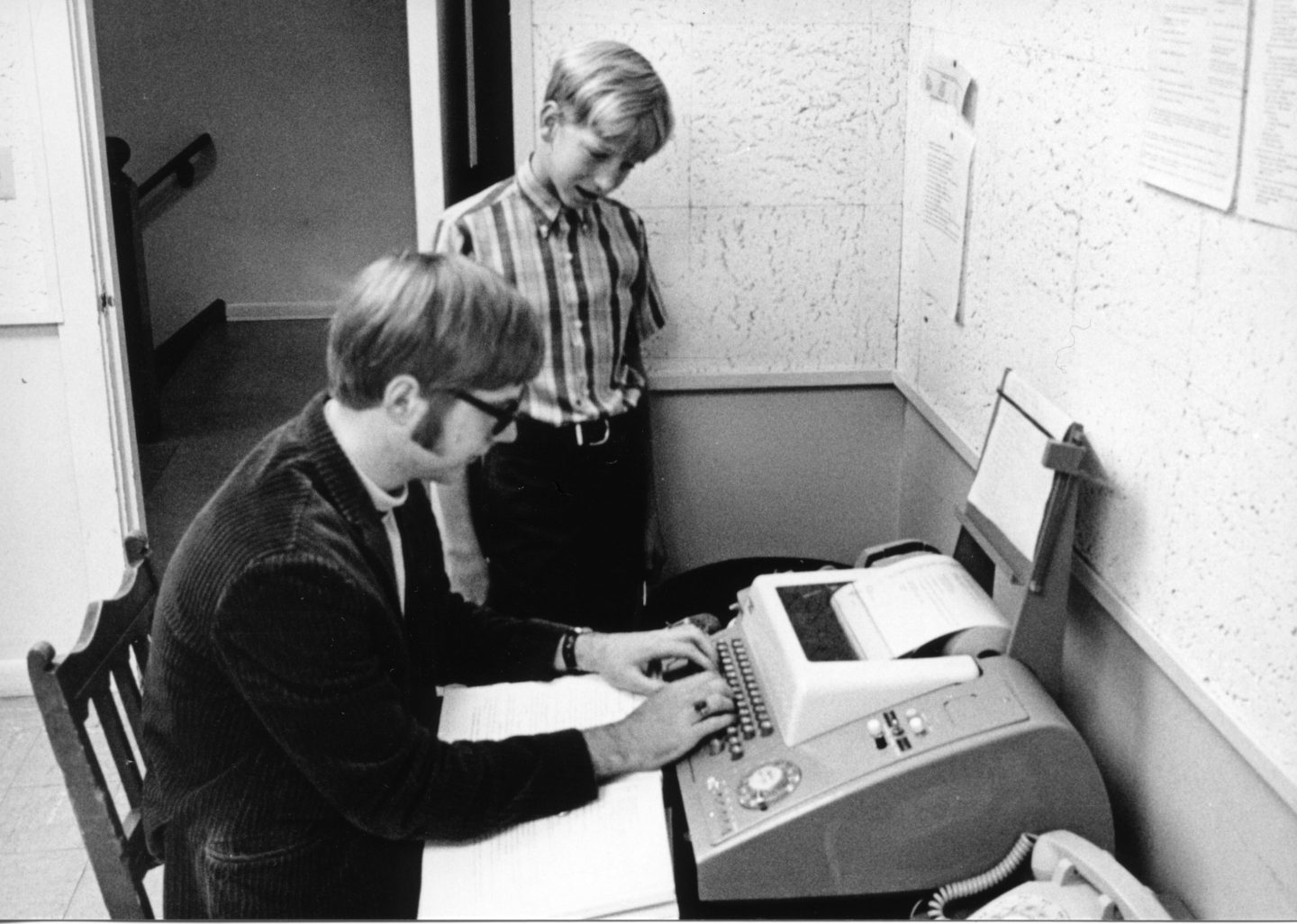
Future Microsoft cofounders Bill Gates and Paul Allen (seated) at a teletype machine in a photo from the Lakeside School yearbook, 1969-1970.
Future Microsoft cofounders Bill Gates and Paul Allen (seated) at a teletype machine in a photo from the Lakeside School yearbook, 1969-1970.Lakeside School

The following is an excerpt from Microsoft cofounder Bill Gates’ new book SOURCE CODE: My Beginnings.

When he wasn’t working, Paul lived in his magazines, his apartment littered with back issues of Popular Electronics, Datamation, Radio-Electronics, and spec sheets for all sorts of computers and their components. He could easily spend an hour foraging through Out of Town News, the landmark newspaper and magazine kiosk in the center of Harvard Square. From his growing pile of paper and publications sprang many ideas for any number of ventures Paul pitched me that fall.

Most of them centered on the microprocessor. For a while, Paul was set on the idea of building a computer company in the model of DEC. DEC had exploited new technologies to lower the price of computers and greatly expand their use. Could we do the same with inexpensive microprocessors, maybe string together multiple chips to make a superpowerful computer really cheaply? What about setting up a timesharing service aimed at consumers? People could dial into our computer to access news and other useful information, like, I don’t know, recipes?

We’d sift through these ideas over pizza or at Aku Aku, a Trader Vic’s–style Polynesian place, talking for hours as I sipped Shirley Temples (at 20 years old I was over the drinking age but preferred the kid’s mocktail to alcohol). Because of Paul’s love of computer hardware, his ideas often centered on building some kind of innovative computer. One great idea he came up with was a technique for wiring together cheaper, less-capable chips into a single powerful processor called a bit-slice computer. His question: Could we use this bit-slice technique to undercut IBM just as DEC had done a decade earlier? At the time, an industry-leading IBM System/360 mainframe computer could cost several hundred thousand dollars. I spent some time on my own studying the details of the IBM machine and Paul’s bit-slice idea. On our next night out, I told him I thought it could work. We could probably make a computer for $20,000 that would be equivalent to the 360.

Still, he knew that I was increasingly cooling to the idea of building hardware. The business of manufacturing computers seemed too risky to me. We’d have to buy parts, hire people to assemble the machines, and find lots of space to pull it off. And how would we ever realistically compete with big companies like IBM?

My view was informed by Traf-O-Data. For eighteen months our partner back in Seattle, Paul Gilbert, had been struggling to get our computer to work. The machine required the delicate coordination of electronic pulses that had to reach each of the machine’s memory chips at exactly the same moment. A delay of a microsecond and everything froze. One wire, a hair longer than it should be, or a trace amount of radiation it produced could throw off the pulses. And did, over and over. These endless glitches fed my worries that we were wasting our time, courting a life of tedious problem-solving that seemed hit-or-miss, not fully in our control.

Gilbert was a self-declared perfectionist, a math-obsessive engineer who doggedly stuck with a problem until he solved it. “I don’t like to be defeated. I’ll get it fixed regardless of what it takes,” he would say. (His girlfriend dropped him that year because he spent too much time on Traf-O-Data.)

I wrote memory test software and then the two Pauls dove in. They’d stare at the oscilloscope patiently making the diagnosis: “a glitch in the data to the line on chip seven.” Kind of like those organic chemistry modules, there was a level of disorder to the hardware problems that frustrated me. I’m sure my nervous energy added to the stress. I was always pushing to see if there was something we could change or add to speed things up.

Gilbert eventually got the hardware working in the spring of my first year of college. That summer I arranged a meeting at my parents’ house with potential customers from Seattle’s King County. I had everything set perfectly that morning, but when the time came for my demo, the unit’s tape reader broke. I pleaded with my mom to tell them that it really, truly had worked flawlessly the night before. Our guests politely finished their coffee and left. After that, we laid out $2,000 for what we considered to be the Rolls-Royce of tape readers. All this effort and expense for a simple computer, with a single job of translating holes in a paper tape into graphs.

Again and again, my dinner conversations with Paul led back to software. Software was different. No wires, no factories. Writing software was just brainpower and time; the two of us sitting at a computer with full control over the output. And it’s what we knew how to do, what made us unique. It was where we had an advantage. We could even lead the way.

From the book SOURCE CODE: My Beginnings by Bill Gates, published on February 4, 2025, by The Knopf Doubleday Publishing Group, a division of Penguin Random House LLC. Copyright © 2025 by Bill Gates.

Read more:

  • Microsoft turns 50: How it’s remained essential, based on my 27 years there 
  • Satya Nadella has made Microsoft 10 times more valuable in his decade as CEO. Can he stay ahead in the AI age?
  • Microsoft turns 50 as the world’s second largest company—trying not to fall behind on AI
  • Microsoft’s memorable cultural legacies at 50, from Clippy to the Blue Screen of Death
Join us at the Fortune Workplace Innovation Summit May 19–20, 2026, in Atlanta. The next era of workplace innovation is here—and the old playbook is being rewritten. At this exclusive, high-energy event, the world’s most innovative leaders will convene to explore how AI, humanity, and strategy converge to redefine, again, the future of work. Register now.
About the Author
By Bill Gates
See full bioRight Arrow Button Icon

Latest in Tech

Finance
Lorem ipsum dolor sit amet, consectetur adipiscing elit, sed do eiusmod tempor incididunt ut labore et dolore magna aliqua. Ut enim ad minim veniam
By Fortune Editors
October 20, 2025
Finance
Lorem ipsum dolor sit amet, consectetur adipiscing elit, sed do eiusmod tempor incididunt ut labore et dolore magna aliqua. Ut enim ad minim veniam
By Fortune Editors
October 20, 2025
Finance
Lorem ipsum dolor sit amet, consectetur adipiscing elit, sed do eiusmod tempor incididunt ut labore et dolore magna aliqua. Ut enim ad minim veniam
By Fortune Editors
October 20, 2025
Finance
Lorem ipsum dolor sit amet, consectetur adipiscing elit, sed do eiusmod tempor incididunt ut labore et dolore magna aliqua. Ut enim ad minim veniam
By Fortune Editors
October 20, 2025
Finance
Lorem ipsum dolor sit amet, consectetur adipiscing elit, sed do eiusmod tempor incididunt ut labore et dolore magna aliqua. Ut enim ad minim veniam
By Fortune Editors
October 20, 2025
Finance
Lorem ipsum dolor sit amet, consectetur adipiscing elit, sed do eiusmod tempor incididunt ut labore et dolore magna aliqua. Ut enim ad minim veniam
By Fortune Editors
October 20, 2025

Most Popular

Finance
Lorem ipsum dolor sit amet, consectetur adipiscing elit, sed do eiusmod tempor incididunt ut labore et dolore magna aliqua. Ut enim ad minim veniam
By Fortune Editors
October 20, 2025
Finance
Lorem ipsum dolor sit amet, consectetur adipiscing elit, sed do eiusmod tempor incididunt ut labore et dolore magna aliqua. Ut enim ad minim veniam
By Fortune Editors
October 20, 2025
Finance
Lorem ipsum dolor sit amet, consectetur adipiscing elit, sed do eiusmod tempor incididunt ut labore et dolore magna aliqua. Ut enim ad minim veniam
By Fortune Editors
October 20, 2025
Finance
Lorem ipsum dolor sit amet, consectetur adipiscing elit, sed do eiusmod tempor incididunt ut labore et dolore magna aliqua. Ut enim ad minim veniam
By Fortune Editors
October 20, 2025
Finance
Lorem ipsum dolor sit amet, consectetur adipiscing elit, sed do eiusmod tempor incididunt ut labore et dolore magna aliqua. Ut enim ad minim veniam
By Fortune Editors
October 20, 2025
Finance
Lorem ipsum dolor sit amet, consectetur adipiscing elit, sed do eiusmod tempor incididunt ut labore et dolore magna aliqua. Ut enim ad minim veniam
By Fortune Editors
October 20, 2025
Rankings
  • 100 Best Companies
  • Fortune 500
  • Global 500
  • Fortune 500 Europe
  • Most Powerful Women
  • Future 50
  • World’s Most Admired Companies
  • See All Rankings
Sections
  • Finance
  • Leadership
  • Success
  • Tech
  • Asia
  • Europe
  • Environment
  • Fortune Crypto
  • Health
  • Retail
  • Lifestyle
  • Politics
  • Newsletters
  • Magazine
  • Features
  • Commentary
  • Mpw
  • CEO Initiative
  • Conferences
  • Personal Finance
  • Education
Customer Support
  • Frequently Asked Questions
  • Customer Service Portal
  • Privacy Policy
  • Terms Of Use
  • Single Issues For Purchase
  • International Print
Commercial Services
  • Advertising
  • Fortune Brand Studio
  • Fortune Analytics
  • Fortune Conferences
  • Business Development
About Us
  • About Us
  • Editorial Calendar
  • Press Center
  • Work At Fortune
  • Diversity And Inclusion
  • Terms And Conditions
  • Site Map
  • Facebook icon
  • Twitter icon
  • LinkedIn icon
  • Instagram icon
  • Pinterest icon

Most Popular

placeholder alt text
Success
Gen Z Patriots quarterback Drake Maye still drives a 2015 pickup truck even after it broke down on the highway—despite his $37 million contract
By Sasha RogelbergFebruary 7, 2026
1 day ago
placeholder alt text
Success
Even with $850 billion to his name, Elon Musk admits ‘money can’t buy happiness.’ But billionaire Mark Cuban says it’s not so simple
By Preston ForeFebruary 6, 2026
2 days ago
placeholder alt text
Economy
Elon Musk warns the U.S. is '1,000% going to go bankrupt' unless AI and robotics save the economy from crushing debt
By Jason MaFebruary 7, 2026
21 hours ago
placeholder alt text
Success
Nestlé’s CEO drinks 8 coffees a day, but says Gen Z staffers are his secret to staying sharp by ‘learning constantly’
By Emma BurleighFebruary 5, 2026
3 days ago
placeholder alt text
AI
AI can make anyone rich: Mark Cuban says it could turn 'just one dude in a basement' into a trillionaire
By Sydney LakeFebruary 7, 2026
1 day ago
placeholder alt text
Future of Work
Anthropic cofounder says studying the humanities will be 'more important than ever' and reveals what the AI company looks for when hiring
By Jason MaFebruary 7, 2026
23 hours ago

© 2026 Fortune Media IP Limited. All Rights Reserved. Use of this site constitutes acceptance of our Terms of Use and Privacy Policy | CA Notice at Collection and Privacy Notice | Do Not Sell/Share My Personal Information
FORTUNE is a trademark of Fortune Media IP Limited, registered in the U.S. and other countries. FORTUNE may receive compensation for some links to products and services on this website. Offers may be subject to change without notice.


Latest in Tech

RetailEurope
Trump’s Greenland crisis triggered a surge in apps designed to help shoppers boycott U.S. goods, though few American imports are on store shelves
By James Brooks and The Associated PressFebruary 8, 2026
4 minutes ago
nfl
CommentaryTV
The Super Bowl was made for TV and instant replay was made for visual AI. Here’s how it could be better and what it would look like
By Jason CorsoFebruary 8, 2026
1 hour ago
monkey
CybersecurityAnimals
One way AI won’t ruin the world: tools to crack down on the $23 billion animal trafficking trade
By Eve Bohnett and The ConversationFebruary 8, 2026
2 hours ago
heacock
CommentaryLeadership
I’m a CEO who grew a ‘boring’ air filter business into a $260 million company, and AI is going to help blue-collar, everyday people just like me
By David HeacockFebruary 8, 2026
3 hours ago
AITech
Meta’s multi-million-dollar Super Bowl ads may not just be about its smart glasses—but about selling Wall Street on Zuckerberg’s AI future
By Marco Quiroz-GutierrezFebruary 8, 2026
4 hours ago
Mark Cuban
SuccessView from the C-Suite
In the AI era, Mark Cuban, Mary Barra, and even Sam Altman have one tip for Gen Z: unplug and go analog
By Preston ForeFebruary 8, 2026
5 hours ago