• Home
  • News
  • Fortune 500
  • Tech
  • Finance
  • Leadership
  • Lifestyle
  • Rankings
  • Multimedia
CommentaryDonald Trump

Trump and Vance shouldn’t give in to European-style labor regulation

By
Liya Palagashvili
Liya Palagashvili
Down Arrow Button Icon
By
Liya Palagashvili
Liya Palagashvili
Down Arrow Button Icon
July 29, 2024, 5:02 AM ET
Liya Palagashvili is a senior research fellow and director of the Labor Policy Project at the Mercatus Center at George Mason University.
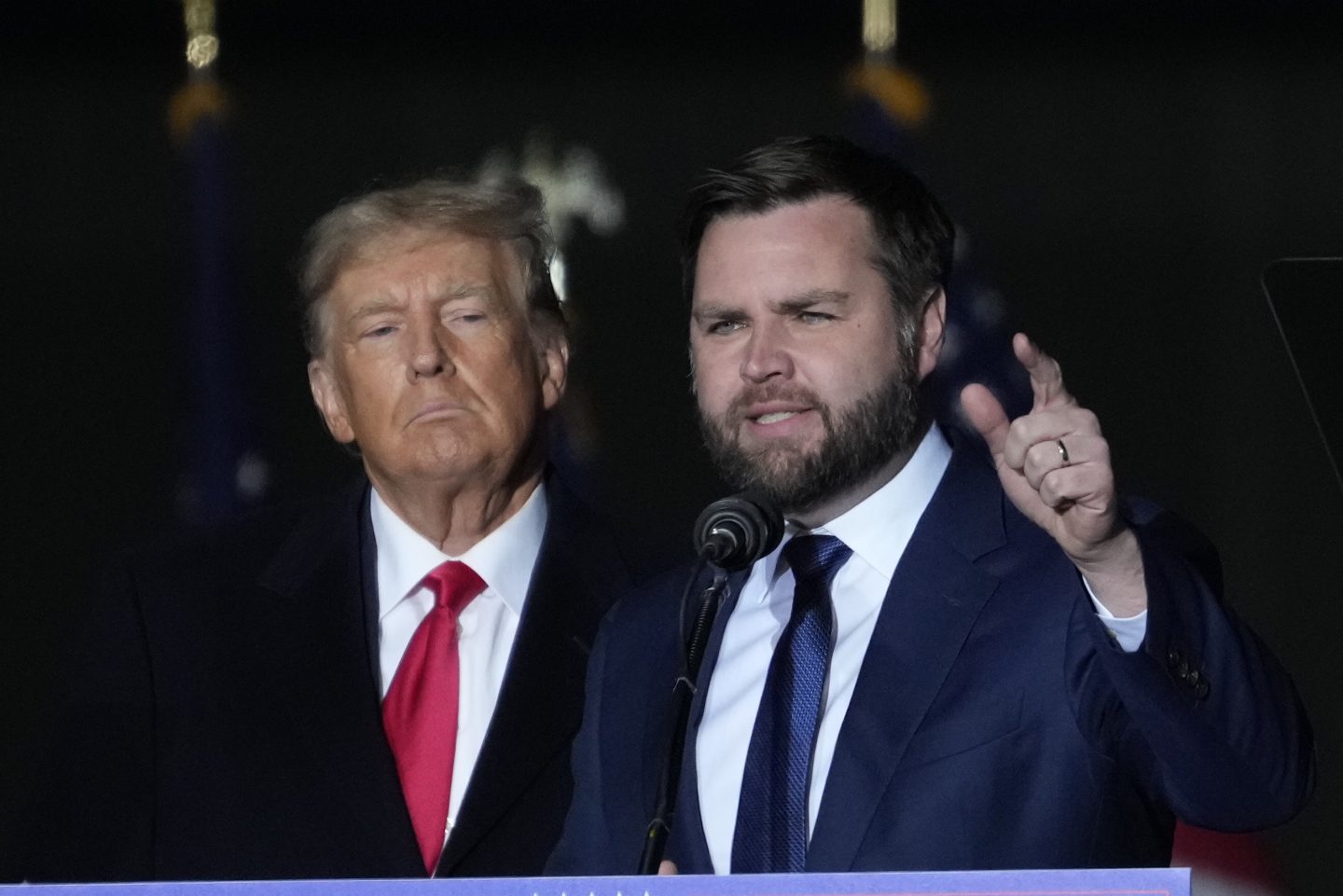
Donald Trump and JD Vance have made overtures to the U.S. labor movement.
Donald Trump and JD Vance have made overtures to the U.S. labor movement.Drew Angerer - Getty Images

A growing movement to break from Republican orthodoxies to carve out a distinctly pro-worker platform has gained traction over the last few years. This idea—that the GOP ought to assert itself more fully as the “pro-worker party”—was solidified when Donald Trump chose J.D. Vance as his running mate and invited the president of the Teamsters union to speak at the Republican convention.

Voters will likely welcome the new GOP priorities, which are in many respects shared by Democrats and even our friends across the Atlantic. But let’s be clear: An agenda that empowers American workers through unionization and employment protection policies will come with trade-offs. The question is how much the GOP can do without diminishing America’s greatest advantage: the dynamic nature of its labor market.

Traditionally, America earned its reputation as the land of opportunity by creating a flourishing entrepreneurial environment with labor markets that generate an abundance of work opportunities for millions of Americans. Mr. Vance’s story of his own American Dream is a prime example of how that empowers the working class.

Vance’s success was not made possible through union membership that protected his job and wages, but rather through the rough-and-rugged American way—hustling from one job to another, jumping between vastly different careers, and chasing high-growth (and high-risk) opportunities. This approach worked out for him and millions of others.

Americans are accustomed to the idea that pro-worker policies—similar to those in Europe—are those that provide extensive job security, embolden unions, and ensure a structured increase in wages and promotion opportunities. A European-style approach can increase job security and ensure steady wages for existing workers. However, it comes at the expense of new and inexperienced workers, job opportunities, and job mobility. Much of Europe has chosen to push labor-market dynamism to the side. 

Italy is a prime example of this tension. Despite all the country has to offer, it is not known for its thriving labor market. Indeed, my husband and almost all of his well-educated cohort from a top university in Italy were forced to seek employment abroad upon graduation. Less than 10 years ago, Italy’s youth unemployment rate was at a staggering 45%. Even today, at 23%, it remains one of the highest in the developed world.

It is no coincidence that Italy is also known for having one of the most so-called pro-worker labor policies among its Western counterparts, characterized by high rates of unionization and policies that provide extensive job security. And yet, no one is migrating to Italy to pursue the Italian Dream (unless, of course, that means living La Dolce Vita in a charming, cliffside villa with your U.S. income).

In fact, a set of studies found that when Italy even slightly reduced its protective employment regulations, it led to increased employment and more jobs, especially for younger and inexperienced workers. Italy is not a unique case, with economists having long documented how more restrictive labor regulations that protect existing jobs lead to less labor mobility, fewer job opportunities, and higher unemployment rates.

This doesn’t mean that we shouldn’t have unions or safety-net policies for workers in America. But if conservatives wish to pursue a path of European-style pro-worker policies, they must be careful not to constrain our economy’s strongest asset.

Economists have proposed a variety of unique ideas to protect workers, ranging from the earned-income tax credit to pursuing some variation of a negative income tax policy. American unions could also be transformed by eliminating their government-granted exclusive-negotiator status so that multiple unions could represent workers for any given employer. Doing so would increase union membership and give workers a more diverse set of institutions and protections or benefits to seek in the workplace.

Donald Trump and J.D. Vance are correct that conservatives should pursue a pro-worker agenda. But it must lean into what has traditionally made the U.S. labor market vibrant—entrepreneurial dynamism, not rigid European-style labor policy.

More must-read commentary published by Fortune:

  • Women can’t fix the ‘broken rung’ unless they acknowledge the role they play in workplace bullying and discrimination
  • Private equity is devouring the economy as boomer entrepreneurs exit—but a new approach to employee ownership can change that
  • Gen Z’s enthusiasm for all things touchable is resurrecting the analog economy—and costing parents
  • Nokia CEO: Europe shouldn’t be afraid to back its innovation champions

The opinions expressed in Fortune.com commentary pieces are solely the views of their authors and do not necessarily reflect the opinions and beliefs of Fortune.

Fortune Brainstorm AI returns to San Francisco Dec. 8–9 to convene the smartest people we know—technologists, entrepreneurs, Fortune Global 500 executives, investors, policymakers, and the brilliant minds in between—to explore and interrogate the most pressing questions about AI at another pivotal moment. Register here.
About the Author
By Liya Palagashvili
See full bioRight Arrow Button Icon

Latest in Commentary

Alex Amouyel is the President and CEO of Newman’s Own Foundation
Commentaryphilanthropy
Following in Paul Newman and Yvon Chouinard’s footsteps: There are more ways for leaders to give it away in ‘the Great Boomer Fire Sale’ than ever
By Alex AmouyelDecember 7, 2025
18 hours ago
Amit Walia
CommentaryM&A
Why the timing was right for Salesforce’s $8 billion acquisition of Informatica — and for the opportunities ahead
By Amit WaliaDecember 6, 2025
2 days ago
Steve Milton is the CEO of Chain, a culinary-led pop-culture experience company founded by B.J. Novak and backed by Studio Ramsay Global.
CommentaryFood and drink
Affordability isn’t enough. Fast-casual restaurants need a fandom-first approach
By Steve MiltonDecember 5, 2025
3 days ago
Paul Atkins
CommentaryCorporate Governance
Turning public companies into private companies: the SEC’s retreat from transparency and accountability
By Andrew BeharDecember 5, 2025
3 days ago
Matt Rogers
CommentaryInfrastructure
I built the first iPhone with Steve Jobs. The AI industry is at risk of repeating an early smartphone mistake
By Matt RogersDecember 4, 2025
4 days ago
Jerome Powell
CommentaryFederal Reserve
Fed officials like the mystique of being seen as financial technocrats, but it’s time to demystify the central bank
By Alexander William SalterDecember 4, 2025
4 days ago

Most Popular

placeholder alt text
Real Estate
The 'Great Housing Reset' is coming: Income growth will outpace home-price growth in 2026, Redfin forecasts
By Nino PaoliDecember 6, 2025
2 days ago
placeholder alt text
AI
Nvidia CEO says data centers take about 3 years to construct in the U.S., while in China 'they can build a hospital in a weekend'
By Nino PaoliDecember 6, 2025
2 days ago
placeholder alt text
Economy
The most likely solution to the U.S. debt crisis is severe austerity triggered by a fiscal calamity, former White House economic adviser says
By Jason MaDecember 6, 2025
1 day ago
placeholder alt text
Economy
JPMorgan CEO Jamie Dimon says Europe has a 'real problem’
By Katherine Chiglinsky and BloombergDecember 6, 2025
1 day ago
placeholder alt text
Big Tech
Mark Zuckerberg rebranded Facebook for the metaverse. Four years and $70 billion in losses later, he’s moving on
By Eva RoytburgDecember 5, 2025
3 days ago
placeholder alt text
Politics
Supreme Court to reconsider a 90-year-old unanimous ruling that limits presidential power on removing heads of independent agencies
By Mark Sherman and The Associated PressDecember 7, 2025
16 hours ago
Rankings
  • 100 Best Companies
  • Fortune 500
  • Global 500
  • Fortune 500 Europe
  • Most Powerful Women
  • Future 50
  • World’s Most Admired Companies
  • See All Rankings
Sections
  • Finance
  • Leadership
  • Success
  • Tech
  • Asia
  • Europe
  • Environment
  • Fortune Crypto
  • Health
  • Retail
  • Lifestyle
  • Politics
  • Newsletters
  • Magazine
  • Features
  • Commentary
  • Mpw
  • CEO Initiative
  • Conferences
  • Personal Finance
  • Education
Customer Support
  • Frequently Asked Questions
  • Customer Service Portal
  • Privacy Policy
  • Terms Of Use
  • Single Issues For Purchase
  • International Print
Commercial Services
  • Advertising
  • Fortune Brand Studio
  • Fortune Analytics
  • Fortune Conferences
  • Business Development
About Us
  • About Us
  • Editorial Calendar
  • Press Center
  • Work At Fortune
  • Diversity And Inclusion
  • Terms And Conditions
  • Site Map

© 2025 Fortune Media IP Limited. All Rights Reserved. Use of this site constitutes acceptance of our Terms of Use and Privacy Policy | CA Notice at Collection and Privacy Notice | Do Not Sell/Share My Personal Information
FORTUNE is a trademark of Fortune Media IP Limited, registered in the U.S. and other countries. FORTUNE may receive compensation for some links to products and services on this website. Offers may be subject to change without notice.