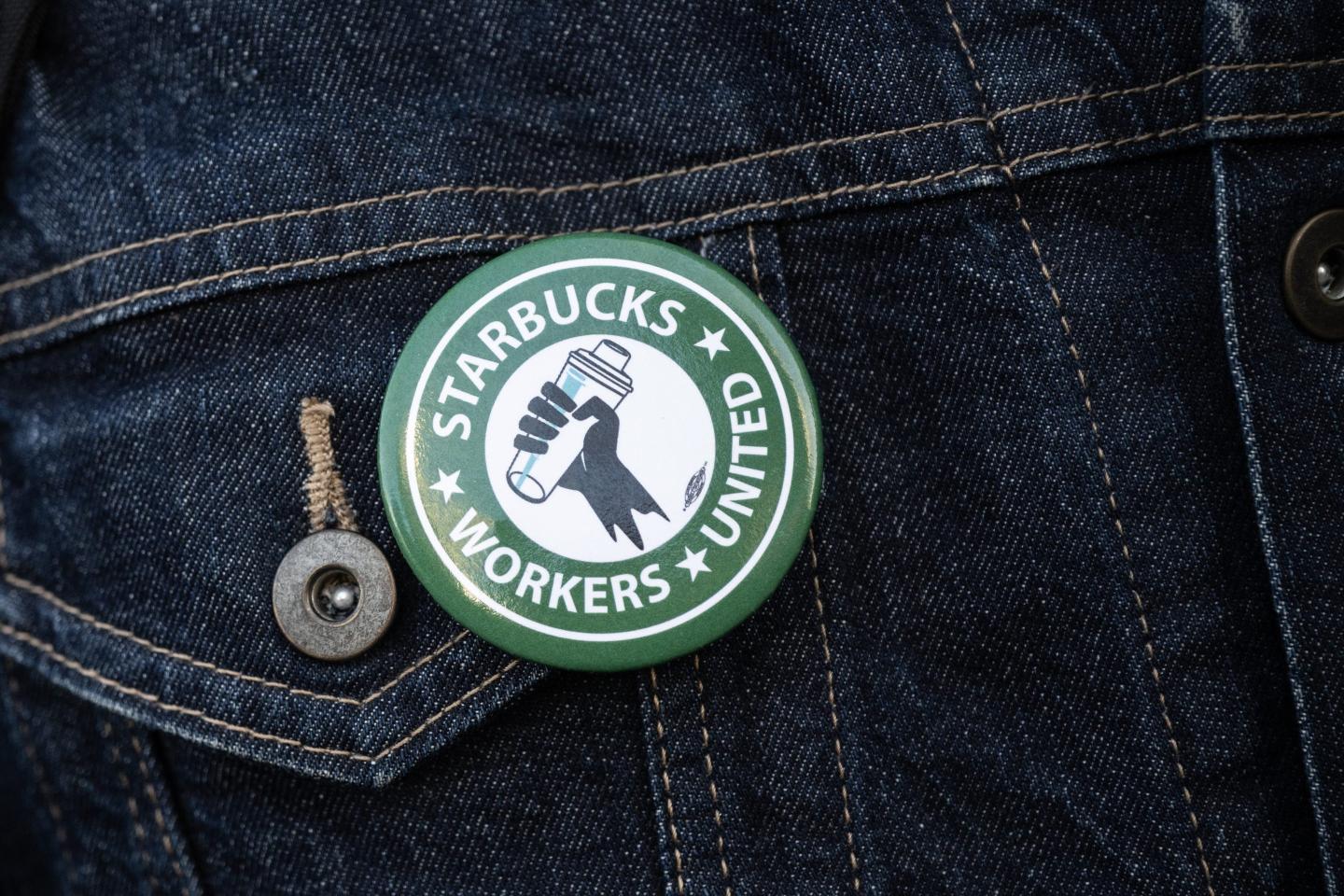
Starbucks Corp.’s new commitment to work with its main union to end hostilities and hash out a fair process for labor organizing is a landmark moment for labor relations — both at the coffee chain that’s long resisted organizing, and far beyond it.
On Tuesday, the company and the Starbucks Workers United union announced that they were beginning discussions meant to secure collective bargaining agreements and resolve litigation. As part of that announcement, Starbucks said it will start providing Workers United’s members with benefits, such as credit-card tipping, that it previously restricted to nonunion stores.
The company will also provide back pay to workers for money they lost by being excluded from such perks since 2022, according to people familiar with the agreement. And rather than bargaining only cafe-by-cafe, the company will also meet at a single table to negotiate with baristas from around the country about how to handle common issues, said the people, who asked not to be identified discussing private information.
Read More: Starbucks, Union Seek Path to Reach Collective Agreement
The new commitments represent a major pivot for Starbucks, which for years has been locked in a bitter, high-profile, multifront battle with the union. Workers United has organized around 400 of the company’s more than 9,700 corporate-run US locations since its first win in 2021. But none of those locations had come close to securing a union contract with the company, and the pace of the union’s growth had slowed, developments that organizers blamed on alleged union-busting and foot-dragging by management.
Regional directors of the US National Labor Relations Board have issued more than 100 complaints against the company, alleging illegal antiunion tactics including closing stores, firing activists, refusing to fairly negotiate at unionized cafes, and wrongly excluding them from benefits it offered their nonunion counterparts. The company has denied wrongdoing and has said the union was the one refusing to fairly negotiate.
Change of Tone
On Tuesday, both sides had a change of tone, each announcing “a shared commitment to working collaboratively and with mutual respect,” and saying they agreed there was “a constructive path forward” on unionization and collective bargaining. A company spokesperson declined Tuesday to discuss details of what had been or would be agreed to, saying “specific framework details will be discussed” further between the two sides and there will be more updates to come.
Workers United will immediately start the process of electing baristas at each unionized cafe to represent their coworkers in contract talks, the union said Tuesday.
Both sides are expecting to hold talks in the coming weeks, the people familiar with the agreement said. Terms and timing of talks sometimes shift on the way to final pacts.
Fleshing out what the new commitments mean could still be an arduous and contentious process. But they open a new era for the company, whose then-chief executive officer, Howard Schultz in 2022 warned of companies “being assaulted, in many ways, by the threat of unionization.” He also told employees, “We didn’t get here by having a union.”
Almost a year ago, Schultz officially handed the company’s reins to Laxman Narasimhan, who from his early days at the company has professed a commitment to understanding workers’ experiences and rebuilding Starbucks’ culture. Narasimhan shadowed Schultz for almost six months and also trained as a barista, working shifts in stores even after becoming CEO.
In December, Starbucks said it reached out to Workers United to attempt to restart a dialogue, with the goal of completing “bargaining and the ratification of contracts in 2024.” Tuesday’s agreement marks the first signs of progress after the company’s outreach.
More Organizing
The breakthrough could quickly lead to a lot more organizing, because it signals that unionizing no longer means missing out on benefits other cafes are receiving, now comes with a better prospect of actually getting a union contract and isn’t counter to the company’s ethos.
“It will spur more unionization, that’s for sure,” as organizers can now tell baristas, “we forced them, so join us,” said labor historian Nelson Lichtenstein, a professor at the University of California at Santa Barbara. Activists have applied pressure on the company through tactics including mounting coordinated work stoppages, pressuring universities to stop serving Starbucks coffee, protesting at appearances by board members and continuing to organize more cafes across the country.
The “cumulative weight” of such tactics, and their impact on the company’s perception among younger customers in particular, may have persuaded executives “that concessions might be the road towards getting this problem off their back,” Lichtenstein said.
If Starbucks agrees to specific terms restricting antiunion tactics, that could spur still more organizing, as could notching significant victories in contract talks.
Other Companies
Starbucks’ pivot could affect many other companies as well. The union campaign at the Seattle-based coffee giant has already been one of the most remarkable and closely watched in decades, spreading swiftly across the country in its early months and helping inspire similar efforts at other major, previously union-free firms such as Apple Inc. and Chipotle Mexican Grill Inc. Successfully negotiating union contracts at the company, an iconic brand in a largely nonunion industry that under Schultz had become a poster child for resisting organizing, could help galvanize many more campaigns.
“They moved a company that to a lot of people — and I will put myself at times in this category — seemed to be immovable,” said Sharon Block, executive director of the Center for Labor and a Just Economy at Harvard Law School, and a former official in the Obama and Biden administrations. “If this kind of campaign results in moving a company like Starbucks, I think a lot of workers are going to say, ‘You know what, I think we can move my company, too.’”
After years of organizing without winning contracts, said Block, “There was a real question about how sustainable the campaign was.” Now, she said, the question instead is just, “How far can it go?”
Like Microsoft Corp.’s agreement to partner with a labor union and not oppose organizing drives, Starbucks’ pivot sends a signal to other executives as well, said Block, offering an alternative to all-out warfare. “There are a lot of other CEOs out there that could learn,” she said. “I hope they will. But we’ll see.”