When the pandemic threat eased, Maureen Holohan was eager to scale back her online shopping and return to physical stores so she could more easily compare prices and scour ingredients on beauty and health care products for herself and her three children.
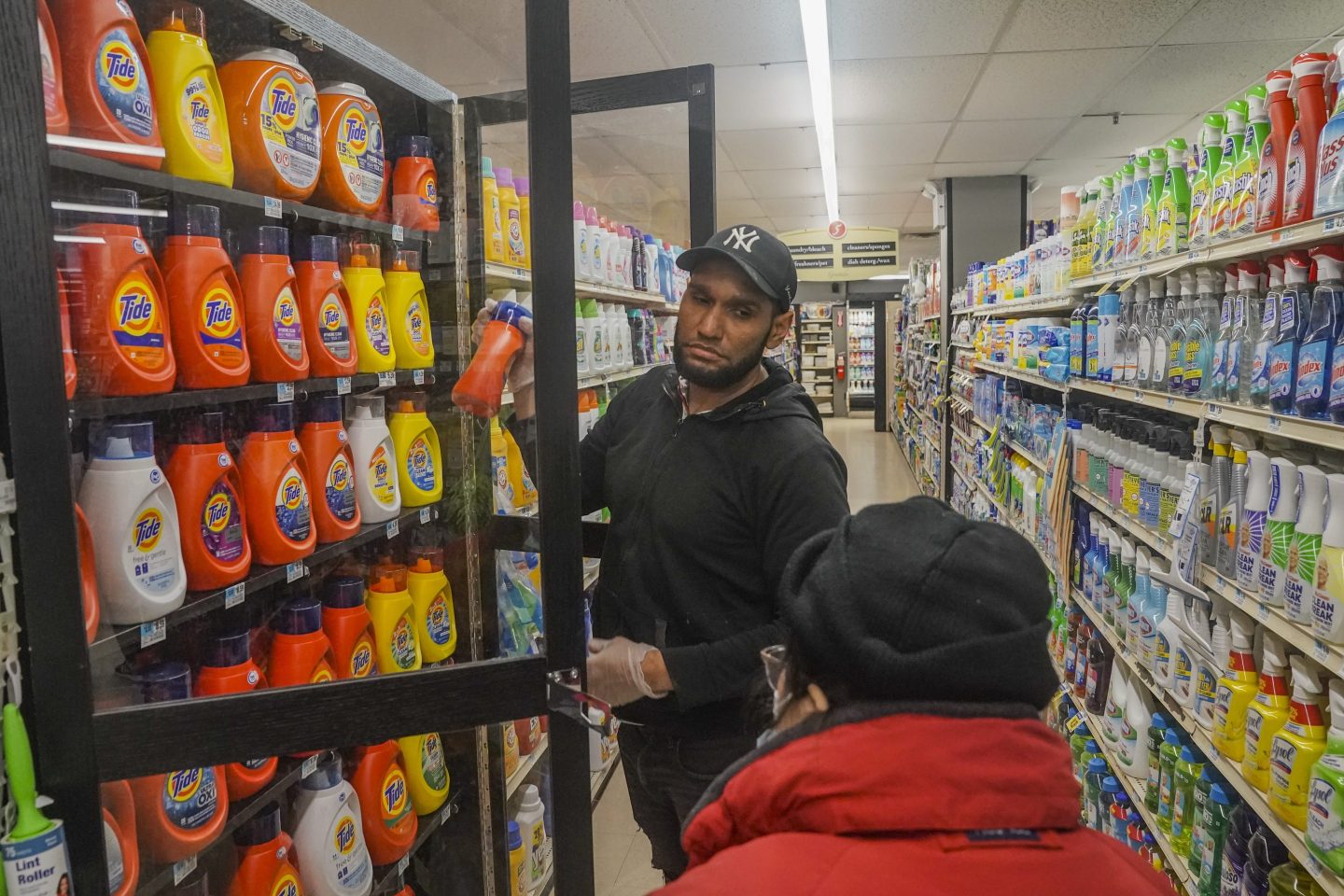
But that experience was short-lived. In the past six months or so, CVS, Target and other retailers where Holohan shops have been locking up more everyday items like deodorant and laundry detergent as a way to reduce theft. And the 56-year-old Chevy Chase, Maryland resident is now back to shopping online or visiting stores where she doesn’t have to wait for someone to retrieve products.
“I know they’ve got to do something, but locking the stuff up definitely just has me walking by that aisle,” said Holohan, a business consultant.
Across the retail landscape, businesses have been putting items under lock and key as a quick way to stop thieves. Some are considering extreme measures, including Rite Aid Corp., whose chief retail officer Andre Persaud told analysts on an earnings call late last year that it’s looking at “literally putting everything behind showcases to ensure the products are there for customers who want to buy it.” It’s also considering using off-duty police officers at some of its stores.
But by trying to solve one problem, these businesses may be creating another: turning off shoppers with overreaching measures.
“Everything has changed. We used to be catered to,” said Sheila Schlegel, 43, of Queens, New York.
But now, “if you’re coming to the store, there’s one person at that store, and that person you can tell has been there for 15 hours,” said Schlegel, who recalled an incident where she waited for a sales clerk to unlock an item only to be told he didn’t have the key. “You don’t want to ask them for something if you don’t have to.”
For consumers of color especially, the stepped-up security measures risk alienating a population that already feels overpoliced. That could unravel some of the inroads that chains like CVS, Sephora and Walmart made in the aftermath of George Floyd’s murder in 2020, when they promised to avoid racially biased practices like locking up products only for Black customers.
“Whenever there’s a push toward greater criminalization, whenever there’s a narrative of increased crime and things like that, it is always consumers of color that are going to be bearing the brunt,” said Tiffany Gill, associate professor of history at Rutgers University, and an expert in African American Women’s History, fashion and beauty culture.
CVS Health Corp. and Sephora declined to comment for the story. Walmart said that its position of not locking up beauty products for women of color remains the same. Target confirmed it was locking up more products but instead of targeting certain items, it locks up entire categories.
It’s unclear how much money retailers are losing due to organized retail crime — or if the problem has substantially increased. But the issue has received more notice in the past few years as high-profile smash-and-grab retail thefts and flash mob robberies have garnered national media attention.
The National Retail Federation, the nation’s largest retail trade group, said its latest security survey of roughly 60 retailers found that inventory loss — called shrink — clocked in at an average rate of 1.4% last year, representing $94.5 billion in losses.
The greatest portion of shrink — 37% — came from external theft, including products taken during organized shoplifting incidents, the trade group said. It also noted retailers, on average, saw a 26.5% uptick in organized theft incidents last year.
But while high theft in stores depletes inventory and limits sales, locking up items also reduces sales — by 15% to 25%, according to Joe Budano, CEO of Indyme, a technology company that sells retailers security devices.
John Catsimatidis, who owns the New York supermarket chains Gristedes and D’Agostino’s, said the chain has locked up more products like aspirin and deodorant in the past year but not as many as his drug store chain rivals. His chains have also doubled the number of security guards at some of its stores
He acknowledged that the move has resulted in some lost sales from impulse shopping but the added security has made shoppers more comfortable and has helped reduce theft, although he’s not sure by how much.
“This is not an exact science,” he said.
Store workers, meanwhile, face the pressure of trying to do their jobs while also monitoring theft. Isabela Burrows, 20, a manager at pet supplies chain PetSmart in Howell, Michigan, noted that her store in recent months has had to lock up more items like diffusers to calm dogs and cats and electric shaving shears. But while she feels more comfortable, she’s also had to deal with shopper annoyance.
“I feel overwhelmed,” Burrows said. “They’re frustrated with me, and I have to find the item.”
In what could be a sign of the overall challenges, drugstore chain Walgreens acknowledged that it might have overblown the shoplifting threat and gone too far in its security measures.
“Maybe, we cried too much last year,” James Kehoe, global chief financial officer at Walgreens told analysts during an earnings call last month. “Probably we put in too much and we might step back a little bit from that.”
But a Walgreens spokesman cautioned that while the company is pleased to see retail theft levels starting to stabilize, they are “still a serious national problem affecting all retailers.”
Some retailers are coming out with less intrusive solutions to store theft. Home improvement retailer Lowe’s has followed Home Depot in testing technology that unlocks power tools when shoppers buy them at the cash registers instead of resorting to keeping the items in cages.
Anat Shakedd, the CEO and co-founder of Nexite, a company that makes tiny Bluetooth tags that can go on items, says her company has partnered with a top department store in the U.S. and other brands across Europe and Israel to help them monitor their inventory without locking things up.
The Freedom Case, developed by Indyme, asks shoppers for a cell phone number to opt into its service. The shoppers then receive a text message with a four-digit code that lets them open the case. Customers can retain their self-service privileges as long as they show normal shopping behaviors. But if they exhibit suspicious behaviors, store workers will be notified to provide assistance, he said.
Holohan said she doesn’t mind extra security guards, but she’s not interested in giving out her phone number.
“It’s invasive,” she said. ”If they’re going to make it that hard to buy something, I’ll find somewhere else to buy that.”
_____
AP Retail Writer Haleluya Hadero in New York contributed to this report.
Learn how to navigate and strengthen trust in your business with The Trust Factor, a weekly newsletter examining what leaders need to succeed. Sign up here.