After years of cheap money helped fuel the rise of speculative investing and profitless business models in the U.S. over the past decade, stubborn inflation has forced the Federal Reserve to increase interest rates faster than ever before in 2022. Now, a new era of higher borrowing costs and more cautious lenders—coupled with slowing growth and recession fears—has frozen once-red hot segments of the U.S. economy.
The initial public offering (IPO) market is essentially shut; tech companies are laying off workers and pausing hiring; the housing market is experiencing a “reset” after years of booming growth; and the venture capital (VC) space has slowed dramatically, with private market valuations tumbling.
But despite the freeze in key sectors—and consistent doomsday predictions from Wall Street—the economy as a whole has continued to grow alongside the resilient labor market. In the fourth quarter of last year, U.S. gross domestic product (GDP) rose at a 2.9% annualized rate, topping analysts’ forecasts. And the unemployment rate came in near pre-pandemic lows at 3.5% in December.
Many economists are predicting that will change this year, however. Morgan Stanley’s chief U.S. economist Ellen Zentner said this week that annualized GDP growth will fall to just 0.2% in the first quarter, while Wells Fargo expects a drop to 0.4%. And some CEOs, billionaire investors, and investment banks believe an outright recession is on the way.
It’s still unclear whether key frozen aspects of the economy will eventually crack under the weight of rising interest rates—sparking a recession—or if the deep freeze will thaw—enabling slow, but positive growth. But credit markets could hold the answer.
“When credit markets pull back, and you’re unable to get financing for transactions or for investment, that’s when things freeze,” Jim Cahn, chief investments and business development officer at Wealth Enhancement Group, a wealth management firm, told Fortune. “Credit is the secret. It’s the fuel of growth. And it’s always been the fuel of growth, since the credit markets evolved 400 years ago at the beginning of the industrial revolution.”
The freezing and frozen segments of the economy
A new era of higher interest rates, inflation, and recession fears have led various segments of the U.S. economy to slow dramatically over the past year.
Venture Capital
The VC space, for example, was supercharged throughout the pandemic. In 2021, global VC funding volume reached a record $681 billion, more than double 2019’s figures.
“[A] growth-at-all-cost mindset fueled by cheap capital in 2020 and 2021 and exploding investor interest caused by a fear of missing out (FOMO) led to large investments into startups across all stages,” Alex Warfel, a PitchBook analyst, explained in a Friday note.
But in 2022, with interest rates rising, there was a 35% decline in VC investment to $445 billion, according to Crunchbase. Warfel said the days of “sky-high valuations for startups and easy fundraising opportunities” are gone, sentiment in the VC space has been “crushed,” and capital has dried up. To his point, the estimated amount of capital demanded by U.S. startups outpaced the amount supplied by $42.8 billion in the fourth quarter, according to PitchBook data.
Logan Allin, founder of Fin Capital, a fintech-focused VC and private equity firm, told Fortune that he doesn’t see the VC space recovering fully until 2024 due in part to the credit crunch, and he argued that for tech startups, 2023 could be a particularly challenging year.
“Our view is that 2023 is going to continue to be a year of extremely acute pain, and actually more painful than 2022 from both a private markets and public equity perspective in tech,” he said.
Allin added the sharp downturn in the market should be a “bit of a wake up call” for VC investors who developed irresponsible habits during the pandemic, failing to do proper due diligence for their investments. He gave the example of the now-defunct crypto exchange, FTX, which he “passed on” because they didn’t get past basic “checklist items” in the due diligence process, including not allowing an independent auditor to look at their financials. But other venture capitalists invested millions in the firm without even looking at their books.
“They were asking for financials and the team at FTX was sending them excel spreadsheets,” he said. “It was just absurd.”

But now, with interest rates rising and many lesser VCs going out of business, Allin believes the market will return to a more rigorous investing approach.
“I think it will be a much healthier, more sustainable venture capital environment now, because we’re investing in valuations and multiples that make sense and that allow the company to grow into them in a much better way,” he said. “It’s a true return to fundamentals. It is a refocusing on real diligence.”
IPOs
When U.S. interest rates were near zero and consumers were flush with cash from stimulus checks during the pandemic, the IPO market experienced a similar surge to the VC space.
In 2021 alone there were a record 1,033 new public listings in the U.S. But in 2022—with interest rates rising and the S&P 500 sinking roughly 20%—there was a 50% reduction in the number of IPOs compared, according to EY’s 2022 Global IPO Trends Report. And in the Americas, the drop was even more pronounced, with the number of IPOs falling 86% last year versus 2021, while total proceeds sank 96% over the same period.
“Deal activity and volume came down precipitously throughout 2022. IPOs were completely shuttered,” Allin said. “There was very little public market appetite for anything, even those companies that were potentially profitable.”
This year, Allin said he sees just a “sliver of an IPO window,” and only for firms that can prove their ability to make money.
“Otherwise, they’re going to trade significantly down, as any of the companies that went public last year or in 2021 did,” he said. “We still have inflation, high interest rates, geopolitical uncertainty, and significant volatility, and that does not create a warm market for IPOs.”
Housing
U.S. home prices soared over 45% between the second quarter of 2020 and the third quarter of last year, as low interest rates and work-from-home trends fueled a housing market boom. But rising interest rates have pushed the averaged 30-year fixed mortgage rate—the most common type in the U.S.—from 3.45% in February of 2020 to just over 6.1% today.
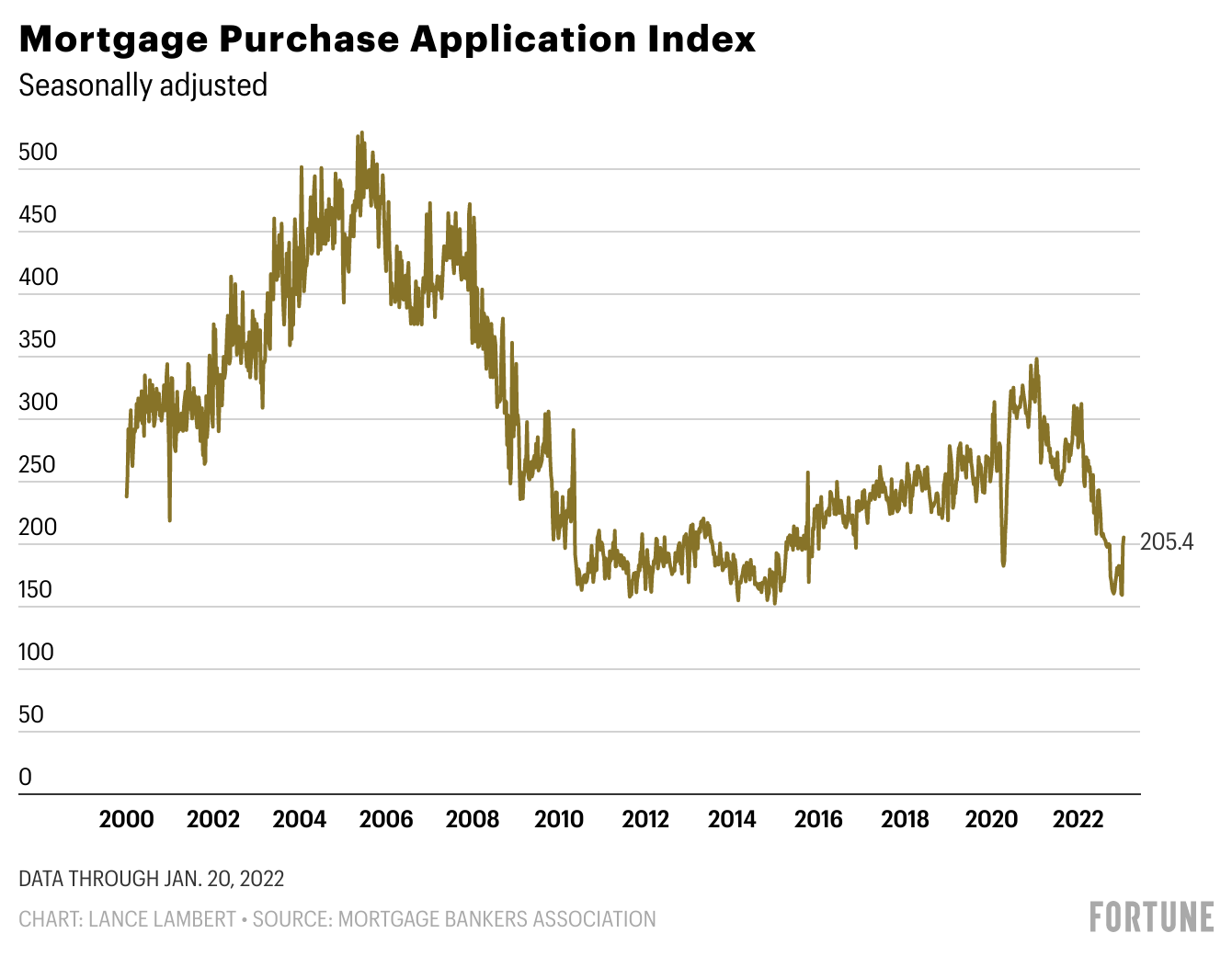
The higher borrowing costs and high home prices have led to an affordability crunch and a major “reset” in the housing market. Mortgage purchase applications were down 39% from a year ago last week.
It’s not just prospective homeowners who are feeling shut out—institutional real estate investors are feeling the pain from rising interest rates as well, according to Jay Hatfield, founder and CEO of the investment management firm Infrastructure Capital Advisors. Higher rates and recession fears have caused lending from banks to “dry up,” he told Fortune, making acquiring new properties—and/or companies in the real estate sector—a challenge.
“There’s a little bit of private lending going on, but it’s at terms that are too onerous to do LBOs [leveraged buyouts] anymore,” he said, referring to when one company tries to buy another company using borrowed money. “And then also, the companies that were buyers like Blackstone. They’re more likely to be sellers than buyers now. So M&A activity has dried up.”
Cahn of Wealth Enhancement Group says that lenders are not only offering much higher interest rates, but they’re also doing a lot more underwriting—or research and risk assessment—before lending money to avoid default risk. He noted that it’s another example that the current freeze in some sectors of the economy is all a “reflection of what’s going on in the credit markets.”
“In 2021, and 18 months before, people were just throwing money at anything as fast as they could because there was so much cash, but in 2022, the credit markets basically froze up,” he emphasized. “And that’s why you’re seeing these industries freeze.”
The frozen economy that’s about to crack?
Will the economy slowly thaw out and avoid a recession, or are the cracks caused by rising interest rates and high inflation about to rupture? That depends on who you ask.
Cahn said his “hunch” is that we’ll have a recession “sometime in the back half of 2023. “I think it’s really, you know, maybe 2024, before we’re back in business as usual,” he said.
He’s not the only one with a pessimistic outlook. Many top investment banks are forecasting a “mild recession” this year, and some forecasters have argued that “severe recession” or even “another variant of a Great Depression” could be on the way.
“We’re definitely going to enter into a harder and harder period from an economic and macro standpoint, that may be a capital “R” recession or lowercase “r” recession, but it’s going to be bad,” Allin said.
While many experts believe a recession is on the way, some argue it won’t be as devastating as past downturns, and the frozen sectors of the economy will begin to unfreeze by the end of 2023 and into 2024. Infrastructure Capital Advisors’ Hatfield said that by the second half of this year “we’ll have a more normal IPO market and a recovery M&A and stock market.”
He argued that “post pandemic tailwinds” have kept the labor market healthy—particularly in the services sector where so many businesses struggled to find workers during the pandemic—and without wide-spread layoffs that crush consumer spending, it’s unlikely there will be a serious downturn in the economy. He also noted that despite the rapid rise in interest rates last year, housing inventories are near an all-time low which he believes will allow that sector to unfreeze throughout the year.
“We need the Fed to pause [interest rate hikes] though,” he said. “And we might get a negative quarter or two [of GDP], but we don’t think we’re gonna have a significant recession.”
Learn how to navigate and strengthen trust in your business with The Trust Factor, a weekly newsletter examining what leaders need to succeed. Sign up here.