There’s no doubt about it: The Pandemic Housing Boom was an inflationary engine. Elevated homebuyer demand during the pandemic simply overwhelmed inventory. It translated into fierce bidding wars and double-digit home price growth. Soaring home prices gave landlords an opening to jack up rents. It also saw builders push homebuilding to levels not seen since 2006. Of course, an elevated builder demand for steel, lumber, and refrigerators only put further stress on an already maxed out global supply chain.
In the eyes of the Fed, it’s time to stop that Pandemic Housing Boom. That’s why the Federal Reserve pulled the housing e-brake: mortgage rates.
The Fed doesn’t set mortgage rates, however, it has the levers available to put upward or downward pressure on mortgage rates. During the early weeks of the pandemic, the Fed kicked off an unprecedented bond buying spree (i.e. quantitative easing). That saw financial markets push mortgage rates to historic lows. This year, the Fed transitioned to bond selling (i.e. quantitative tightening). As a result, financial markets pushed up the average 30-year fixed mortgage rate from 3.1% to 5.7% over the past six months.
Central bankers knew what they were doing.
This swift move-up in mortgage rates has pushed the U.S. housing market—which has seen home prices spike 39.8% since March 2020—into a full-blown housing correction. Those higher mortgage rates mean that homebuyers are finally feeling the full-brunt of record home price appreciation. Some borrowers—who must meet lenders’ strict debt-to-income ratios—have lost their mortgage eligibility altogether.
What does this “housing correction” mean for U.S. home prices? To find out, Fortune examined revised housing forecasts published by Capital Economics, Mortgage Bankers Association, Fannie Mae, CoreLogic, Moody’s Analytics, and Zillow. (You can read Fortune’s recent analysis on the 37 markets that would do the best if a housing crash hits—and the 11 that would fare worst here.)
Let’s start with the optimistic crowd.
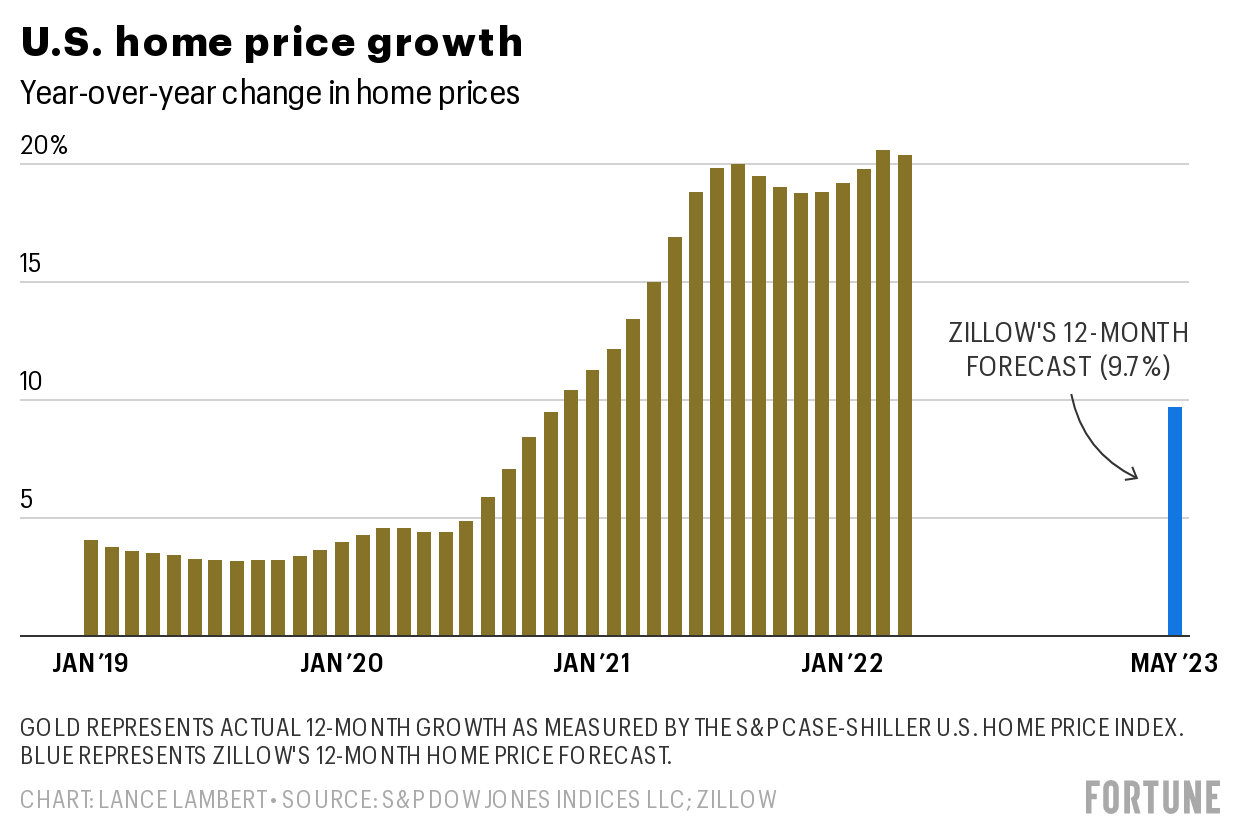
Among the six forecast models we examined, every single one predicts we’ve entered into a period of decelerating home price growth. Fortune calls it The Great Deceleration.
That said, the industry is split on where this declaration will take us. Zillow is clearly the most bullish. Between May 2022 and May 2023, Zillow predicts U.S. home prices will jump another 9.7%. While that would mark a significant deceleration from the 20.4% posted over the past year, it would hardly be a relief for buyers. After all, that would still be double the average annual home price appreciation (4.4%) posted since 1987.
“The trend appears to show that the market passed an inflection point for home values between April and May, transitioning from ever-hotter to somewhat-cooler price growth. This deceleration is a clear signal that buyers are dialing back their demand for homes in the face of daunting affordability challenges,” wrote Zillow economists in their latest outlook.
Zillow remains relatively bullish, however, we should point out this forecast also represents a huge downward revision. Just four months ago, Zillow was predicting year-over-year home price growth would hit 17.8% next year. Over just four months, Zillow has slashed its price growth outlook by 8.1 percentage points. The reason? The U.S. housing market is slowing—fast.
Zillow is clearly the only housing bull left. However, not everyone is bearish. Over the coming year, CoreLogic predicts U.S. home prices will rise 5.6%. In 2023, the Mortgage Bankers Association and Fannie Mae forecast U.S. home price growth of 3.1% and 3.2%, respectively. If any of those three forecasts come to fruition, it would mean the U.S. housing market returned to a period of normalized growth.
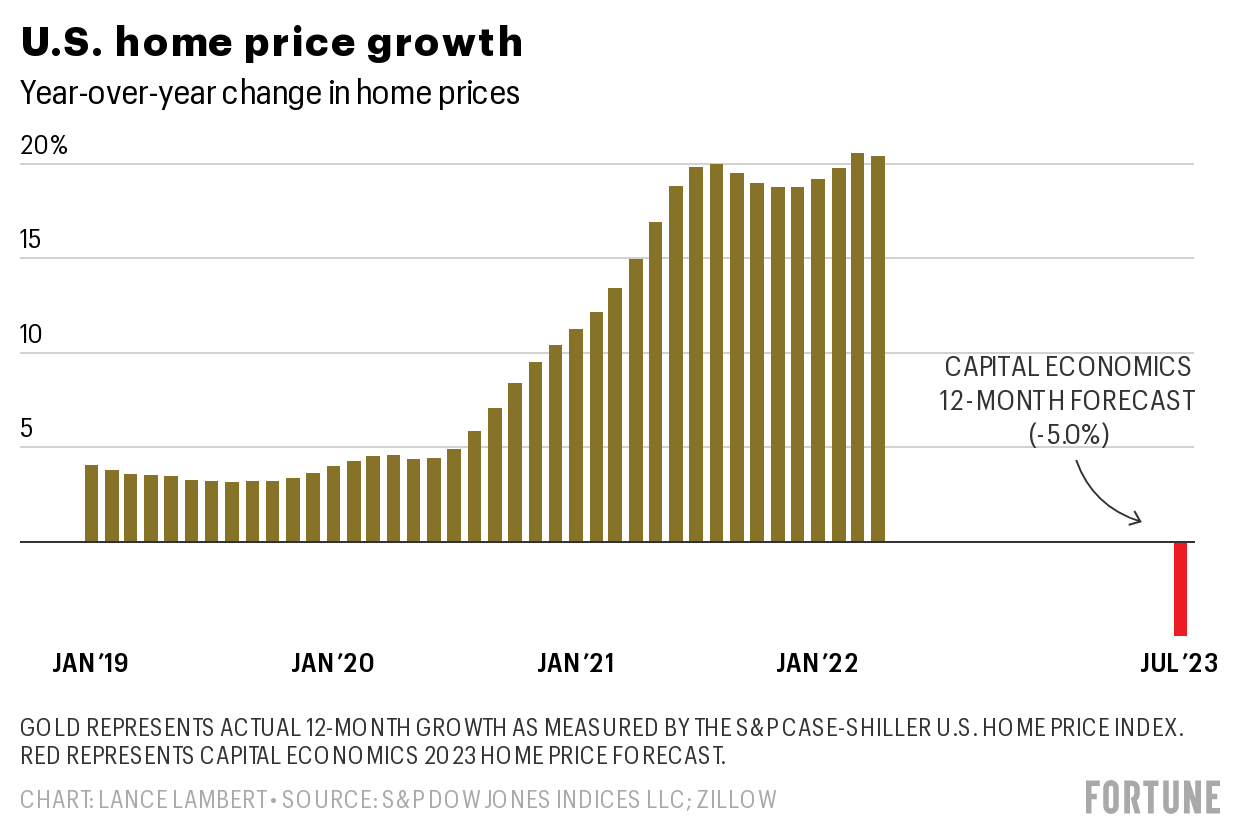
Zillow and Capital Economics don’t see eye to eye.
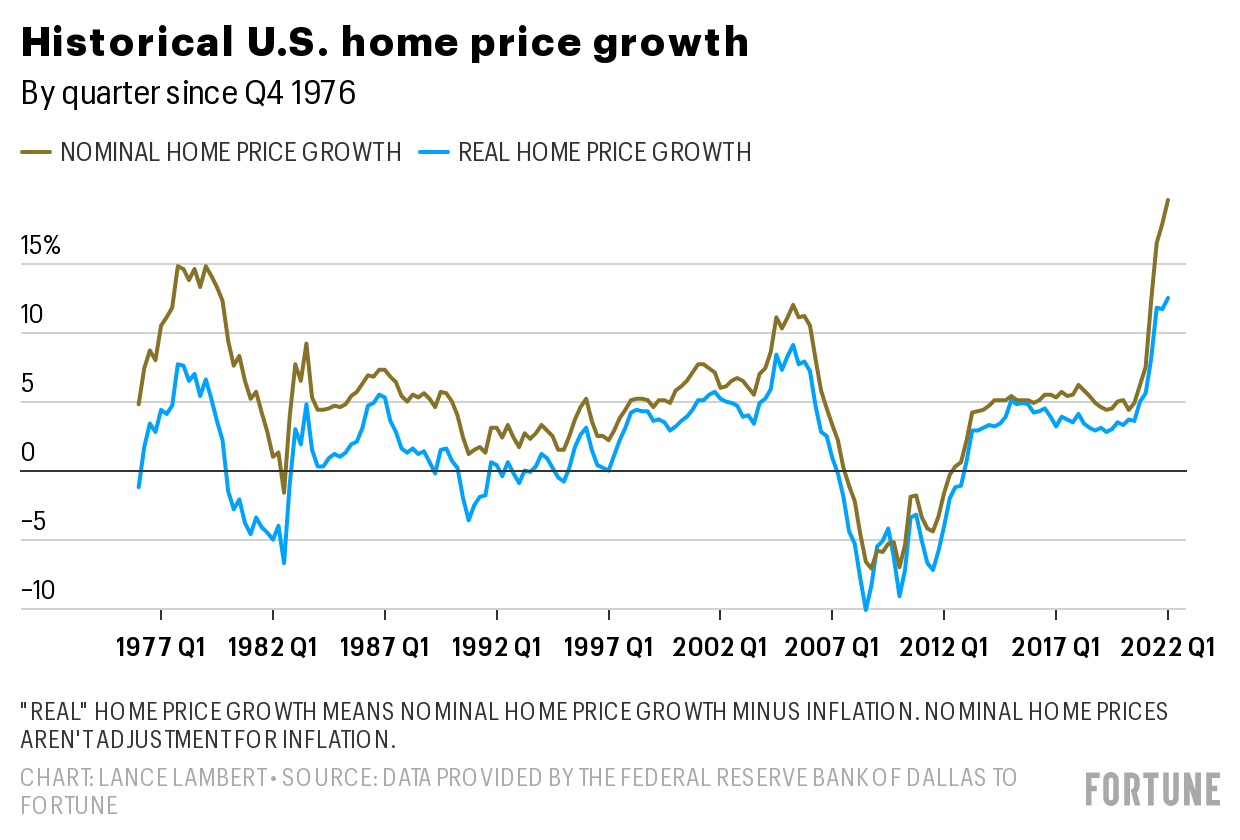
Over the coming year, Capital Economics predicts home prices will fall 5%. Historically speaking, that’s a bold prediction. Year-over-year home-price declines are incredibly rare: They have only happened twice (see below) over the past half century.
“Mortgage rates are rising and will reach 6.5% by mid-2023. As a result, mortgage payments as a share of income will exceed the peak seen in the mid-2000s. That will cut home sales, with existing sales ending 2022 more than 20% down from their end-2021 level. House prices will also decline as affordability constraints bite, but tight markets and a lack of forced sellers means we expect the drop to be relatively modest, with annual growth falling to -5% by mid-2023,” wrote Capital Economics in its latest outlook.
If home prices do indeed fall on a national basis, it would likely translate into much deeper price cuts in some regional housing markets. At least that’s according to Moody’s Analytics chief economist Mark Zandi. Over the coming year, Moody’s Analytics predicts U.S. home prices will jump 0%. However, Zandi says significantly “overvalued” housing markets—like Boise and Phoenix—should see house prices fall by 5% to 10%. But that prediction assumes no recession. If a recession hits, Moody’s Analytics predicts a 5% decline in national home prices and a 15% to 20% decline in significantly “overvalued” regional housing markets.
“The housing market has peaked. … Everything points to a rolling over of the housing market,” Zandi recently told Fortune.
These forecasts, of course, are just looking out one-year. To better understand what might lay ahead, it could be helpful to look to the past. The past does not repeat itself, but it often rhymes.
On three occasions over the past half century, U.S. home prices have become detached from underlying economic fundamentals: the ’70s housing boom, the ’00s housing boom, and the Pandemic Housing Boom. Those first two booms lead to very different outcomes.
As baby boomers aged into homeownership, the 1970s U.S. housing market went into overdrive. Throughout the decade, builders put up as many suburban homes as they could muster. It wasn’t enough. By the end of the 1970s, the supply and demand mismatch had sent U.S. home prices up a staggering 167%. That period, of course, saw something we’re seeing once again today: an inflationary wave. By the early 1980s, the Federal Reserve had tamed the inflation beast through higher interest rates. Those spiked mortgage rates—which topped out at 18% in 1981—pushed the housing market into a brief year-over-year nominal home price decline in 1982. However, it wasn’t a housing crash. Instead, the housing market was able to return to a balanced market by the mid-1980s following several years of strong income growth.
The early 2000s housing boom wasn’t as fortunate.
By summer 2006, homebuyers were finally pushing back at sky-high home prices, which had jumped 84.6% between January 2000 and July 2006. That cooling pushed the U.S. housing market into a housing correction. As that housing correction intensified, it became clear things were worse than housing economists thought: Lenders had given out subprime mortgages to borrowers who simply couldn’t afford to pay them back. Once home prices started falling in 2007, the dam broke and those mortgages went belly up. That subsequent housing market crash would see nominal home prices fall every year between 2007 and 2012.
If you’d like to stay informed on the shifting housing market, follow me on Twitter at @NewsLambert.
Sign up for the Fortune Features email list so you don’t miss our biggest features, exclusive interviews, and investigations.