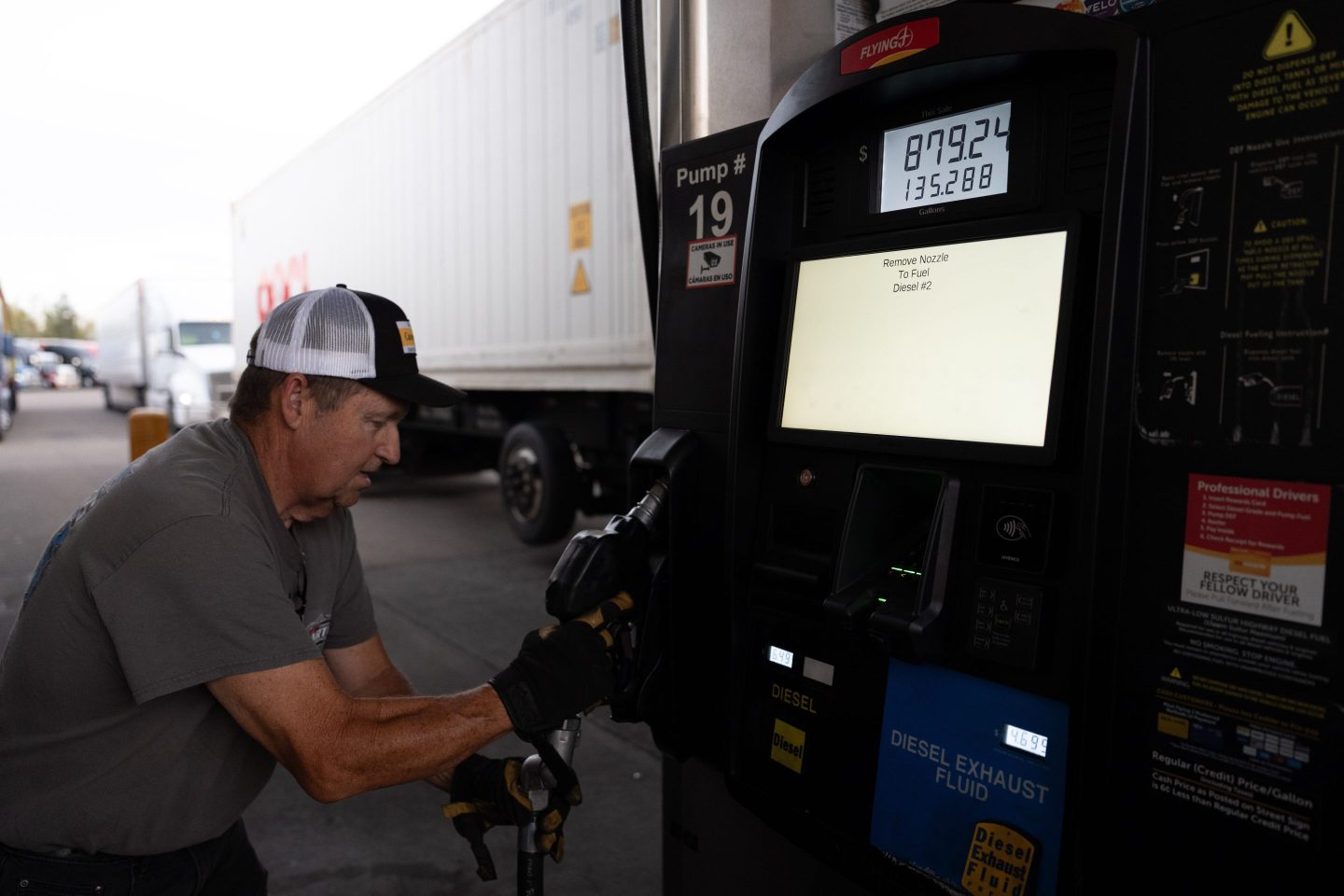
Record high gas prices, a red-hot housing market, and soaring stocks: it’s starting to feel a lot like 2007 again.
Millennials remember the so-called Great Recession well, not least because the massive crash of the global financial system coincided with many from the generation graduating into the jobs market.
The similarities between that era and the economy today have brought recession prognosticators out in force.
From billionaire hedge fund managers to Wall Street analysts, predictions of impending economic doom are widespread. But talking to experts—and looking closely at the data—indicates that history isn’t repeating itself.
That’s no guarantee the economy will crash or maintain its relatively smooth sailing, but it does mean that whatever happens will look entirely different. Here are the crucial differences between now and then.
The inflation risk
The biggest difference between the pre-Great Recession era and what we are seeing in the U.S. economy today is inflation. In February, the U.S. inflation rate hit 7.9% year-over-year, a four-decade high. The Great Recession, on the other hand, is now accepted as the end of the “Great Moderation,” a period of low inflation and macroeconomic stability. Although the macro part turned volatile afterward, inflation stayed ultra-low, averaging just 2.85% in 2007 and 3.84% in 2008.
“I think there’s one big difference, that in some sense may swamp everything else. And that’s the behavior of inflation,” Dr. John Weinberg, a nearly 20-year veteran of the Federal Reserve Bank of Richmond, told Fortune. “There is a risk that in order to contain inflation, the Fed is going to have to raise rates at a pace that weakens the economy.”
The Fed’s recent decision to raise interest rates to combat inflation could spark a recession, Weinberg said, noting that we haven’t seen a monetary policy-induced recession in decades.
“We’re coming out of an extended period of very low and stable inflation…So it’s hard to compare the eras without thinking about inflation and the path of monetary policy,” Weinberg said.
The ‘black swan’ of housing prices
The Great Recession is also widely accepted to be rooted in a so-called black swan event— the subprime mortgage crisis—an economic event considered so rare as to be effectively impossible to predict.
The widespread expansion of mortgage credit to borrowers with bad credit and often without proof of income was enabled by mortgage-backed securities (MBS) that repackaged risky mortgages into pools. These pools were then sold to investors, increasing overall market risk dramatically. The catch was it was considered safe because experts assured investors home prices would continue to go up, and any decline was a “black swan.”
“The enthusiasm of that market has been well documented,” Weinberg told Fortune. “Loans were widely available that only really made sense if you assumed home prices would keep rising.”
When prices did the unthinkable and fell, 23% of U.S. homeowners ended up underwater on their mortgages—meaning the value of their home was less than what they owed the bank.
Still, there are a number of similarities between the housing market of the pre-Great Recession era and today’s market.
From 2003 to the first quarter of 2007, U.S. home prices rose more than 38%. In the 12 months leading up to February 2022 alone, home prices jumped 18.8%. The obvious parallels between these periods of rapid U.S. home price growth have led some to question whether another housing crash could be on the horizon.
But there are substantial differences in this tale of two housing markets. First, there’s the overall supply of housing in America.
From 2000 to 2010, U.S homebuilders produced 27.1 million homes. The next decade, that number plunged to just 5.8 million, according to Census Bureau data. This lack of production has led to a serious supply crunch in today’s housing market. While that may not be great news for homebuyers, it does mean home prices’ current uptick may be more sustainable than what was seen in the mid-2000s.
Americans’ debt sustainability is another key difference.The debt of American households rose to nearly 100% of U.S. GDP by the fourth quarter of 2006, spurred on by record mortgage growth. These days the figure sits at around 77%, Federal Reserve data shows.
An everything bubble?
When it comes to the stock market, the similarities between 2007 and today are obvious. Both eras saw a rapid appreciation in equity prices, leading valuations to rise to near-historic levels. By some standards, stocks are now even more overvalued than they were back then, leading some experts to argue we’re experiencing an “everything bubble.”
One of the most prized measures of the stock market’s relative value is Yale economist and Nobel laureate Robert Shiller’s cyclically adjusted price-to-earnings (CAPE) ratio. Currently, the ratio stands at 36.67, while before 2008 it was measured between 25 and 27. The CAPE ratio has only ever been higher than today during the dot-com era in late 1999 and into 2000.
Still, some experts say the stock market is valued differently than it used to be.
“The growth trajectory is dramatically different today, than it was when I was covering stocks in ‘07 ahead of the financial crisis,” Wedbush tech analyst Dan Ives told Fortune. “Tech valuations relative to growth, in particular, are much cheaper today, by about 25%, than they were going back to ‘07.”
Ives argued that the financial stability of tech stalwarts, which by some estimates represent over 20% of the S&P 500, is unparalleled, noting that the Great recession was mainly a “black swan driven event.”
“Many have yelled fire in a crowded theater for the last 15 years,” Ives added.
Never miss a story: Follow your favorite topics and authors to get a personalized email with the journalism that matters most to you.