The flaming-hot housing market has seen median home prices soar an unprecedented 24% since the outbreak of the virus last year. But in recent weeks, that fire has lost some of its heat as buyers finally start to push back at sky-high prices. Simply put: The housing market is slowing a bit.
Already, a growing list of doomsayers point to the shifting market as taking us one step closer to a bursting housing bubble. In their minds, housing went up too fast and now must come back down. Investor Peter Boockvar chimed in last week on CNBC: “I feel bad for the people who bought homes over the past year because they’re the ones that paid the very elevated prices.”
But what does the data say? When you look under the hood, the run-up to 2008 housing bubble and the hot 2021 housing market are very different bull markets. While there are several reasons why our latest frenzy won’t result in a bust, there’s one reason in particular that really stands out.
Before we get to the answer, we need to look back at the last crash.
In the years leading up to the financial crisis, a complete and utter frenzy overtook the housing market. Ready to profit, homebuilders went on a building spree. It meant that once the market started to slow in 2006, the surplus of new constructions quickly put negative pressure on prices. The housing supply glut only got worse when underwater borrowers foreclosed. It took years for housing to shake that glut.
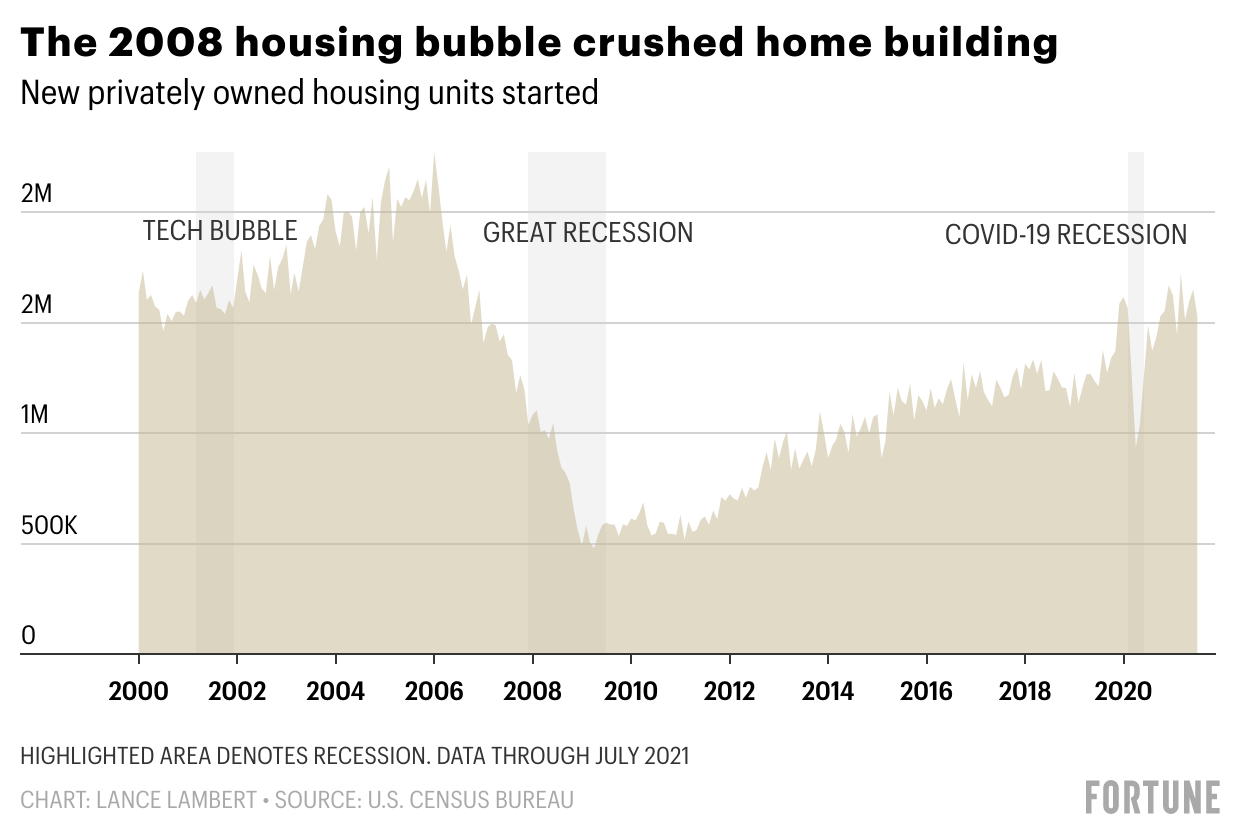
How does that compare with 2021? Well, they’re very different—almost polar opposites. Burned by the 2008 crisis, homebuilders have been extremely conservative in recent years. In the eight years leading up to the Great Recession, homebuilders averaged 1.7 million monthly housing starts. Meanwhile, over the past eight years (2013 to 2021) they’ve averaged just 1.2 million per month. The problem? Recent levels of building aren’t growing fast enough to keep up with population growth. Indeed, our nation is under-built by about 3.8 million single-family homes, according to Freddie Mac.
Timid levels of building coupled with strong demand is why housing inventory—the number of homes for sale—was falling even before the pandemic. The rush of buyers into the market during the pandemic only made matters worse. Between April 2020 to April 2021, housing inventory fell over 50%. Though it has since ticked up, we’re still near a 40-year low.

This is a long-winded way of saying a supply glut is unlikely to return anytime soon. That’s the No. 1 reason a housing market crash is unlikely. Sure, price growth could go flat or even fall without a supply glut—but a 2008-style crash is improbable without it.
CoreLogic, a real estate research firm, forecasts just a 3.2% appreciation coming in the next 12 months. But let’s say CoreLogic is wrong, and prices fall a bit. In that scenario, sidelined buyers—who got worn down after losing bidding war after bidding war in 2021—could rush back into the market. Of course, that would halt a big upswing in supply.
“The fed-up shoppers have seen how much prices have risen and how quickly and don’t feel comfortable jumping in at today’s levels,” Ali Wolf, chief economist at Zonda, a housing market research firm, told Fortune. “These shoppers play an important role as the housing market softens a bit. If some of them jump in as the market slows, they could put a floor on how much the market softens. The buyers on the sidelines now can actually help extend the life of the housing cycle.”
Even with the recent cooling, the market still has a lot going for it. As Fortune has previously reported, we’re in the middle of the five-year period during which the largest tranche of millennials, those born between 1989 and 1993, are hitting their thirties—the age when first-time homebuying really kicks into gear.
Another reason a crash is unlikely: When factoring in income levels, housing costs are lower now than heading into 2008. Leading up to the foreclosure crisis, 7.2% of U.S. personal income was going toward mortgage payments. In 2021, that figure is just 3.4%. In part, homebuyers have the pandemic to thank: It spurred low interest rates and lowered mortgage and PMI (private mortgage insurance) payments.
That said, there are two big wild cards. If inflation fears cause the Federal Reserve to move up its timeline on higher rates, it would have an instant negative effect on the market. The second risk is posed by the wind down at the end of September of the mortgage forbearance program, which allows some borrowers to pause their payments. The program still protects 1.7 million borrowers. Of course, if those buyers face foreclosure or simply opt to sell rather than restart payments, then it could cause the number of homes for sale to rise. But even that is unlikely to create a supply glut: An analysis done by Home.LLC for Fortune forecasts the end of mortgage forbearance would only cause a temporary 11% rise in inventory.
More finance coverage from Fortune:
- “Active ETFs”: Inside the booming (and potentially profitable) new investing trend
- These are the most overvalued housing markets in the U.S.
- He’s just 12 years old and has already made over $350,000 selling NFTs
- Silicon Valley’s Long-Term Stock Exchange finally lists its first companies: Twilio and Asana
- Saudi Aramco is the world’s most profitable oil giant. For investors, it’s one big yawn
Subscribe to Fortune Daily to get essential business stories straight to your inbox each morning.