
This story is part of The Path to Zero, a series of special reports on how business can lead the fight against climate change. This quarter’s stories go in-depth on sustainability in supply chains.
As President Joe Biden and other world leaders assembled for the G7 meeting in Cornwall, in the U.K., in June they were confronted with Mount Recyclemore, a huge sculpture of their faces made entirely out of electronic waste. The aim, said artist Joe Rush, was to draw attention to the huge global e-waste crisis not just as a problem for politicians to solve but “a problem that the human race has to deal with.”
That includes the tech companies that produce the devices fueling this crisis, from smartphones and wearables to TVs, electric vehicles, laptops, flashlights, and tablets. Electronics are making their way into a growing wave of products, leading to a tide of toxic waste as devices break, are discarded, or are deemed outdated.
E-waste is the fastest-growing domestic waste stream on earth, with the world generating a record 53.6 million metric tons of e-waste in 2019, according to a UN report published last year. And while the latest UN report published in June projected a 6.4% decline in sales-related e-waste for 2020, as purchases of electronics went down, this drop is expected to be temporary.
As we return to business as usual, e-waste is projected to grow almost 40% by 2030.
Big tech companies—some of which have pledged to become carbon neutral and zero waste by 2030—know the problem of e-waste is not going away, with climate, environmental, health, and reputational liability making it more acute. Many have made strides in recent years to develop policies to tackle the problem, often framed in the language of “circular economy,” meaning supply chains move from a linear “take, make, and dispose” approach to one based on keeping resources in use for as long as possible.
But as companies continue to pump out new products and make it difficult for people to repair or even continue to use older devices, campaigners say much bolder action is needed—not just from companies themselves but from governments too.
“Corporations make a lot of promises, and they’re voluntary promises,” said Scott Cassel, founder of the nonprofit Product Stewardship Institute. They don’t tend to be effective or bring the rest of the industry along, he said, unless they are part of legislation that clearly sets out companies’ responsibility for the life cycle of their products.
Electronic products often have relatively short life spans. Smartphones, for example, last on average between two and three years, in part because tech companies’ frequent new product launches entice people to upgrade. In 2020, Apple released five new versions of the iPhone, while Samsung came out with 15.
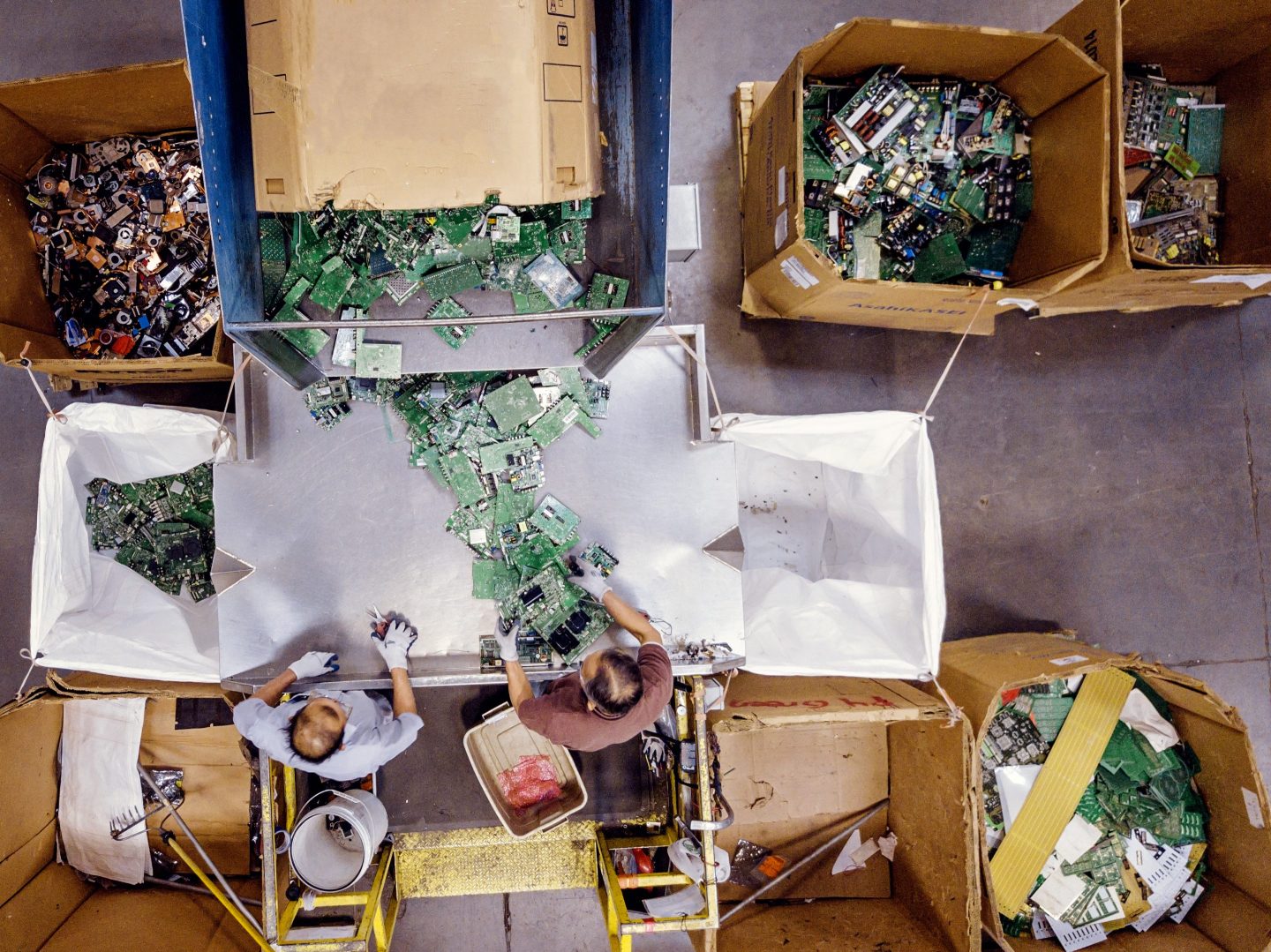
The switch to 5G is projected to increase this churn as people ditch old devices for ones that are 5G compatible. “It’s going to be a bigger turnover of electronics than when we went from analogue to digital, or we went from black and white to color,” said John Shegerian, cofounder and CEO of ERI, the biggest electronics recycler in the U.S. “It all has to be responsibly recycled.”
While e-waste has boomed, only 17.4% of it was recycled globally in 2019. In the U.S., the rate was 15%. The rest is often sent to landfills, leaching toxic chemicals into the soil and water, or it’s incinerated. Wealthy countries still export e-waste to lower-income countries, where it either ends up in landfills or part of informal recycling systems, putting workers’ health at risk.
Electronics contain precious metals such as silver, gold, and platinum along with rare earth elements including yttrium and neodymium. Mining for these metals creates pollution and emissions, and can involve human rights abuses, including child labor. Failure to recycle is also a lost economic opportunity; the UN values total recoverable materials for e-waste at around $57 billion.
Recycling commitments are often the centerpiece of tech companies’ e-waste policies. Many, including Amazon, Dell, Microsoft, and Apple, have take-back programs allowing consumers to send back old devices to be reused or recycled.
Companies are also incorporating more recycled materials. From 2022, Google said, 100% of products it launches will include recycled materials beyond just plastics. Amazon’s new Echo, Fire TV, and tablets include recycled plastic and aluminum. Dell has pledged that by 2030 more than half of the materials it uses in its products will be recycled or renewable, and for each product it sells, it aims to reuse or recycle an equivalent product. And Microsoft said it plans to increase its use of recycled aluminum and make its Surface devices 100% recyclable by 2030.
Apple has gone further, aiming to end its reliance on mining altogether. The company, which sells around 200 million iPhones a year, made the iPhone 12 with almost 100% recycled rare earth elements and aims “to one day” use only recycled or renewable materials in its products. It also created a robot called Daisy, which dismantles around 200 different smartphones an hour to extract metals for recycling.
Recycling, however, is only one part of the story, said Jim Puckett of the nonprofit Basel Action Network, which campaigns against the export of toxic waste. True sustainability means “you turn off the tap of waste,” he said, “not just find a new place for the waste.”

Design for longevity is a big piece of this puzzle. Dell said its products are increasingly modular and use minimal adhesive to make it easier to disassemble and repair them. But many devices still have glued-in batteries or parts soldered together, making them all but impossible to fix.
“It’s patently absurd that you would spend $800 on a supersophisticated piece of electronics that has almost no moving parts,” said Nathan Proctor, of the nonprofit U.S. Public Research Interest Group. He is part of the “right to repair” movement, which argues that until companies give consumers and independent repair outlets the tools, manuals, and other information to repair devices, the e-waste problem won’t be cracked.
Dell is one of very few big companies that make most repair information available online, said Proctor. Many others, such as Microsoft and Apple, cite a commitment to increasing repairability and expanding the number of independent repair outlets. But campaigners argue this means little while tech companies continue to lobby against right-to-repair legislation on the basis it would compromise safety and data privacy. Nearly 30 states considered right-to-repair bills in 2021, but more than half have been quashed, according to a Bloomberg analysis.
Proctor hopes a Federal Trade Commission report in May, which found “scant evidence to support manufacturers’ justifications for repair restrictions,” will increase pressure on companies to make repair easier.
For some experts only a business model change will incentivize companies to increase the life of their products. If consumers leased devices rather than buying them outright, said Puckett, companies would be motivated to design beautiful, durable, upgradeable products. He believes a lease-based market will emerge: “It’s just a question of who’s going to take the leap first.”
The industry is “recognizing the importance and the value of the circular economy,” said Vanessa Gray of the International Telecommunication Union, “but it’s still not sufficient.” She called for more collaboration.
In March 2021, companies including Google, Dell, and Microsoft, together with the World Business Council for Sustainable Development (WBCSD) and others, launched the Circular Electronics Partnership. The aim is to work together to develop a road map to reach a circular economy for electronics by 2030, including improving recycling, increasing take-back schemes, and prioritizing reuse and repair.
Brendan Edgerton of the WBCSD said this pre-competitive partnership is a big move for “a historically secretive and closed industry.” Yet, as with many voluntary initiatives, there are no real accountability mechanisms or detailed pledges.
Legal frameworks to tackle e-waste are developing. By 2019, 78 countries had e-waste policies. In the U.S., while there is little at the federal level, 25 states and the District of Columbia have some form of e-waste laws. There has been more significant progress in the EU, which has “extended producer responsibility” laws, making companies responsible for the collection, recycling, and responsible end-of-life disposal of their products. It also passed a law in March requiring companies make large consumer electronics, such as fridges, repairable for up to a decade, which is expected to be extended to smartphones and laptops. More recently there have been calls for the bloc to make e-waste recycling mandatory.
“Industry is not going to solve it alone; the government is not going to solve this alone; environmental activists are not going to solve this alone,” said Cassel of the Product Stewardship Institute, noting all sectors need to acknowledge the scale of the problem. “It only works when we pull together.”
Subscribe to Fortune Daily to get essential business stories straight to your inbox each morning.