• Home
  • Latest
  • Fortune 500
  • Finance
  • Tech
  • Leadership
  • Lifestyle
  • Rankings
  • Multimedia

Trendingnow

1

'Dr. Doom' Nouriel Roubini says we're headed for universal basic income or 'some form of socialism' as AI revolutionizes work—He calls that optimistic

2

‘I want to die broke’: Billionaire philanthropist Denny Sanford dies after giving away $4 billion

3

Power companies are using eminent domain to seize land for data centers as 70% of Americans say not in my backyard

1

'Dr. Doom' Nouriel Roubini says we're headed for universal basic income or 'some form of socialism' as AI revolutionizes work—He calls that optimistic

2

‘I want to die broke’: Billionaire philanthropist Denny Sanford dies after giving away $4 billion

3

Power companies are using eminent domain to seize land for data centers as 70% of Americans say not in my backyard
EuropeGreenland
Europe

Americans have been quietly plundering Greenland for over 100 years, since a Navy officer chipped fragments off the Cape York iron meteorite

By
Paul Bierman
Paul Bierman
and
The Conversation
The Conversation
Down Arrow Button Icon
By
Paul Bierman
Paul Bierman
and
The Conversation
The Conversation
Down Arrow Button Icon
January 14, 2026, 5:20 PM ET
greenland
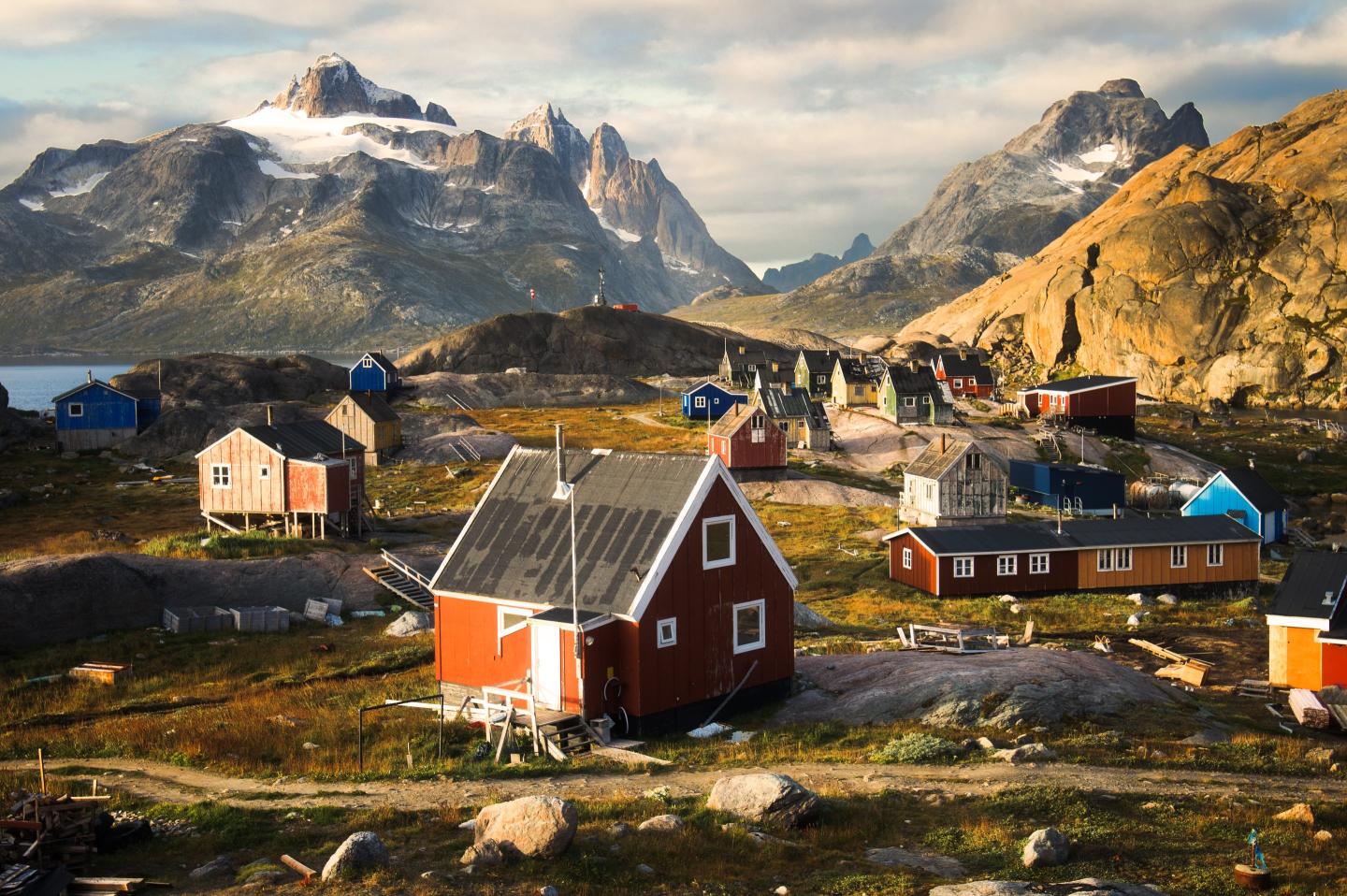
Greenland has long been of interest to Americans.Getty Images
Add Fortune on Google for similar content.

President Donald Trump’s insistence that the U.S. will acquire Greenland “whether they like it or not” is just the latest chapter in a codependent and often complicated relationship between America and the Arctic’s largest island – one that stretches back more than a century but has recently been on the rocks.

Recommended Video

On Jan. 14, 2026, U.S., Danish and Greenlandic officials met at the White House to discuss Trump’s comments. The foreign minister of Denmark later told reporters that while the two sides had a “fundamental disagreement,” they would “continue to talk.” In Congress, Republican Sen. Mitch McConnell also criticized Trump’s threats, saying seizing Greenland would mean “incinerating the hard-won trust of loyal allies in exchange for no meaningful change in U.S. access to the Arctic.”

Although Americans have long pursued policies in Greenland that U.S. leaders considered strategic and economic imperatives, Trump’s approach is more agressive than any previous president. As I recounted in my 2024 book, “When the Ice is Gone,” about Greenland’s environmental, military and scientific history, some prior American ideas for Greenland were little more than engineering fantasies, while others reflected unfettered military bravado.

A person stands next to a sled and dog team looking at a large radar installation.
Inuit and their dog team stand in front of a U.S. military radar installation at Thule, Greenland, that scanned the skies for Soviet bombers and missiles during the Cold War. More than 100 native Inuit were removed from their land during base construction. NF/SCANPIX/AFP via Getty Images

But today’s world isn’t the same as when the United States last had a significant presence in Greenland, decades ago during the Cold War.

Before charging headlong into this icy island again, the U.S. would be remiss not to learn from past failures and consider how Earth’s rapidly changing climate is fundamentally altering the region.

Early U.S. plundering of Greenland’s metals

In 1909, Robert Peary, a U.S. Navy officer, announced that he had won the race to the North Pole – a spectacular claim debated fiercely at the time. Before that, Peary had spent years exploring Greenland by dogsled, often taking what he found.

In 1894, he convinced six Greenlanders to come with him to New York, reportedly promising them tools and weapons in return. Within a few months, all but two of the Inuit had died from diseases.

A man stands beside a very large rock almost as tall as he is
People moved the 34-ton Cape York meteorite fragment named Ahnighito from the Greenland coast to Robert Peary’s ship, which took it to New York in 1897. Account Of The Discovery And Bringing Home Of The ‘Saviksue’ or Great Cape York Meteorites. New York 1898/Wikimedia Commons

Peary also took three huge fragments of the Cape York iron meteorite, known to Greenlanders as Saviksoah. It was a unique source of metal that Greenlandic Inuit had used for centuries to make tools. The largest piece of the meteorite, Ahnighito, weighed 34 tons. Today, it sits in the American Museum of Natural History, which reportedly paid Peary $40,000 for the space rocks.

World War II: Strategic location and minerals

World War II put Greenland on the map strategically for the U.S. military. In spring 1941, Denmark’s ambassador signed a treaty giving the U.S. military access to Greenland to help protect the island from Nazi Germany and contribute to the war effort in Europe. That treaty remains in effect today.

The new American bases in western and southern Greenland became crucial refueling stops for planes flying from America to Europe.

An illustration of Uncle Sam pounding a sign into Greenland labeled 'Keep Out!' with a tiny drawing of Adolf Hitler on the horizon.
A political cartoon by Herbert L. Block, published in April 1941, shortly after a treaty authorized the U.S. to build military bases in Greenland. A Herblock Cartoon, © The Herb Block Foundation

Hundreds of American soldiers were garrisoned at Ivittuut, a remote town on the southern Greenland coast where they protected the world’s largest cryolite mine. The rare mineral was used for smelting aluminum, critical for building airplanes during the war.

And because Greenland is upwind from Europe, weather data collected on the island proved essential for battlefield forecasts as officers planned their moves during World War II.

A view across the water to a small mining outpost.
The Ivittuut cryolite mine in southwestern Greenland, shown in 1940. U.S. troops guarded the mine, essential for aluminum production, during World War II. U.S. Coast Guard via Wikimedia Commons

Both the Americans and Germans built weather stations on Greenland, starting what historians refer to as the weather war. There was little combat, though allied patrols routinely scoured the east coast of the island for Nazi encampments. The weather war ended in 1944 when the U.S. Coast Guard, and its East Greenland dogsled patrol, found the last of four German weather stations and captured their meteorologists.

Men holds their hands in the air in surrender while soldiers point guns at them.
American soldiers capture members of Germany’s Edelweiss II weather station in northeastern Greenland in 1944. U.S. Coast Guard via Wikimedia Commons

Cold War: Fanciful engineering ideas vs the ice

The heyday of U.S. military engineering dreams in Greenland arrived during the Cold War in the 1950s.

To counter the risk of Soviet missiles and bombers coming over the Arctic, the U.S. military transported about 5,000 men, 280,000 tons of supplies, 500 trucks and 129 bulldozers, according to The New York Times, to a barren, northwest Greenland beach – 930 miles (1,500 kilometers) from the North Pole and 2,752 miles (4,430 kilometers) from Moscow.

There, in one top-secret summer, they built the sprawling American air base at Thule. It housed bombers, fighters, nuclear missiles and more than 10,000 soldiers. The whole operation was revealed to the world the following year, on a September 1952 cover of LIFE magazine and by the U.S. Army in its weekly television show, “The Big Picture.”

Trucks packed into a ship arrive with the ocean in the background.
A wave of U.S. military engineers lands on the shores of northwestern Greenland to build Thule Airbase in summer 1951. Keystone-France/Gamma-Keystone via Getty Images

But in the realm of ideas born out of paranoia, Camp Century and Project Iceworm were the pinnacle.

The U.S. Army built Camp Century, a nuclear-powered base, inside the ice sheet by digging deep trenches and then covering them with snow. The base held 200 men in bunkrooms heated to 72 degrees Fahrenheit (22 Celsius). It was the center of U.S. Army research on snow and ice and became a reminder to the USSR that the American military could operate at will in the Arctic.

Military engineers building Camp Century wear parkas and stand in a tunnel wide enough to drive a truck through.
Metal arches placed over trenches cut into the snow-formed roofs at Camp Century. The arches were covered with snow and ice, removed, and reused. A similar idea had been planned for rail lines through the ice. U.S. Army Corps of Engineers, 1960
Trucks are parked outside the partially buried Camp Century.
An aerial view shows Camp Century, which was powered by a portable nuclear reactor. US Army

The Army also imagined hundreds of miles of rail lines buried inside Greenland’s ice sheet. On Project Iceworm’s tracks, atomic-powered trains would move nuclear-tipped missiles in snow tunnels between hidden launch stations – a shell game covering an area about the size of Alabama.

In the end, Project Iceworm never got beyond a 1,300-foot (400-meter) tunnel the Army excavated at Camp Century. The soft snow and ice, constantly moving, buckled that track as the tunnel walls closed in. In the early 1960s, first the White House, and then NATO, rejected Project Iceworm.

A truck between walls carved in ice
A U.S. Army truck with railroad wheels sits on a 1,300-foot-long track beneath the snow at Camp Century, Greenland. This is the closest the military got to realizing Project Iceworm. Robert W. Gerdel Papers, Ohio State University

In 1966, the Army abandoned Camp Century, leaving hundreds of tons of waste inside the ice sheet. Today, the crushed and abandoned camp lies more than 100 feet (30 meters) below the ice sheet surface. But as the climate warms and the ice melts, that waste will resurface: millions of gallons of frozen sewage, asbestos-wrapped pipes, toxic lead paint and carcinogenic PCBs.

Who will clean up the mess and at what cost is an open question.

Greenland remains a tough place to turn a profit

In the past, the American focus in Greenland was on short-term gains with little regard for the future. Abandoned bases, scattered around the island today and in need of cleanup, are one example. Peary’s disregard of the lives of local Greenlanders is another.

History shows that many of the fanciful ideas for Greenland failed because they showed little consideration of the island’s isolation, harsh climate and dynamic ice sheet.

Large rusted construction trucks and some fuel drums.
World War II-vintage trucks abandoned at a U.S. airfield in east Greenland were still there decades later. Posnov/Moment via Getty Images

Trump’s demands for American control of the island as a source of wealth and U.S. security are similarly shortsighted. In today’s rapidly warming climate, disregarding the dramatic effects of climate change in Greenland can doom projects to failure as Arctic temperatures climb.

Recent floods, fed by Greenland’s melting ice sheet, have swept away bridges that had stood for half a century. The permafrost that underlies the island is rapidly thawing and destabilizing infrastructure, including the critical radar installation and runway at Thule, renamed Pituffik Space Base in 2022. The island’s mountain sides are crashing into the sea as the ice holding them together melts.

The U.S. and Denmark have conducted geological surveys in Greenland and pinpointed deposits of critical minerals along the rocky, exposed coasts. However, most of the mining so far has been limited to cryolite and some small-scale extraction of lead, iron, copper and zinc. Today, only one small mine extracting the mineral anorthosite, which is useful for its aluminum and silica, is running.

It’s the ice that matters

The greatest value of Greenland for humanity is not its strategic location or potential mineral resources, but its ice. https://www.youtube.com/embed/9lnP0Rjb2E0?wmode=transparent&start=0 A NASA animation of satellite data shows Greenland’s ice sheet mass losses between 2002 and 2023, measured in meters of water equivalent in the ice.

If human activities continue to heat the planet, melting Greenland’s ice sheet, sea level will rise until the ice is gone. Losing even part of the ice sheet, which holds enough water to raise global sea level 24 feet in all, would have disastrous effects for coastal cities and island nations around the world.

That’s big-time global insecurity. The most forward-looking strategy is to protect Greenland’s ice sheet rather than plundering a remote Arctic island while ramping up fossil fuel production and accelerating climate change around the world.

Paul Bierman, Professor of Natural Resources and Environmental Science, University of Vermont

This article is republished from The Conversation under a Creative Commons license. Read the original article.

The Conversation
About the Authors
By Paul Bierman
See full bioRight Arrow Button Icon
By The Conversation
See full bioRight Arrow Button Icon
Add Fortune on Google for similar content.

Latest in Europe

Finance
Lorem ipsum dolor sit amet, consectetur adipiscing elit, sed do eiusmod tempor incididunt ut labore et dolore magna aliqua. Ut enim ad minim veniam
By Fortune Editors
October 20, 2025
Finance
Lorem ipsum dolor sit amet, consectetur adipiscing elit, sed do eiusmod tempor incididunt ut labore et dolore magna aliqua. Ut enim ad minim veniam
By Fortune Editors
October 20, 2025
Finance
Lorem ipsum dolor sit amet, consectetur adipiscing elit, sed do eiusmod tempor incididunt ut labore et dolore magna aliqua. Ut enim ad minim veniam
By Fortune Editors
October 20, 2025
Finance
Lorem ipsum dolor sit amet, consectetur adipiscing elit, sed do eiusmod tempor incididunt ut labore et dolore magna aliqua. Ut enim ad minim veniam
By Fortune Editors
October 20, 2025
Finance
Lorem ipsum dolor sit amet, consectetur adipiscing elit, sed do eiusmod tempor incididunt ut labore et dolore magna aliqua. Ut enim ad minim veniam
By Fortune Editors
October 20, 2025
Finance
Lorem ipsum dolor sit amet, consectetur adipiscing elit, sed do eiusmod tempor incididunt ut labore et dolore magna aliqua. Ut enim ad minim veniam
By Fortune Editors
October 20, 2025

Most Popular

Finance
Lorem ipsum dolor sit amet, consectetur adipiscing elit, sed do eiusmod tempor incididunt ut labore et dolore magna aliqua. Ut enim ad minim veniam
By Fortune Editors
October 20, 2025
Finance
Lorem ipsum dolor sit amet, consectetur adipiscing elit, sed do eiusmod tempor incididunt ut labore et dolore magna aliqua. Ut enim ad minim veniam
By Fortune Editors
October 20, 2025
Finance
Lorem ipsum dolor sit amet, consectetur adipiscing elit, sed do eiusmod tempor incididunt ut labore et dolore magna aliqua. Ut enim ad minim veniam
By Fortune Editors
October 20, 2025
Finance
Lorem ipsum dolor sit amet, consectetur adipiscing elit, sed do eiusmod tempor incididunt ut labore et dolore magna aliqua. Ut enim ad minim veniam
By Fortune Editors
October 20, 2025
Finance
Lorem ipsum dolor sit amet, consectetur adipiscing elit, sed do eiusmod tempor incididunt ut labore et dolore magna aliqua. Ut enim ad minim veniam
By Fortune Editors
October 20, 2025
Finance
Lorem ipsum dolor sit amet, consectetur adipiscing elit, sed do eiusmod tempor incididunt ut labore et dolore magna aliqua. Ut enim ad minim veniam
By Fortune Editors
October 20, 2025
Fortune Secondary Logo
Rankings
  • 100 Best Companies
  • Fortune 500
  • Global 500
  • Fortune 500 Europe
  • Most Powerful Women
  • World's Most Admired Companies
  • See All Rankings
  • Lists Calendar
Sections
  • Finance
  • Fortune Crypto
  • Features
  • Leadership
  • Health
  • Commentary
  • Success
  • Retail
  • Mpw
  • Tech
  • Lifestyle
  • CEO Initiative
  • Asia
  • Politics
  • Conferences
  • Europe
  • Newsletters
  • Personal Finance
  • Environment
  • Magazine
  • Education
Customer Support
  • Frequently Asked Questions
  • Customer Service Portal
  • Privacy Policy
  • Terms Of Use
  • Single Issues For Purchase
  • International Print
Commercial Services
  • Advertising
  • Fortune Brand Studio
  • Fortune Analytics
  • Fortune Conferences
  • Business Development
  • Group Subscriptions
About Us
  • About Us
  • Press Center
  • Work At Fortune
  • Terms And Conditions
  • Site Map
  • About Us
  • Press Center
  • Work At Fortune
  • Terms And Conditions
  • Site Map
  • Facebook icon
  • Twitter icon
  • LinkedIn icon
  • Instagram icon
  • Pinterest icon

Latest in Europe

Volvo car CEO pushes back on Navarro’s ‘Pirate’ China comments
EuropeVolvo
Volvo car CEO pushes back on Navarro’s ‘Pirate’ China comments
By Rafaela Lindeberg and BloombergJuly 20, 2026
7 hours ago
Nestlé KitKat Original chocolate bars
RetailMarketing
How Nestlé turned a chocolate heist into a masterclass in brand building 
By Sam BirchallJuly 20, 2026
13 hours ago
The U.K. is getting a new prime minister, but bond investors are really in charge and ‘hyper-reactive,’ Wall Street veteran says
EconomyUK
The U.K. is getting a new prime minister, but bond investors are really in charge and ‘hyper-reactive,’ Wall Street veteran says
By Jason MaJuly 19, 2026
1 day ago
Esther Perel speaks on stage during a panel discussion at SXSW in London.
Workplace Culturecorporate culture
Esther Perel has a warning for executives: your workforce is suffering from social atrophy and AI is making it worse 
By Sam BirchallJuly 17, 2026
3 days ago
Europe optimized its supply chains for cost. Now it must pay for resilience  
Commentarysupply chains
Europe optimized its supply chains for cost. Now it must pay for resilience  
By Richard SaynorJuly 16, 2026
4 days ago
Rocket shortage leaves Europe defenseless in space wars
Europespace
Rocket shortage leaves Europe defenseless in space wars
By Gerry Doyle, Alan Crawford and BloombergJuly 13, 2026
7 days ago

Most Popular

'Dr. Doom' Nouriel Roubini says we're headed for universal basic income or 'some form of socialism' as AI revolutionizes work—He calls that optimistic
AI
'Dr. Doom' Nouriel Roubini says we're headed for universal basic income or 'some form of socialism' as AI revolutionizes work—He calls that optimistic
By Jason MaJuly 18, 2026
2 days ago
‘I want to die broke’: Billionaire philanthropist Denny Sanford dies after giving away $4 billion
Success
‘I want to die broke’: Billionaire philanthropist Denny Sanford dies after giving away $4 billion
By Sydney LakeJuly 20, 2026
8 hours ago
Power companies are using eminent domain to seize land for data centers as 70% of Americans say not in my backyard
AI
Power companies are using eminent domain to seize land for data centers as 70% of Americans say not in my backyard
By Aaron Walayat and The ConversationJuly 19, 2026
2 days ago
Mark Cuban says he has the solution to growing income inequality, and it's to reward every employee—from CEO to janitor—with company stock
Success
Mark Cuban says he has the solution to growing income inequality, and it's to reward every employee—from CEO to janitor—with company stock
By Sasha RogelbergJuly 20, 2026
4 hours ago
Red Lobster’s 37-year-old CEO waited tables before joining the C-suite—he says it was a crash course in managing ‘difficult people and situations’
Success
Red Lobster’s 37-year-old CEO waited tables before joining the C-suite—he says it was a crash course in managing ‘difficult people and situations’
By Preston ForeJuly 19, 2026
2 days ago
Warren Buffett says his $147 billion investing career was an accident: ‘I may be one of the 10 luckiest in the world’
Future of Work
Warren Buffett says his $147 billion investing career was an accident: ‘I may be one of the 10 luckiest in the world’
By Sarah GlodekJuly 20, 2026
15 hours ago

© 2026 Fortune Media IP Limited. All Rights Reserved. Use of this site constitutes acceptance of our Terms of Use and Privacy Policy | CA Notice at Collection and Privacy Notice | Do Not Sell/Share My Personal Information
FORTUNE is a trademark of Fortune Media IP Limited, registered in the U.S. and other countries. FORTUNE may receive compensation for some links to products and services on this website. Offers may be subject to change without notice.