
When the pandemic hit the United States in March 2020, fundraising briefly ground to a halt in Silicon Valley. “People thought there would be a strong retrenchment that was reminiscent of the dotcom era and the retrenchment of 2009,” says Pam Kostka, a Silicon Valley vet and CEO of the organization All Raise.
But that pause turned out to be short-lived. For much of the tech industry, the pandemic provided an unexpected boom as consumers and businesses flocked to work-from-home technology, delivery platforms, and other freshly relevant corners of the sector. Startups as a whole raised 13% more from venture capitalists in 2020 compared to 2019, for an annual total of $150 billion, as measured by PitchBook, a company that tracks data from the venture capital and private equity industries.
With 2020 in the rear view, one more result is clear: That boom was distributed unevenly.
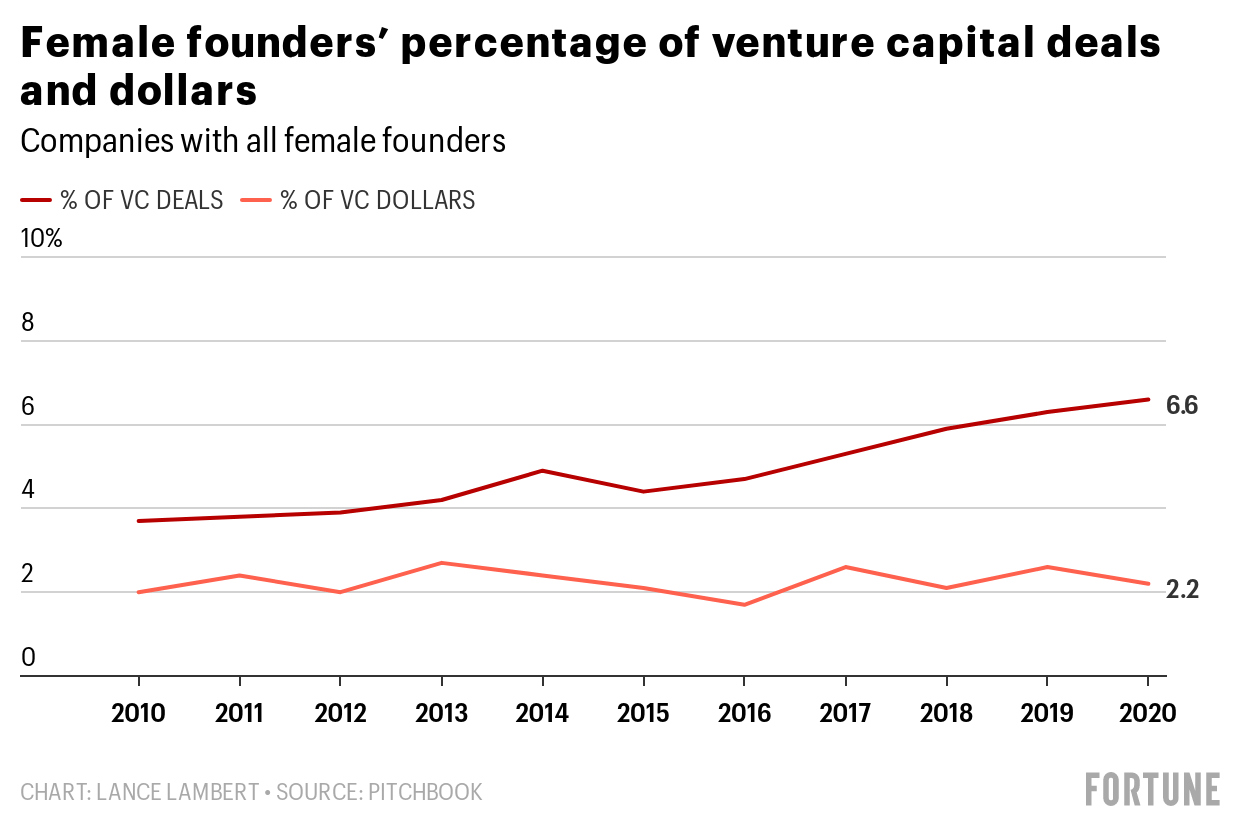
Despite the big money that flowed into startups in 2020, companies founded solely by women received less investment than in 2019, both by share of the pie and total dollars. Female-founded companies raised $3.31 billion in 2020, or 2.2% of the year’s total sum, compared to $3.5 billion and 2.6% in 2019.
The same went for mixed-gender founding teams, which raised $18 billion (12% of all VC dollars) in 2020 compared to $18.43 billion (14%) the year prior. Men’s share of the pie, meanwhile, grew from 83.5% to 85.8%, for a total of $128 billion.
Kostka, whose organization works to support gender and racial diversity among startup founders and investors, pins the blame on a different kind of retrenchment. “Networking was harder,” she explains. “There was what I call the ‘known founder effect.'”
Investors, unable to connect face-to-face with new people in 2020, put their money behind familiar founders—those already in their networks or whom they had already backed in an earlier stage (29% of all funding went to later-stage deals last year, vs. 25% in 2019). Stuck at home, investors were less likely to seek out founders beyond their immediate web, a trend that tended to disadvantage founders who are female and/or people of color.

By number of deals, female founders closed fewer transactions in 2020 (676) than in 2019 (709). That decline was in line with industry trends, as founders of all genders signed fewer deals in total—giving female founders a larger slice of the pie by this one metric. Female-only founding teams closed 6.6% of all 2020 deals, compared to 6.3% in 2019.
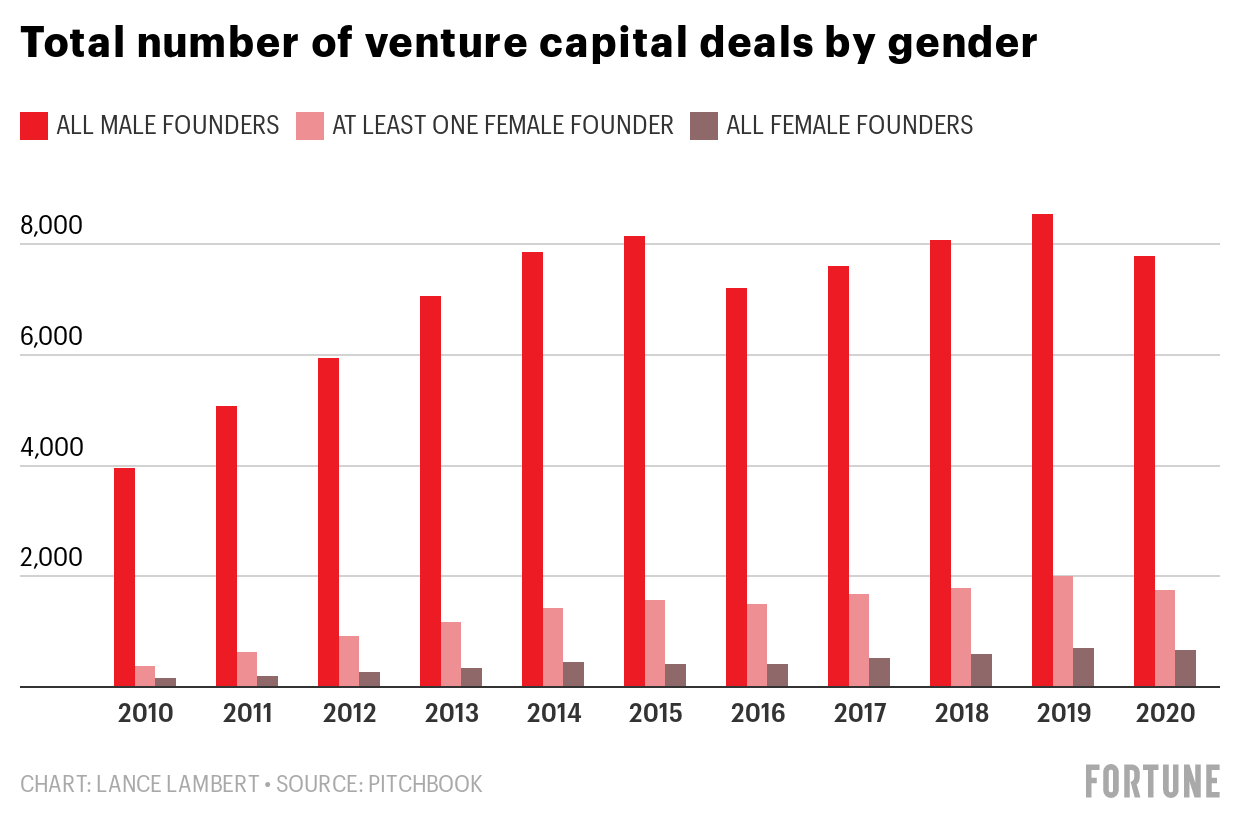
The effects of the year’s trends on female founders crystallized during the third quarter, when male-founded businesses took in the most funding of any quarter ($37 billion) and investment in female-founded businesses dropped to its second-lowest point ($630 million). That quarter may have exhibited a lag effect, Kostka says, with the results of the prior months of the pandemic—the canceled pitch meetings of March and April—bearing fruit.
Interestingly, that time of year was when the realities of the pandemic’s impact on women became clear in other segments of the economy. Some 865,000 women dropped out of the workforce in September, a month when kids returned to school remotely, triggering a widespread childcare crisis.
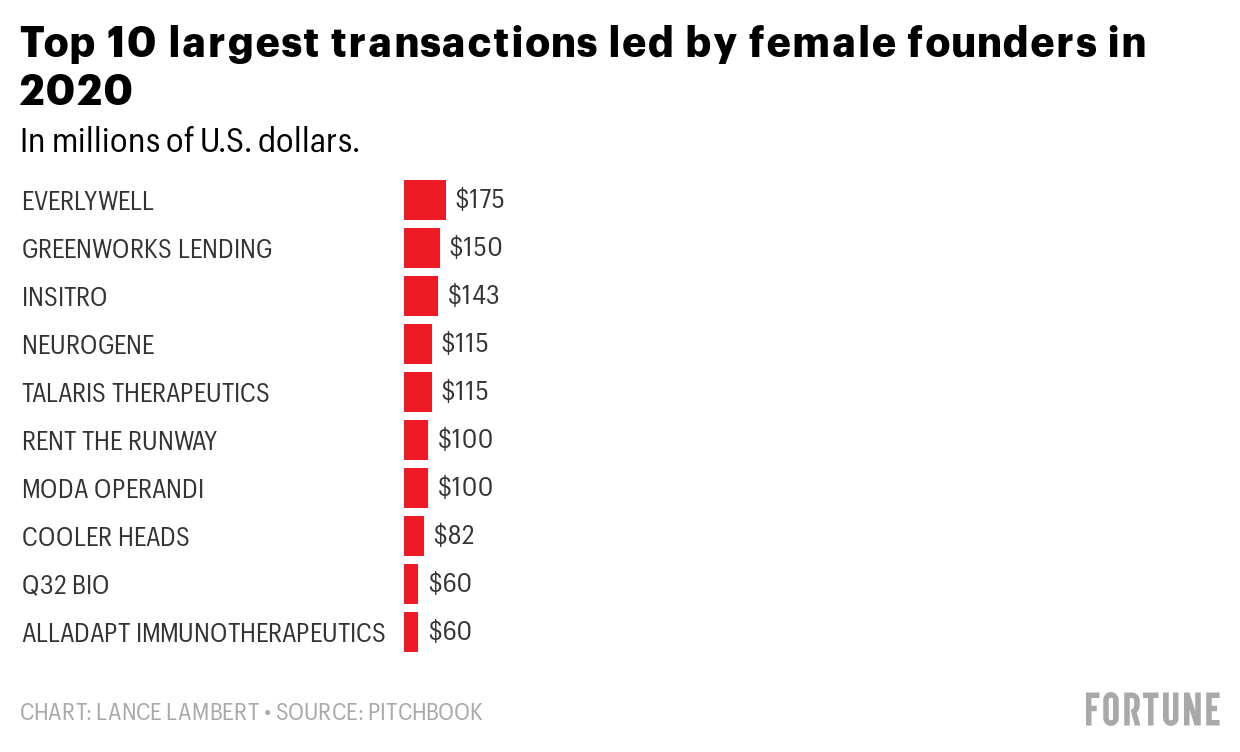
It wasn’t all bad news in 2020. Everlywell, the at-home lab-testing startup founded by CEO Julia Cheek, claimed the top deal of the year for a startup founded by a women-only team. The company, which became an early entrant in the coronavirus testing race, raised $175 million in a December Series D round.
Another notable deal in 2020 belonged to Gro Intelligence, the artificial intelligence analytics platform for the agriculture industry cofounded by CEO Sara Menker. Menker in December raised an $85 million Series B round—one of the largest ever raised by a Black female founder. Menker has two cofounders, Sewit Ahderom and Nemo Semret, so the deal falls into the category of mixed-gender founding teams. (The round was announced in January 2021, but closed in December, per PitchBook.)
And All Raise, a nonprofit, raised funding of its own to support its mission to diversify Silicon Valley—$11 million in November.
As evidenced by Everlywell and Gro Intelligence, the year’s top deals for female founders leaned away from consumer businesses, which have dominated the top 10 in recent years. Kostka’s feelings on that trend are mixed. On the one hand, women often found consumer-oriented startups, and many of those businesses—especially those not poised to cater to a stay-at-home lifestyle—were hard hit in 2020.
On the other hand, the growth of investment in nonconsumer businesses founded by women helps bolster investor confidence that women can be successful in those sectors. “It’s not just that female founders have brilliant ideas for consumer products,” says Kostka. “They have brilliant ideas for fintech, for enterprise.”
One exception to the shift away from consumer: Rent the Runway, cofounded by CEO Jennifer Hyman. The clothing rental business—a model that was as upended by the pandemic as any startup could be—began raising a $100 million Series G round in the spring that closed in the fall of 2020; this round was a combination of debt and equity through a fund managed by the Ares Private Equity Group. The deal, however, was a down round, valuing the business around $750 million, below its 2019 valuation of $1 billion.
The top 10 deals for male-founded companies in 2020 included Elon Musk’s SpaceX, fintech startups SoFi and Stripe, and the now-defunct Quibi (Meg Whitman was CEO of that company, but Jeffrey Katzenberg was credited as a solo founder).

In a year that featured several notable exits to the public markets—including the explosion of the use of special purpose acquisition companies, or SPACs—only two U.S. female-only-founded companies exited, according to PitchBook, both through acquisitions. (The top exit was for Brynn Putnam’s fitness startup Mirror, sold to Lululemon in June for $500 million.)
Two notable exits are already on the books for 2021, however; the January IPO of Poshmark, cofounded by Tracy Sun, and the approaching IPO of Bumble, the dating app business led by Whitney Wolfe Herd.