
The recent comments by the CEO of Wells Fargo about a supposed lack of Black talent to hire from generated considerable controversy. Charles Scharf’s comments also alluded to a prevailing attitude toward diversity, equity, and inclusion efforts in corporate settings. And while that attitude is a problem in its own right, Scharf’s comments highlight a more troubling truth: The pipeline of Black talent into financial services is not where it should be, particularly for Black women, and the root of that trend is systemic.
Dana Peterson of Citibank recently found that systemic racism has cost Black people $16.1 trillion and 6.1 million jobs. That same racism, coupled with sexism, also manifests in corporate boardrooms and explains why there have only ever been two Black women Fortune 500 CEOs. Which begs the question: How do we use public financial commitments and newfound attention toward ending anti-Black racism to generate bold solutions that actually upend systemic racism in corporate settings?
Our recent white paper suggests that companies can begin to tackle this challenge by addressing the talent pipeline, specifically for Black women in quantitative fields such as economics, finance, math, and accounting. Understanding how corporate settings serve (or rather do not serve) Black women begins with determining whether Black women are equipped with the information and skills needed to ensure their success at the highest levels of leadership.
We show that from 2015 through 2019, across majors such as economics, math, accounting, and finance, the number of Black women completing degrees has been on the decline despite slight increases for both Asian-Americans and Hispanics. Furthermore, fields that are deemed more quantitatively demanding, such as economics, finance, and math, have considerably less representation of Black women.
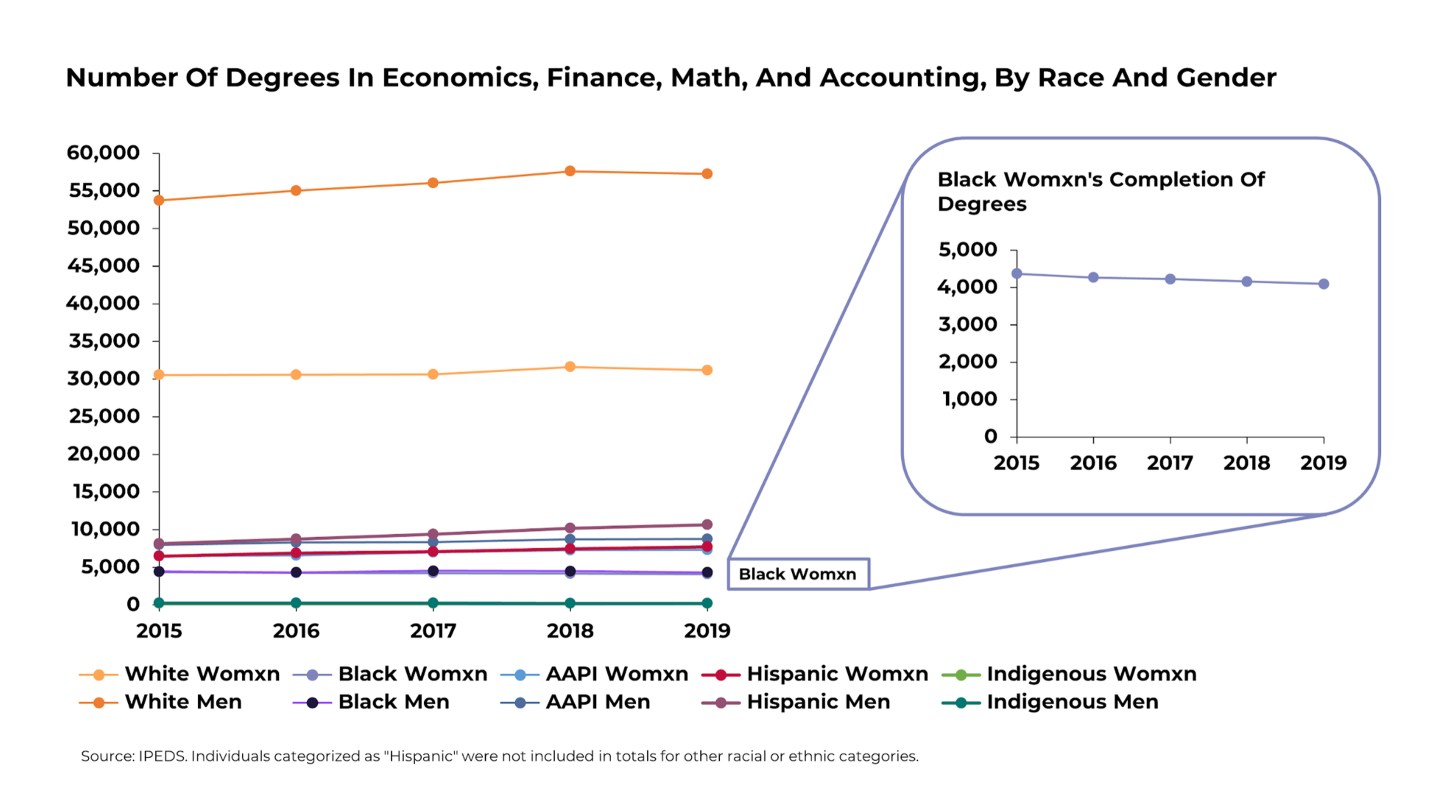

This decline in representation matters. Black women are arguably among the most important economic decision-makers in the country because our decisions shape our communities and the labor market for decades. Black women make up approximately 7% of the total U.S. population, but degree completion data shows that in 2019, Black women made up only 2.5% of those completing degrees in economics, finance, accounting, or math. And a similar trend emerges when you look at data across career professionals in these same fields. Black women’s representation in careers across finance, economics, math, and accounting is not increasing. COVID-19 has also likely made these outcomes worse, considering that mass job layoffs continue to disproportionately impact Black women as our unemployment rate climbs to an astronomical 12.7%.
One may wonder why this is the case. Research shows that over time the following constraints contribute to low participation of Black women in economics and related fields:
- Access to information: A recent paper by economists Gary Hoover, Ebonya Washington, and Amanda Bayer finds that too few students have access to information about careers in economics, or about what economists do, and that more information would be an asset. Our own experience echoes this point: 73% of Black women who attended the Sadie Collective conference in 2020 shared that they did not feel prepared for a career in economics and related fields. After the conference’s skill-building workshops and panels, a post-survey showed that 94% of respondents felt more prepared.
- Discrimination in the field: A New York Times op-ed, coauthored by one of us, Anna Gifty, and Lisa D. Cook, also showed that Black women consistently feel the brunt of discrimination in the profession, more so than other groups. And on average, Black women take the most measures to avoid possible harassment, discrimination, or unfair/disrespectful treatment compared to white and Asian respondents regardless of gender.
- Lack of role models: According to a 2019 report, fewer than 0.5% of Ph.D.s in economics were awarded to Black women—and it is hard to be what you cannot see. When asked before the Sadie Collective’s second annual conference, “Have you ever met a Black women economist?,” 33.5% of respondents shared that they had not. In a related statistic, only 2.2% of tenured or tenure-track economics faculty identified as Black in the 2018–2019 academic year. Moreover, among grade schools across the nation, there is a lack of exposure to quantitative-science majors and professions, along with negative perceptions surrounding the mathematical ability of Black girls.
Here’s the bottom line: As long as companies rely on quantitative analysis to wield power in our economy and national policy, the absence of Black women from these fields will counteract any public declarations made toward addressing the impact of anti-Black racism within society and the workplace.
To begin addressing the abysmal lack of Black women in the corporate space, we suggest that organizations provide sustained financial and programmatic support to existing initiatives that are among the best at doing the work. These include our own organization, The Sadie Collective, the only nonprofit organization centered on improving the pipeline and pathways for Black women in economics, finance, data science, and policy; Black Girls in Boardrooms, which offers mentoring support and workshops to Black women who have entered the corporate world; and Corporate in Color, which provides training sessions and one-on-one advice to Black women who want to refine their personal brand in corporate settings. Additionally, the corporate world can look to digital movements that showcase Black people in math, including #BlackinMathWeek, happening Nov. 8–14, and #BlackinDataWeek, which will follow.
What 2020 has shown us is that corporate diversity is in desperate need of a makeover. While the accumulation of unfortunate killings of unarmed Black people had to be the turning point, centering Black people—and more specifically, Black women—goes beyond just statements. In order to ensure that many more Black girls follow in the footsteps of women like Thasunda Brown Duckett of JPMorgan Chase, Bozoma Saint John of Netflix, or Mellody Hobson of Ariel Investments, the corporate world must commit to centering Black women, as Vice President-elect Kamala Harris emphasized in her victory speech on Saturday. Corporations must decide whether this current moment is one that demands change within, and beyond, the boardroom.
Read the full Sadie Collective white paper here.
***
Fanta Traore is a graduate of Howard University’s economics department, a former Federal Reserve employee, and current dual degree MPP/MBA candidate at Yale University. Anna Gifty Opoku-Agyeman is a researcher, speaker, and writer who is an alum of Harvard University’s Research Scholar in Economics program and the University of Maryland, Baltimore County. They cofounded the Sadie Collective, which addresses the underrepresentation of Black women in economics and related fields, and the viral digital campaign #BlackBirdersWeek. Follow them on Twitter (@itsafronomics, @TheFantaTraore) and Instagram (@annagiftyo, @TheFantaTraore).











