• Home
  • Latest
  • Fortune 500
  • Finance
  • Tech
  • Leadership
  • Lifestyle
  • Rankings
  • Multimedia

Trendingnow

1

Bolt CEO says he let go of his entire HR team for creating problems that didn’t exist: ‘Those problems disappeared when I let them go’ 

2

Meet a 21-year-old community college student who's going to China as the first American woman welder in the trades Olympics

3

The Bezos family just donated $100 million to help achieve one of Mayor Zohran Mamdani’s top campaign promises

1

Bolt CEO says he let go of his entire HR team for creating problems that didn’t exist: ‘Those problems disappeared when I let them go’ 

2

Meet a 21-year-old community college student who's going to China as the first American woman welder in the trades Olympics

3

The Bezos family just donated $100 million to help achieve one of Mayor Zohran Mamdani’s top campaign promises
Magazine

Distrust is contagious: How the coronavirus could upend America’s business relationships to China

By
Clay Chandler
Clay Chandler
Executive Editor, Asia
Down Arrow Button Icon
By
Clay Chandler
Clay Chandler
Executive Editor, Asia
Down Arrow Button Icon
March 16, 2020, 6:00 AM ET

Subscribe to Fortune’s Outbreak newsletter for a daily roundup of stories on the coronavirus outbreak and its impact on global business.

From the moment it erupted in Wuhan, China, the COVID-19 virus has proved particularly lethal to patients with the prior, chronic illnesses often described as “underlying health conditions.” Now the contagion is having a similarly grim effect on the U.S.-China economic relationship—where accumulated mistrust and resentment have ­created unhealthy conditions of a different kind. 

As the virus shakes the world’s business community, sending global stocks into or close to bear-market territory, it’s easy to forget that many of the first economic warning signs came from U.S. companies with significant China exposure. Apple and Nike reported supply-line disruptions. Ford, General Motors, and Tesla shuttered factories in China and fretted over shortages everywhere else. Starbucks and Walmart closed Chinese stores, while Disney suspended operations at parks in Shanghai and Hong Kong. 

At minimum, the chaos has prompted U.S. investors and executives to rethink the wisdom of concentrating supply lines in China and relying heavily on Chinese consumers. More broadly, the epidemic has added kindling to a smoldering debate about “decoupling”—the idea that after four decades of stitching the U.S. economy ever more closely to China’s, the time may have come to pry them apart again. 
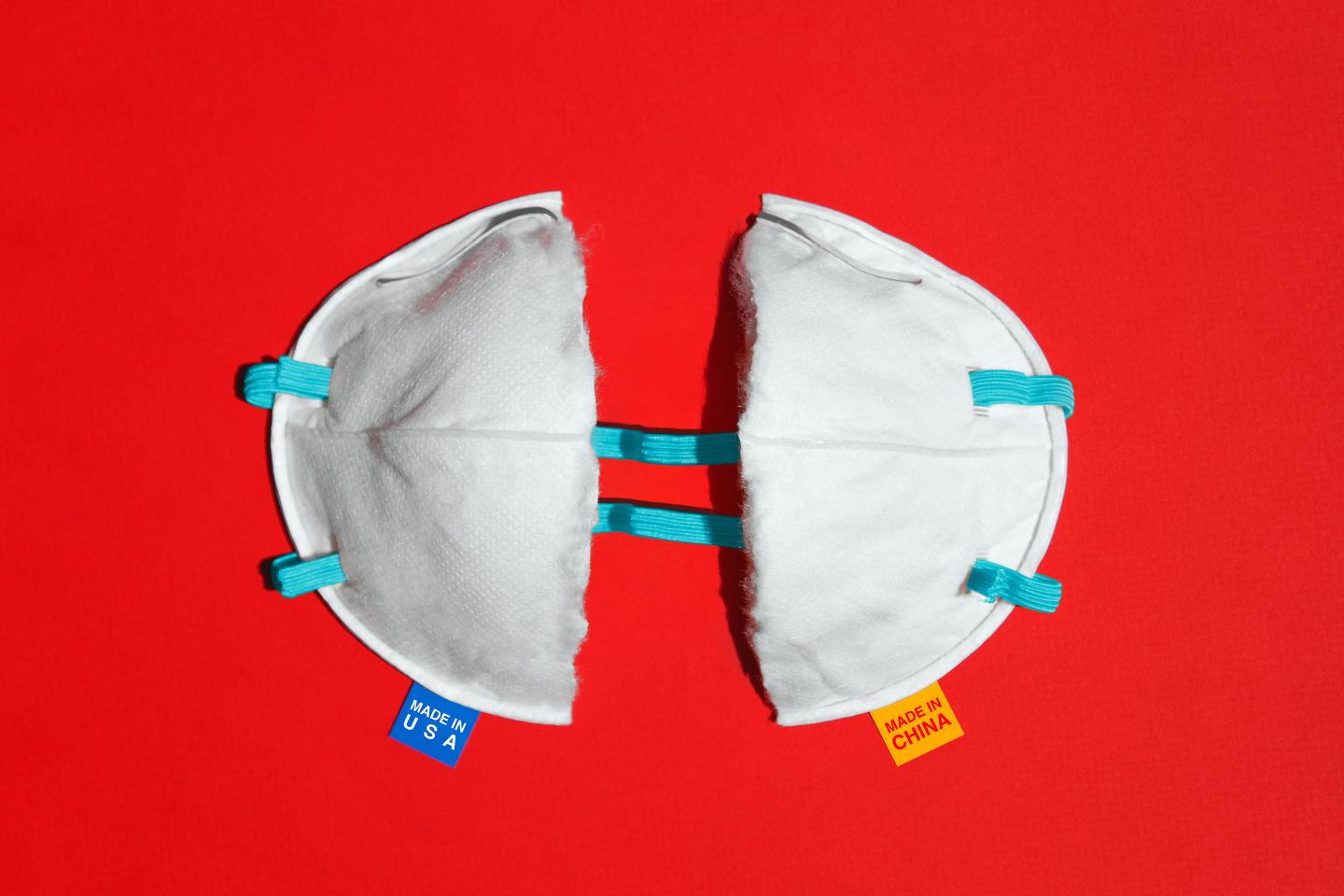
DEC.04.20.Coronavirus-Mask
Photo-Illustration by Selman Design

Decoupling implies a full split, and few business leaders are willing to use the “D” word on the record. But proponents of a more distant relationship, including some of President Trump’s top economic advisers, have seized on the contagion as proof of the dangers of doing business in a secretive, Communist-controlled economy. Over the past few weeks, White House trade adviser Peter Navarro has called the outbreak a “wake-up call,” while Commerce Secretary Wilbur Ross predicted it would help bring manufacturing jobs back to the U.S. Even those who favor continued engagement warn that the virus may hasten a decisive fracture in relations already frayed by three years of hostile rhetoric over matters of trade, technology, national security, and human rights.
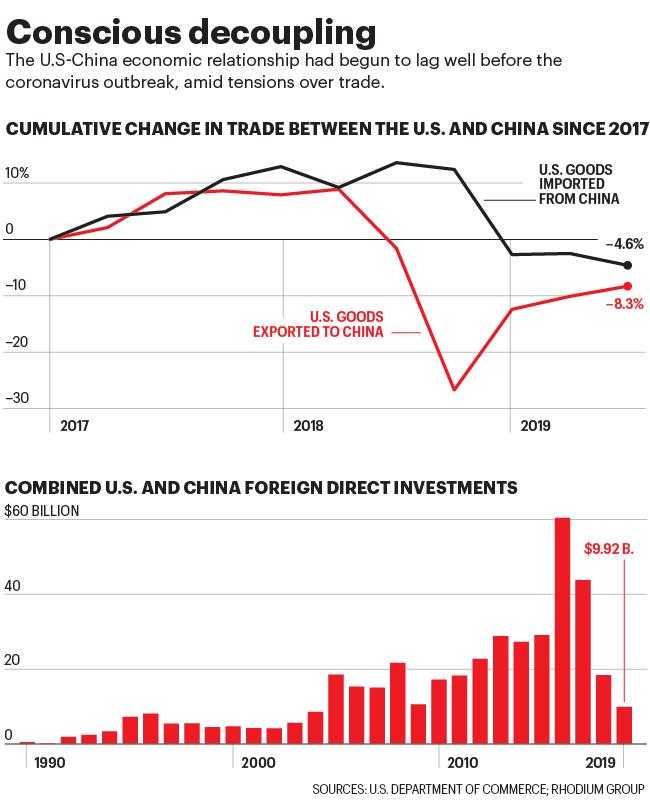
Trump and China’s Xi Jinping in December reached a “phase 1” deal that puts trade hostilities on hold. But escalating conflict had already led U.S. businesses to reroute orders worth hundreds of billions of dollars to other countries, in industries from textiles to toys. Huge electronics retailer Best Buy has suggested that it will reduce products made in China to 40% of the cost of goods it sells, down from 60% in 2019. In a recent earnings call, CEO Corie Barry called the coronavirus “one more piece of evidence that will continue to put pressure on diversifying supply lines.” 

The superpowers’ diverging paths are painfully apparent in technology. Google, Facebook, and Twitter are banned in China, and first-time foreign visitors marvel that it is almost impossible to get around, communicate, or dine there without relying on Chinese tech giants Tencent or Alibaba. In hardware, the U.S. has cited security and human-rights concerns in cutting Chinese tech companies out of its supply chains. It has also placed telecommunications giant Huawei and dozens of other Chinese firms on a blacklist that prevents them from buying key components from U.S. firms without a waiver. Beijing has responded by turning its technological back on America, accelerating its drive for autonomy in areas such as semiconductors and artificial intelligence.

Even those who favor continued engagement warn that the virus may hasten a decisive fracture in relations already frayed by three years of hostile rhetoric.

Another symptom of the diseased relationship is the constricted flow of talent. The 370,000 Chinese students enrolled in U.S. colleges and universities account for 34% of all international students in the U.S., and many U.S. schools rely on Chinese tuition to balance their budgets. But travel restrictions designed to contain the virus have prevented thousands of Chinese students from returning to the U.S. for this spring’s semester. Even before the outbreak, Chinese students were finding it harder to obtain U.S. visas, and many in the applied sciences complain of a “red scare,” in which they are increasingly viewed as government spies.

The rift creates difficult choices for economies that trade heavily with the superpowers. Taiwan’s biggest chipmaker, the $36-billion-in-revenue Taiwan Semiconductor Manufacturing Co. (TSMC), supplies U.S. companies including Apple and Chinese firms including Huawei. In recent weeks, the Trump administration has pressured it to shift production of its military-use chips to the U.S. TSMC says that it hasn’t ruled out the possibility but that there is “no concrete plan.” 

The prospect of a split is especially troubling in Australia, a staunch U.S. ally that is also the developed world’s most China-reliant economy, with trade worth around $200 billion annually. Australia ships a third of its exports to China, and Chinese nationals account for 15% of its tourists. Former Australian Prime Minister Kevin Rudd, now president of the New York–based Asia Society Policy Institute, has been beating the drum to warn against separation. “A fully decoupled world would be a deeply destabilizing place, undermining the global economic growth assumptions of the last 40 years,” he lamented in a recent speech.

By the numbers:

–109 billion

Decline in China-U.S. trade from 2018 to 2019. Source: U.S. Commerce Department

370,000

Chinese students enrolled in U.S. colleges and universities. Source: Institute of International Education

60%

Share of Americans with an unfavorable attitude toward China—a record high. Source: Pew Research Center

By mid-March, China’s government was declaring that the slowdown caused by the coronavirus was reversing, reporting that more than 90% of the state-owned firms it oversees had resumed operation (though many are far from full strength). In theory, trade and investment between the U.S. and China could stage a “V-shaped” recovery, as happened after the SARS epidemic in 2003. 

But COVID-19’s economic toll, far greater than that of SARS, is also affecting an American public that’s less sympathetic than ever to China. In 2019, the percentage of Americans with an unfavorable attitude toward China jumped to a record high of 60%, according to the Pew Research Center. In the upcoming presidential election, hostility toward China may be the rare issue on which Trump and his Democratic opponent agree. 

Both nations have too much to lose from completely severing their myriad commercial connections. And COVID-19 has shown how much damage the economic equivalent of a quarantine can do. For now, like the rest of us in this age of contagion, they’ll opt for fewer contacts and less prosperity in exchange for less entanglement. Call it the economic version of social distancing.

With reporting by Phil Wahba

A version of this article appears in the January 2020 issue of Fortune with the headline “Distrust is Contagious.”

More coronavirus coverage from Fortune:

—How to get a refund on your Broadway tickets after coronavirus shut down
—A Q&A with WHO special envoy David Nabarro on COVID-19
—The best Twitters to follow for reliable information on the coronavirus outbreak
—After SXSW cancellation, Austin hotels and restaurants are bracing for a rough road
—While canceling mass gatherings, the U.K. is still aiming for deliberate “herd immunity”
—Walmart, Target, CVS, and Walgreens will loan space for coronavirus test centers
—Let’s remember what we learned in WWII, as well as in 2008

Follow Fortune on Flipboard to stay up-to-date on the latest news and analysis.

About the Author
By Clay ChandlerExecutive Editor, Asia

Clay Chandler is executive editor, Asia, at Fortune.

See full bioRight Arrow Button Icon

Latest from the Magazine

Finance
Lorem ipsum dolor sit amet, consectetur adipiscing elit, sed do eiusmod tempor incididunt ut labore et dolore magna aliqua. Ut enim ad minim veniam
By Fortune Editors
October 20, 2025
Finance
Lorem ipsum dolor sit amet, consectetur adipiscing elit, sed do eiusmod tempor incididunt ut labore et dolore magna aliqua. Ut enim ad minim veniam
By Fortune Editors
October 20, 2025
Finance
Lorem ipsum dolor sit amet, consectetur adipiscing elit, sed do eiusmod tempor incididunt ut labore et dolore magna aliqua. Ut enim ad minim veniam
By Fortune Editors
October 20, 2025
Finance
Lorem ipsum dolor sit amet, consectetur adipiscing elit, sed do eiusmod tempor incididunt ut labore et dolore magna aliqua. Ut enim ad minim veniam
By Fortune Editors
October 20, 2025
Finance
Lorem ipsum dolor sit amet, consectetur adipiscing elit, sed do eiusmod tempor incididunt ut labore et dolore magna aliqua. Ut enim ad minim veniam
By Fortune Editors
October 20, 2025
Finance
Lorem ipsum dolor sit amet, consectetur adipiscing elit, sed do eiusmod tempor incididunt ut labore et dolore magna aliqua. Ut enim ad minim veniam
By Fortune Editors
October 20, 2025

Most Popular

Finance
Lorem ipsum dolor sit amet, consectetur adipiscing elit, sed do eiusmod tempor incididunt ut labore et dolore magna aliqua. Ut enim ad minim veniam
By Fortune Editors
October 20, 2025
Finance
Lorem ipsum dolor sit amet, consectetur adipiscing elit, sed do eiusmod tempor incididunt ut labore et dolore magna aliqua. Ut enim ad minim veniam
By Fortune Editors
October 20, 2025
Finance
Lorem ipsum dolor sit amet, consectetur adipiscing elit, sed do eiusmod tempor incididunt ut labore et dolore magna aliqua. Ut enim ad minim veniam
By Fortune Editors
October 20, 2025
Finance
Lorem ipsum dolor sit amet, consectetur adipiscing elit, sed do eiusmod tempor incididunt ut labore et dolore magna aliqua. Ut enim ad minim veniam
By Fortune Editors
October 20, 2025
Finance
Lorem ipsum dolor sit amet, consectetur adipiscing elit, sed do eiusmod tempor incididunt ut labore et dolore magna aliqua. Ut enim ad minim veniam
By Fortune Editors
October 20, 2025
Finance
Lorem ipsum dolor sit amet, consectetur adipiscing elit, sed do eiusmod tempor incididunt ut labore et dolore magna aliqua. Ut enim ad minim veniam
By Fortune Editors
October 20, 2025
Fortune Secondary Logo
Rankings
  • 100 Best Companies
  • Fortune 500
  • Global 500
  • Fortune 500 Europe
  • Most Powerful Women
  • World's Most Admired Companies
  • See All Rankings
  • Lists Calendar
Sections
  • Finance
  • Fortune Crypto
  • Features
  • Leadership
  • Health
  • Commentary
  • Success
  • Retail
  • Mpw
  • Tech
  • Lifestyle
  • CEO Initiative
  • Asia
  • Politics
  • Conferences
  • Europe
  • Newsletters
  • Personal Finance
  • Environment
  • Magazine
  • Education
Customer Support
  • Frequently Asked Questions
  • Customer Service Portal
  • Privacy Policy
  • Terms Of Use
  • Single Issues For Purchase
  • International Print
Commercial Services
  • Advertising
  • Fortune Brand Studio
  • Fortune Analytics
  • Fortune Conferences
  • Business Development
  • Group Subscriptions
About Us
  • About Us
  • Press Center
  • Work At Fortune
  • Terms And Conditions
  • Site Map
  • About Us
  • Press Center
  • Work At Fortune
  • Terms And Conditions
  • Site Map
  • Facebook icon
  • Twitter icon
  • LinkedIn icon
  • Instagram icon
  • Pinterest icon

Latest from the Magazine

Why the AI field’s biggest names are betting billions on ‘world models’
MagazineAutomation
Why the AI field’s biggest names are betting billions on ‘world models’
By Sharon GoldmanMay 20, 2026
15 hours ago
High gas prices are just the beginning: How the Iran war is changing the global energy map
MagazineIran
High gas prices are just the beginning: How the Iran war is changing the global energy map
By Jordan BlumMay 19, 2026
2 days ago
How EarthRanger uses AI to help protect endangered species—and boost the wildlife tourism industry
MagazineAfrica
How EarthRanger uses AI to help protect endangered species—and boost the wildlife tourism industry
By Alexandra KirkmanMay 18, 2026
3 days ago
Anduril CEO Brian Schimpf
MagazineDefense
Inside Anduril: Meet the quiet engineer-CEO building America’s $31 billion weapons startup
By Allie GarfinkleMay 6, 2026
15 days ago
A Michigan farm town voted down plans for a giant OpenAI-Oracle data center. Weeks later, construction began
MagazineData centers
A Michigan farm town voted down plans for a giant OpenAI-Oracle data center. Weeks later, construction began
By Sharon GoldmanMay 6, 2026
15 days ago
The American Express CEO defied haters who said he’d never have the top job—winning with millennials and Gen Z and trouncing the competition
MagazineAmerican Express
The American Express CEO defied haters who said he’d never have the top job—winning with millennials and Gen Z and trouncing the competition
By Shawn TullyMay 6, 2026
15 days ago

Most Popular

Bolt CEO says he let go of his entire HR team for creating problems that didn’t exist: ‘Those problems disappeared when I let them go’ 
Workplace Culture
Bolt CEO says he let go of his entire HR team for creating problems that didn’t exist: ‘Those problems disappeared when I let them go’ 
By Preston ForeMay 19, 2026
1 day ago
Meet a 21-year-old community college student who's going to China as the first American woman welder in the trades Olympics
Future of Work
Meet a 21-year-old community college student who's going to China as the first American woman welder in the trades Olympics
By Mike Householder and The Associated PressMay 17, 2026
3 days ago
The Bezos family just donated $100 million to help achieve one of Mayor Zohran Mamdani’s top campaign promises
Politics
The Bezos family just donated $100 million to help achieve one of Mayor Zohran Mamdani’s top campaign promises
By Jake AngeloMay 12, 2026
8 days ago
Current price of oil as of May 19, 2026
Personal Finance
Current price of oil as of May 19, 2026
By Joseph HostetlerMay 19, 2026
1 day ago
Spirit Airlines apologizes to all the Americans who can't afford any summer vacation flights as it shuts down
Travel & Leisure
Spirit Airlines apologizes to all the Americans who can't afford any summer vacation flights as it shuts down
By Rio Yamat and The Associated PressMay 18, 2026
2 days ago
Current price of silver as of Tuesday,  May 19, 2026
Personal Finance
Current price of silver as of Tuesday, May 19, 2026
By Joseph HostetlerMay 19, 2026
1 day ago

© 2026 Fortune Media IP Limited. All Rights Reserved. Use of this site constitutes acceptance of our Terms of Use and Privacy Policy | CA Notice at Collection and Privacy Notice | Do Not Sell/Share My Personal Information
FORTUNE is a trademark of Fortune Media IP Limited, registered in the U.S. and other countries. FORTUNE may receive compensation for some links to products and services on this website. Offers may be subject to change without notice.