• Home
  • Latest
  • Fortune 500
  • Finance
  • Tech
  • Leadership
  • Lifestyle
  • Rankings
  • Multimedia
Commentaryeconomic sanctions

Limiting this governmental emergency power could curb presidential overreach

By
Elizabeth Goitein
Elizabeth Goitein
and
Andrew Boyle
Andrew Boyle
Down Arrow Button Icon
By
Elizabeth Goitein
Elizabeth Goitein
and
Andrew Boyle
Andrew Boyle
Down Arrow Button Icon
March 4, 2020, 2:30 PM ET
Commentary-Trump-Mexico Border Wall-National Emergency
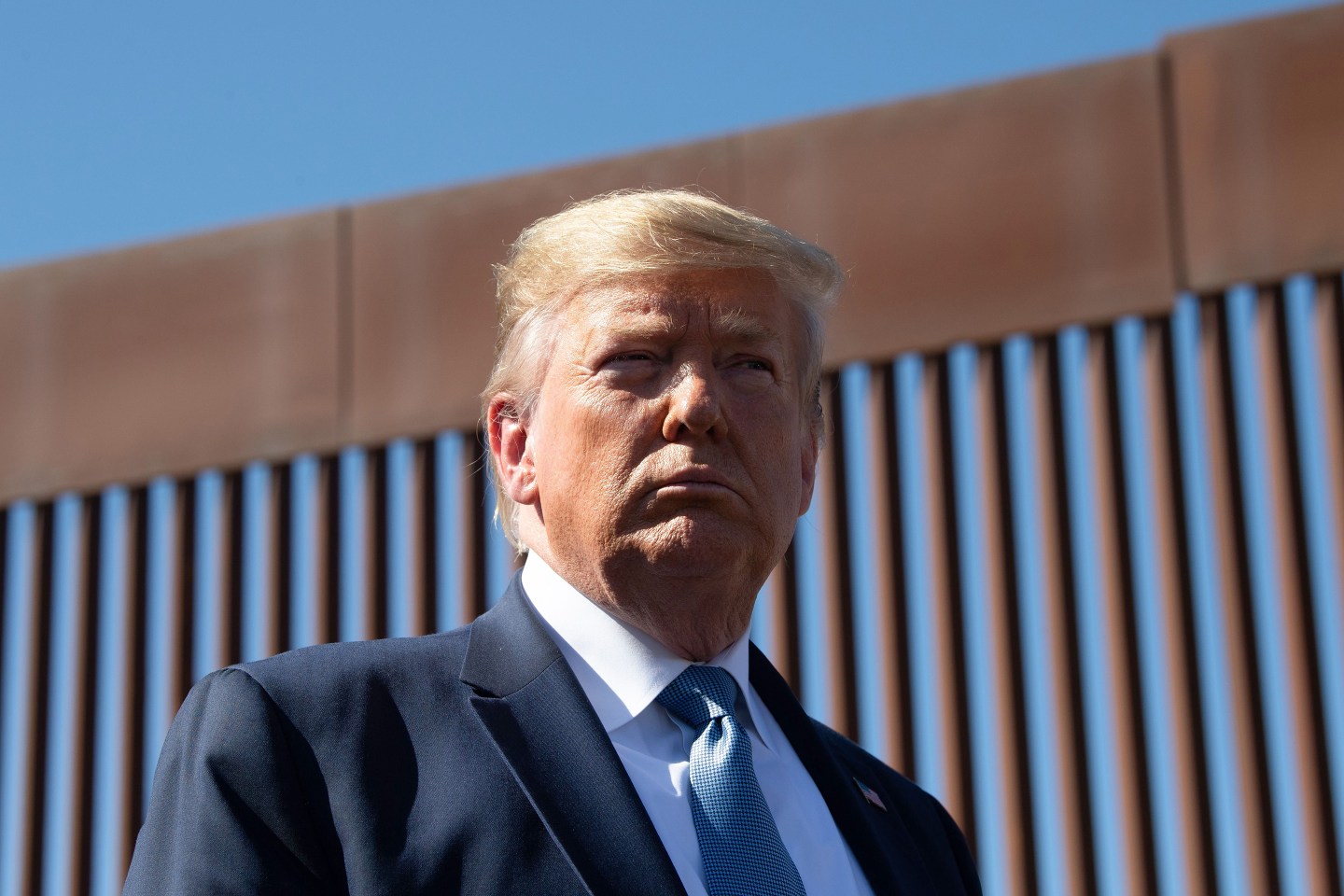
TOPSHOT - US President Donald Trump visits the US-Mexico border fence in Otay Mesa, California on September 18, 2019. (Photo by Nicholas KAMM / AFP) (Photo credit should read NICHOLAS KAMM/AFP via Getty Images)NICHOLAS KAMM—AFP/Getty Images

More than a year after President Donald Trump declared a “national emergency” at the southern border, Congress is just beginning to reckon with the many laws that give presidents enhanced powers when they use those words. One such law is the International Emergency Economic Powers Act (IEEPA), and the sweeping powers it confers—combined with a lack of basic checks and balances—make it ripe for abuse. 

But a bill recently introduced by Rep. Ilhan Omar (D-Minn.), the “Congressional Oversight of Sanctions Act,” which is part of a larger proposed foreign policy overhaul package, would be a start toward guarding against presidential overreach. 

IEEPA is one of the many emergency powers that a president can invoke under the National Emergencies Act. To deploy IEEPA, the president must declare an emergency based on an “unusual or extraordinary threat” that has its source, at least in part, from overseas. The U.S. government can then take a range of extraordinary economic measures, from blocking all financial transactions or trade with individuals, entities, or governments deemed associated with the threat to freezing designees’ property and bank accounts. And it can do all of this while merely investigating whether to designate someone. 

Although the typical IEEPA order targets foreign governments or organizations, the law can be used against Americans, too. After the September 11th attacks, President George W. Bush quickly deployed IEEPA to shut down several Muslim American charities, and to freeze the assets of individual Muslim Americans, based on suspicions that their charitable contributions benefited terrorists overseas—even though this was never proven in court. Judges in Oregon and Ohio did find that the government’s actions were unconstitutional, but the Supreme Court has not ruled on the issue.

IEEPA is by far the most commonly invoked emergency power. Presidents have issued 58 IEEPA declarations in the past 40 years, and most have lasted more than a decade. There are 31 IEEPA declarations in effect today—including the longest-running national emergency, which President Carter declared in 1979 in response to the Iran hostage crisis. 

Ironically, when Congress passed IEEPA in response to various Nixon administration scandals, its intent was to restrain executive power and to make the use of sanctions—in the words of one congressional committee—“rare and brief.” What went wrong? 

For one thing, presidents have largely ignored the requirement of an “unusual and extraordinary threat.” Presidents typically invoke IEEPA whenever they believe it would advance foreign policy goals, regardless of whether an actual emergency—one that creates a sudden and urgent crisis for the U.S.—exists. 

In addition, presidential use of IEEPA is difficult for Congress to check. Congress can terminate an IEEPA emergency only by passing a law that the president signs, or by mustering a supermajority to override his veto. To date, Congress has never attempted to terminate an IEEPA emergency. 

Indeed, Congress appears quite happy to delegate the complex realm of foreign sanctions to the president. But this passivity is short-sighted. The Trump administration, for instance, has threatened to use IEEPA in unprecedented ways, including to impose tariffs against Mexico in retaliation for illegal immigration at the southern border, and to order U.S. companies out of China as leverage in the U.S.-China trade war. 

The potential for domestic presidential overreach is even more frightening: In the wrong hands, IEEPA could be abused to target organizations engaged in political dissent or opposition, based on unproven claims of ties to foreign threats. 

The introduction of Rep. Omar’s “Congressional Oversight of Sanctions Act” is an opening to protect against such abuse. Among other changes, the bill would limit initial use of IEEPA’s powers to 60 days. If Congress does not vote within this period to continue the sanctions, they must end. If, on the other hand, Congress votes to approve the sanctions, they may continue, but Congress must reapprove them every six months. Along with detailed reporting to Congress about how and why sanctions are being deployed, the bill would also require the president to submit periodic assessments of how effectively the sanctions are achieving their stated goals. 

Granted, the bill is not perfect. Asking Congress to separately reauthorize more than 30 sanctions regimes every six months would create a burden that Congress would almost certainly be unwilling to shoulder; requiring Congress to vote on a package of sanctions every year would be a more workable solution. Moreover, the bill does not address IEEPA’s failure to provide due process for Americans made subject to its provisions. At a minimum, Congress should require the government to obtain a warrant when it seeks to freeze Americans’ assets, and to provide detailed notice of the reasons why the American was targeted—along with a hearing in which the target can present a defense—when applying other types of sanctions. 

Nonetheless, the bill constructively takes on a problem that has received far too little attention from Congress. And, importantly, it could serve to launch a long-overdue conversation on Capitol Hill about how Congress can head off presidential abuse of IEEPA—and more actively fulfill its role as a check against presidential overreach.  

Elizabeth Goitein is co-director of the Liberty and National Security Program at the Brennan Center for Justice.
Andrew Boyle is counsel in the Liberty and National Security Program at the Brennan Center for Justice.

More opinion in Fortune:

—What companies can do to make work better for black employees
—Should consumers be wary of Apple’s heartbeat monitoring app?
—Being a CEO is more tenuous than ever. How I survived 30 years at Aflac
—How Warren Buffett built Berkshire Hathaway
—Are the Houston Astros irredeemable cheaters? Or are they all of us?

Listen to our audio briefing, Fortune 500 Daily

About the Authors
By Elizabeth Goitein
See full bioRight Arrow Button Icon
By Andrew Boyle
See full bioRight Arrow Button Icon

Latest in Commentary

Finance
Lorem ipsum dolor sit amet, consectetur adipiscing elit, sed do eiusmod tempor incididunt ut labore et dolore magna aliqua. Ut enim ad minim veniam
By Fortune Editors
October 20, 2025
Finance
Lorem ipsum dolor sit amet, consectetur adipiscing elit, sed do eiusmod tempor incididunt ut labore et dolore magna aliqua. Ut enim ad minim veniam
By Fortune Editors
October 20, 2025
Finance
Lorem ipsum dolor sit amet, consectetur adipiscing elit, sed do eiusmod tempor incididunt ut labore et dolore magna aliqua. Ut enim ad minim veniam
By Fortune Editors
October 20, 2025
Finance
Lorem ipsum dolor sit amet, consectetur adipiscing elit, sed do eiusmod tempor incididunt ut labore et dolore magna aliqua. Ut enim ad minim veniam
By Fortune Editors
October 20, 2025
Finance
Lorem ipsum dolor sit amet, consectetur adipiscing elit, sed do eiusmod tempor incididunt ut labore et dolore magna aliqua. Ut enim ad minim veniam
By Fortune Editors
October 20, 2025
Finance
Lorem ipsum dolor sit amet, consectetur adipiscing elit, sed do eiusmod tempor incididunt ut labore et dolore magna aliqua. Ut enim ad minim veniam
By Fortune Editors
October 20, 2025

Most Popular

Finance
Lorem ipsum dolor sit amet, consectetur adipiscing elit, sed do eiusmod tempor incididunt ut labore et dolore magna aliqua. Ut enim ad minim veniam
By Fortune Editors
October 20, 2025
Finance
Lorem ipsum dolor sit amet, consectetur adipiscing elit, sed do eiusmod tempor incididunt ut labore et dolore magna aliqua. Ut enim ad minim veniam
By Fortune Editors
October 20, 2025
Finance
Lorem ipsum dolor sit amet, consectetur adipiscing elit, sed do eiusmod tempor incididunt ut labore et dolore magna aliqua. Ut enim ad minim veniam
By Fortune Editors
October 20, 2025
Finance
Lorem ipsum dolor sit amet, consectetur adipiscing elit, sed do eiusmod tempor incididunt ut labore et dolore magna aliqua. Ut enim ad minim veniam
By Fortune Editors
October 20, 2025
Finance
Lorem ipsum dolor sit amet, consectetur adipiscing elit, sed do eiusmod tempor incididunt ut labore et dolore magna aliqua. Ut enim ad minim veniam
By Fortune Editors
October 20, 2025
Finance
Lorem ipsum dolor sit amet, consectetur adipiscing elit, sed do eiusmod tempor incididunt ut labore et dolore magna aliqua. Ut enim ad minim veniam
By Fortune Editors
October 20, 2025
Rankings
  • 100 Best Companies
  • Fortune 500
  • Global 500
  • Fortune 500 Europe
  • Most Powerful Women
  • Future 50
  • World’s Most Admired Companies
  • See All Rankings
Sections
  • Finance
  • Leadership
  • Success
  • Tech
  • Asia
  • Europe
  • Environment
  • Fortune Crypto
  • Health
  • Retail
  • Lifestyle
  • Politics
  • Newsletters
  • Magazine
  • Features
  • Commentary
  • Mpw
  • CEO Initiative
  • Conferences
  • Personal Finance
  • Education
Customer Support
  • Frequently Asked Questions
  • Customer Service Portal
  • Privacy Policy
  • Terms Of Use
  • Single Issues For Purchase
  • International Print
Commercial Services
  • Advertising
  • Fortune Brand Studio
  • Fortune Analytics
  • Fortune Conferences
  • Business Development
About Us
  • About Us
  • Editorial Calendar
  • Press Center
  • Work At Fortune
  • Diversity And Inclusion
  • Terms And Conditions
  • Site Map
  • Facebook icon
  • Twitter icon
  • LinkedIn icon
  • Instagram icon
  • Pinterest icon

Latest in Commentary

ready
CommentaryPinterest
Pinterest CEO: the Napster phase of AI needs to end
By Bill ReadyJanuary 19, 2026
2 days ago
mohamad ali
CommentaryConsulting
I lead IBM Consulting, here’s how AI-first companies must redesign work for growth
By Mohamad AliJanuary 19, 2026
2 days ago
CommentaryLetter from London
I have been coming to Davos for 16 years. I have never seen such a crisis in U.S./European relations 
By Kamal AhmedJanuary 19, 2026
2 days ago
ravi
Commentaryinformation technology
Learning and work are converging in an integrated new life template for the AI era 
By Ravi Kumar SJanuary 19, 2026
2 days ago
dusek
CommentaryDavos
Geoeconomics is the new geopolitics: Playing offense in the new economy
By Mirek DusekJanuary 19, 2026
2 days ago
Davos
CommentaryDavos
Building corporate resilience in a fragmenting world
By Sunny Mann and Anahita ThomsJanuary 18, 2026
3 days ago

Most Popular

placeholder alt text
AI
Elon Musk says that in 10 to 20 years, work will be optional and money will be irrelevant thanks to AI and robotics
By Sasha RogelbergJanuary 19, 2026
2 days ago
placeholder alt text
Politics
The U.S. Supreme Court could throw a wrench into Trump’s plan to take Greenland as soon as Tuesday
By Jim EdwardsJanuary 19, 2026
2 days ago
placeholder alt text
Success
Despite his $2.6 billion net worth, MrBeast says he’s having to borrow cash and doesn’t even have enough money in his bank account to buy McDonald’s
By Emma BurleighJanuary 13, 2026
7 days ago
placeholder alt text
Success
Half of veterans leave their first post-military jobs in less than a year, and spouses face sky-high unemployment—this CEO has a $500 million fix
By Emma BurleighJanuary 19, 2026
2 days ago
placeholder alt text
Commentary
I oversee a lab where engineers try to destroy my life’s work. It's the only way to prepare for quantum threats
By Bernard VianJanuary 18, 2026
3 days ago
placeholder alt text
Personal Finance
Current price of silver as of Tuesday, January 20, 2026
By Joseph HostetlerJanuary 20, 2026
14 hours ago

© 2025 Fortune Media IP Limited. All Rights Reserved. Use of this site constitutes acceptance of our Terms of Use and Privacy Policy | CA Notice at Collection and Privacy Notice | Do Not Sell/Share My Personal Information
FORTUNE is a trademark of Fortune Media IP Limited, registered in the U.S. and other countries. FORTUNE may receive compensation for some links to products and services on this website. Offers may be subject to change without notice.