This is the web version of the Bull Sheet, Fortune’s no-BS daily newsletter on the markets. Sign up to receive it in your inbox here.
Dear subscribers, welcome to the inaugural Bull Sheet newsletter.
We’ll be with you every day the major U.S. markets are trading, delivering to your inbox daily insights and observations about the issues moving the global markets, from Hong Kong to Wall Street and beyond.
I’m Bernhard Warner, Fortune’s global editor of finance and investing, and I’ll be your pilot most mornings.
On this trip, you’re encouraged to talk to the driver. So tell me what you’re thinking: what you like about this newsletter and what you’re just not buying. I want you to think of this as a community. Our community. So drop me a line whenever at bullsheet@fortune.com or by replying to this email.
When we were putting together this newsletter, we wanted to capture the spirit of these historic markets. There’s only one word for that. And voila, Bull Sheet was born. I guess that makes us all Bull Sheeters. I promise you though: Bull Sheet will be no BS. 🐂
What will you find in Bull Sheet?
I’m a data geek, and so I’ll look for the underlying numbers behind the ups and downs of the market. I’ll take the data and turn what catches my eye into charts. So, expect a nice visual in each newsletter—scroll below for today’s.
Let’s get right into it, shall we?
***
The bull market, by the numbers
- Today, we have four companies—Amazon, Apple, Alphabet and Microsoft—with $1 trillion valuations. A fifth, Saudi Aramco, is flirting (again) with $2 trillion. (Speaking of Aramco, if any of you got in on that IPO, definitely drop me a line.)
- According to PwC, the combined market cap of the world’s 100 largest companies topped $21 trillion last year. In the past decade, the biggest of the big saw their value nearly double.
- And then there’s the Dow, which, after Friday’s close, is a mere 651.90 points away from the big 30,000. (I can’t be the only one who remembers all the fuss, back in 1999, of the countdown to Dow 10,000—can I? A reminder: General Electric, Walmart and American Express were among the names that led us into uncharted territory that day.)
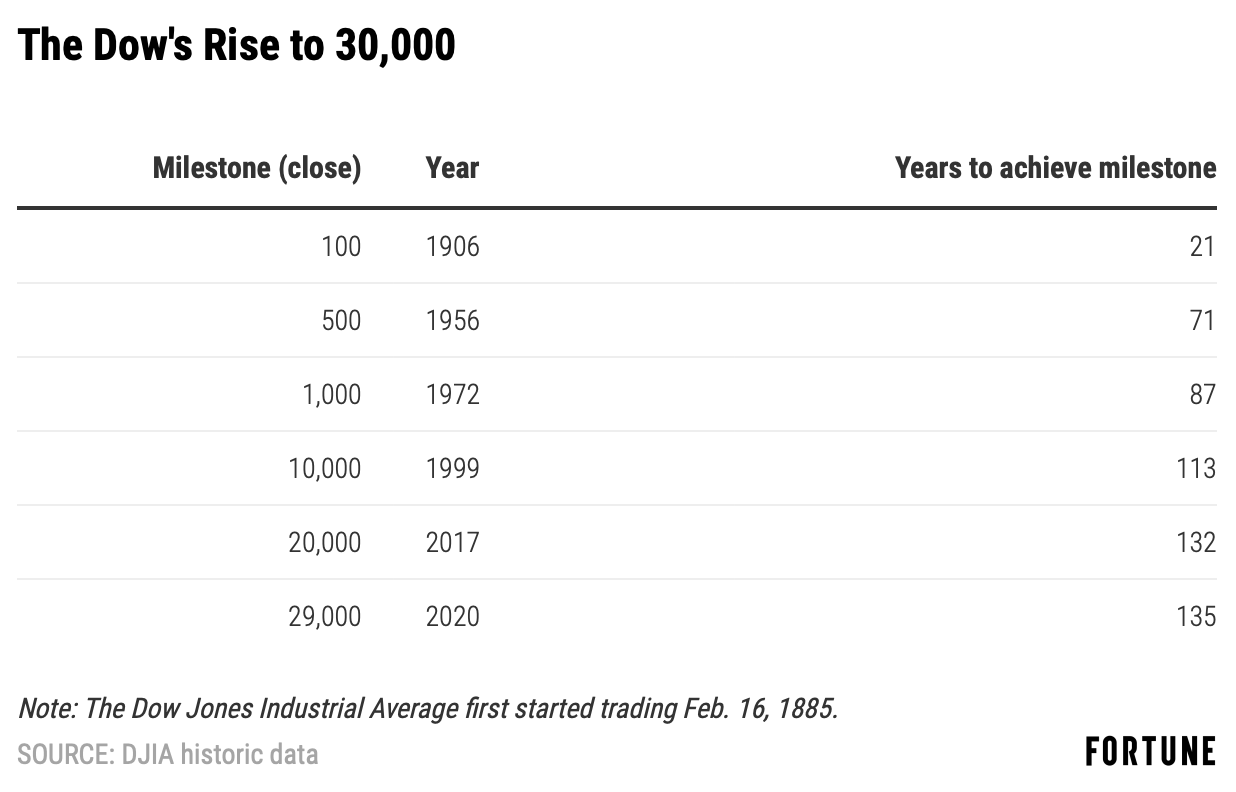
I ran the numbers on the Dow the other day, looking all the way back to its inauguration in 1885. It took 87 years—or 21,652 trading days—to finally crack 1,000 in 1972. Meanwhile, the recent 9,000-point leap, from 20,000 to 29,000, was a breeze, taking slightly under three years.
Here’s a look at the major Dow milestones over its 135-year history.
So who here has a bet on when we’ll hit 30,000? Hit me up. I’ll do a nice little shout-out to whomever comes closest.
Bernhard Warner
@BernhardWarner
Bernhard.Warner@Fortune.com
Tuesday Reads
A (new) SARS is born? The pneumonia-like coronavirus is moving quickly through Asia, sinking the markets there (Europe is faring only slightly better) on Tuesday. Asian retail and tourism stocks were hit particularly hard. The outbreak brings back memories of the SARS contagion of 2003, which killed about 800.
Trust fall. The annual Edelman Global Trust Barometer came out on Monday and it does not make for a heartwarming read. "A majority of respondents in every developed market do not believe they will be better off in five years’ time," the report notes. Meanwhile, a gaudy 56% of respondents around the world say capitalism as it exists today does more harm than good. At this rate, Edelman will need to rebrand it the Distrust Barometer.
Peak youth. A decade-long bull market has set us—some of us, anyhow—up nicely for the next decade. But there are plenty of warning signs—from climate change to inequality—that could make the '20s anything but roaring. One that caught my eye: for the first time, there are more seniors than children under 5 in the world. And that trend isn't going to reverse itself. That's a lot of pensions to fund.
Davos, man. Remember that time at Davos when Bill Gates declared to the great and the good that spam (the messages, not the meat) would be eradicated by 2006? Or when Soc Gen copped to the rogue trade that cost it $7 billion? The New York Times does a neat "Davos by the Numbers" roundup for those of you who like World Economic Forum trivia—such as the cost of entry back in 1980 (Answer: $4,000).
The repo man cometh, and taketh. Banks around the world are pulling money out of and putting money into the repo markets at a record clip—which makes the recent instability of the market all the more concerning. The Financial Stability Board, a group of global regulators, has put a number on the inflows and outflows. Banks poured a combined $5.9 trillion into the world's repo markets in 2018. What the banks giveth, they also taketh away. During the same period, they also pulled out $6 trillion in the overnight funding from the repo markets.
Market Candy
It’s quiz time, Bull Sheeters. What’s the best-performing industry sector so far in 2020?
A. Internet services and social media
B. Investment services
C. Legal marijuana
D. Healthcare facilities
The answer is... C., legal marijuana, up 21.8% (as of Friday's close). Internet services and social media is a distant second at 7.36%. The markets have spoken.