• Home
  • Latest
  • Fortune 500
  • Finance
  • Tech
  • Leadership
  • Lifestyle
  • Rankings
  • Multimedia
Healthpublic health

When Delay Is Deadly

By
Clifton Leaf
Clifton Leaf
Down Arrow Button Icon
By
Clifton Leaf
Clifton Leaf
Down Arrow Button Icon
January 19, 2018, 5:44 PM ET

Every year at the annual and overwhelmingly large J.P. Morgan Healthcare Conference there is one announcement or presentation that stands out from the rest. This year that newsworthy moment, in my view, had nothing to do with the latest Phase III drug trial, pharma merger, or biotech discovery. Indeed, it didn’t have anything do with a drug or insurance company at all. Rather, it was a sparsely attended, early evening panel led by the conference sponsor itself—which, on the face of it, would seem wearying enough. And this one had what may be the most unappetizing title of all: “Deferred Care: How Tax Refunds Enable Healthcare Spending and What To Do About It.”

But man, I can’t stop thinking about it. The frightening takeaway for this unfortunately named talk? Americans—of nearly every income bracket—are deferring, and sometimes skipping, the healthcare they need because they can’t afford the out-of-pocket costs. This is true when they’re insured. This is true when they’re employed. This is true for individuals aged 18 to 64—and wherever they reside in the U.S., it seems. It’s true, in other words, across the board.

The panel discussion featured some of the smartest folks in the health field—Dr. Toby Cosgrove, the pioneering heart surgeon and former CEO of Cleveland Clinic; Bob Kocher, the Venrock partner who helped shape the Affordable Care Act; Humana CEO Bruce Broussard, who’s very thoughtful on the healthcare value chain; and two JPM folks—Bei Ling, JPMorgan Chase’s global head of compensation and benefit, and moderator Diana Farrell, CEO of the JPMorgan Chase Institute (hereafter, please, JPMCI), the bank’s in-house socially minded think tank.

As good and lively as the discussion was, though, it was the underlying study by JPMCI that was so incredibly jarring. From the bank’s universe of 37 million checking account customers, the think tank’s researchers stripped identifiers and grabbed a sample of 2.3 million families across 23 U.S. states for whom they had “a very good window into their financial lives,” said Fiona Greig, JPMCI’s Director of Consumer Research, who presented the study’s key findings prior to the panel discussion. They then examined their bank deposits and balances as well as their debit card, credit card, and electronic payments to healthcare providers and drug stores, allowing the team to get what they called “a cash flow view of healthcare spending.”

This was a somewhat conservative estimate of that cash flow because it didn’t reflect every cash outlay or payments for things like health insurance premiums, but the patterns of personal financial liquidity were clear even without them.

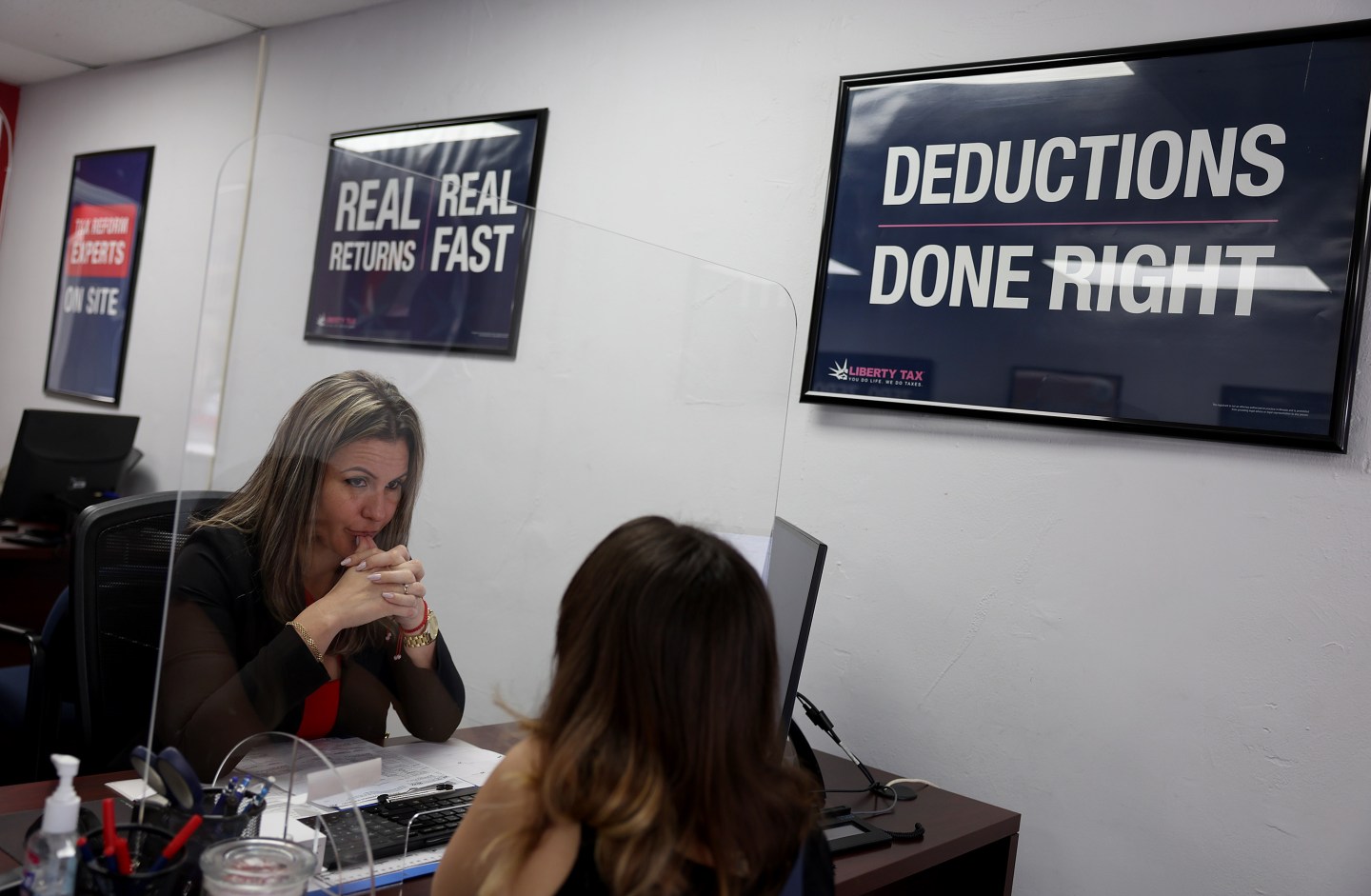
Then, somewhat ingeniously, the research team looked at what happened to that family cash flow in the days and months before and after their annual tax refund from the IRS—and how it affected their healthcare spending. “We focused on tax refunds because this is an important cash flow event for most families in the U.S.,” says Greig. “Seventy-three percent of tax filers receive an average tax refund on the order of $3,000”—and for some 40 percent of families “this is the single largest cash infusion of the entire year.”

The maximum number of people on any given day receiving a tax refund is just 4% of the population. “And the uncertainty with which that tax refund arrives is exactly what enables us to pin down the connection between cash flow dynamics and healthcare spending,” says Greig. “So we developed a first-ever look daily view of the healthcare spending in the 100 days prior to and after the arrival of that tax refund.” And the pattern is striking. Healthcare spending is relatively stable in those 100 days—but the day after the tax refund arrives, such spending shoots up by 60 percent. Moreover, it stays high for the next 75 days (to the tune of 20 percent above the baseline). “Now, we know that this is actually the cash that is enabling people to make this payment because when we look at a similar chart by payment channel, we see that healthcare spending on debit cards increased by 83%, and healthcare spending on electronic payments (online bill pay and the like) increases by 56%,” she says. “Credit card spending on healthcare, though, remains pretty flat throughout this time frame. So it is actually precisely the payment channels that require cash in the account to make the payment that are most sensitive to this.”

For lower income families, no surprise, the change was more stark. Account holders in the lowest checking account quintile (those with average balances of less than $536) increased their post-refund healthcare spending by a twentyfold factor larger than those with accounts in the highest quintile (balances over $3,577).

And American families are not just deferring payments, they’re putting off care when cash flow is low. The team could tell that because of the large share of in-person payments to healthcare service providers in the wake of the refund.

It has long been known that many families don’t have enough cash on hand to cover a medical emergency. “Now we also see that a significant number of Americans put off going to the doctor and other routine health services until they actually have cash in their account, even when they know that it is coming,” said Farrell, in an accompanying press release to the study.

The full report is here and there’s a great data visualization with other findings here. Both are well worth the investment of time.

This essay appears in today’s edition of the Fortune Brainstorm Health Daily. Get it delivered straight to your inbox.

About the Author
By Clifton Leaf
See full bioRight Arrow Button Icon

Latest in Health

Finance
Lorem ipsum dolor sit amet, consectetur adipiscing elit, sed do eiusmod tempor incididunt ut labore et dolore magna aliqua. Ut enim ad minim veniam
By Fortune Editors
October 20, 2025
Finance
Lorem ipsum dolor sit amet, consectetur adipiscing elit, sed do eiusmod tempor incididunt ut labore et dolore magna aliqua. Ut enim ad minim veniam
By Fortune Editors
October 20, 2025
Finance
Lorem ipsum dolor sit amet, consectetur adipiscing elit, sed do eiusmod tempor incididunt ut labore et dolore magna aliqua. Ut enim ad minim veniam
By Fortune Editors
October 20, 2025
Finance
Lorem ipsum dolor sit amet, consectetur adipiscing elit, sed do eiusmod tempor incididunt ut labore et dolore magna aliqua. Ut enim ad minim veniam
By Fortune Editors
October 20, 2025
Finance
Lorem ipsum dolor sit amet, consectetur adipiscing elit, sed do eiusmod tempor incididunt ut labore et dolore magna aliqua. Ut enim ad minim veniam
By Fortune Editors
October 20, 2025
Finance
Lorem ipsum dolor sit amet, consectetur adipiscing elit, sed do eiusmod tempor incididunt ut labore et dolore magna aliqua. Ut enim ad minim veniam
By Fortune Editors
October 20, 2025

Most Popular

Finance
Lorem ipsum dolor sit amet, consectetur adipiscing elit, sed do eiusmod tempor incididunt ut labore et dolore magna aliqua. Ut enim ad minim veniam
By Fortune Editors
October 20, 2025
Finance
Lorem ipsum dolor sit amet, consectetur adipiscing elit, sed do eiusmod tempor incididunt ut labore et dolore magna aliqua. Ut enim ad minim veniam
By Fortune Editors
October 20, 2025
Finance
Lorem ipsum dolor sit amet, consectetur adipiscing elit, sed do eiusmod tempor incididunt ut labore et dolore magna aliqua. Ut enim ad minim veniam
By Fortune Editors
October 20, 2025
Finance
Lorem ipsum dolor sit amet, consectetur adipiscing elit, sed do eiusmod tempor incididunt ut labore et dolore magna aliqua. Ut enim ad minim veniam
By Fortune Editors
October 20, 2025
Finance
Lorem ipsum dolor sit amet, consectetur adipiscing elit, sed do eiusmod tempor incididunt ut labore et dolore magna aliqua. Ut enim ad minim veniam
By Fortune Editors
October 20, 2025
Finance
Lorem ipsum dolor sit amet, consectetur adipiscing elit, sed do eiusmod tempor incididunt ut labore et dolore magna aliqua. Ut enim ad minim veniam
By Fortune Editors
October 20, 2025
Rankings
  • 100 Best Companies
  • Fortune 500
  • Global 500
  • Fortune 500 Europe
  • Most Powerful Women
  • Future 50
  • World’s Most Admired Companies
  • See All Rankings
Sections
  • Finance
  • Leadership
  • Success
  • Tech
  • Asia
  • Europe
  • Environment
  • Fortune Crypto
  • Health
  • Retail
  • Lifestyle
  • Politics
  • Newsletters
  • Magazine
  • Features
  • Commentary
  • Mpw
  • CEO Initiative
  • Conferences
  • Personal Finance
  • Education
Customer Support
  • Frequently Asked Questions
  • Customer Service Portal
  • Privacy Policy
  • Terms Of Use
  • Single Issues For Purchase
  • International Print
Commercial Services
  • Advertising
  • Fortune Brand Studio
  • Fortune Analytics
  • Fortune Conferences
  • Business Development
About Us
  • About Us
  • Editorial Calendar
  • Press Center
  • Work At Fortune
  • Diversity And Inclusion
  • Terms And Conditions
  • Site Map
  • Facebook icon
  • Twitter icon
  • LinkedIn icon
  • Instagram icon
  • Pinterest icon

Latest in Health

raccoon
North AmericaAnimals
For 15 years, a neuroscientist has studied raccoon intelligence in Central Virginia. Then a drunk one passed out in a nearby liquor store
By Kelly Lambert and The ConversationJanuary 16, 2026
9 hours ago
Healthoutdoor and sporting goods
5 Best Home Saunas of 2026: Approved by Testers and Experts
By Christina SnyderJanuary 15, 2026
1 day ago
drug
HealthDrugs
Overdose deaths in U.S. have been dropping for over 2 years, the longest decline in decades
By Mike Stobbe and The Associated PressJanuary 15, 2026
2 days ago
Successwork-life balance
Despite a $45 million net worth, Big Bang Theory star Kunal Nayyar still works tough, 16-hour days—he repeats this mantra when he’s overwhelmed
By Orianna Rosa RoyleJanuary 15, 2026
2 days ago
Healthbenefits
The head of marketing at Slate posted on LinkedIn requesting cleaning services as a benefit at her company. The next day, HR answered her call
By Sydney LakeJanuary 15, 2026
2 days ago
Best protein lead image
HealthDietary Supplements
The 9 Best Protein Powders of 2026: How to Choose, According to an RD
By Christina SnyderJanuary 14, 2026
2 days ago

Most Popular

placeholder alt text
Europe
Americans have been quietly plundering Greenland for over 100 years, since a Navy officer chipped fragments off the Cape York iron meteorite
By Paul Bierman and The ConversationJanuary 14, 2026
2 days ago
placeholder alt text
Health
The head of marketing at Slate posted on LinkedIn requesting cleaning services as a benefit at her company. The next day, HR answered her call
By Sydney LakeJanuary 15, 2026
2 days ago
placeholder alt text
Economy
America’s $38 trillion national debt is so big the nearly $1 trillion interest payment will be larger than Medicare soon
By Shawn TullyJanuary 15, 2026
2 days ago
placeholder alt text
Politics
Ford CEO Jim Farley says the White House will 'always answer the phone,' but needs Trump to do more to curtail China’s threat to America's autos
By Sasha RogelbergJanuary 16, 2026
20 hours ago
placeholder alt text
Personal Finance
Peter Thiel makes his biggest donation in years to help defeat California’s billionaire wealth tax
By Nick LichtenbergJanuary 14, 2026
2 days ago
placeholder alt text
Politics
Anthony Scaramucci thinks Trump's 'hard-left' move to cap credit-card fees is because he's 'texting back and forth with Mayor Mamdani'
By Nick Lichtenberg and Eva RoytburgJanuary 16, 2026
11 hours ago

© 2025 Fortune Media IP Limited. All Rights Reserved. Use of this site constitutes acceptance of our Terms of Use and Privacy Policy | CA Notice at Collection and Privacy Notice | Do Not Sell/Share My Personal Information
FORTUNE is a trademark of Fortune Media IP Limited, registered in the U.S. and other countries. FORTUNE may receive compensation for some links to products and services on this website. Offers may be subject to change without notice.