• Home
  • Latest
  • Fortune 500
  • Finance
  • Tech
  • Leadership
  • Lifestyle
  • Rankings
  • Multimedia
Commentary

Is Trump Becoming More Friendly To Trade?

By
Alan Wolff
Down Arrow Button Icon
By
Alan Wolff
Down Arrow Button Icon
June 12, 2017, 12:45 PM ET
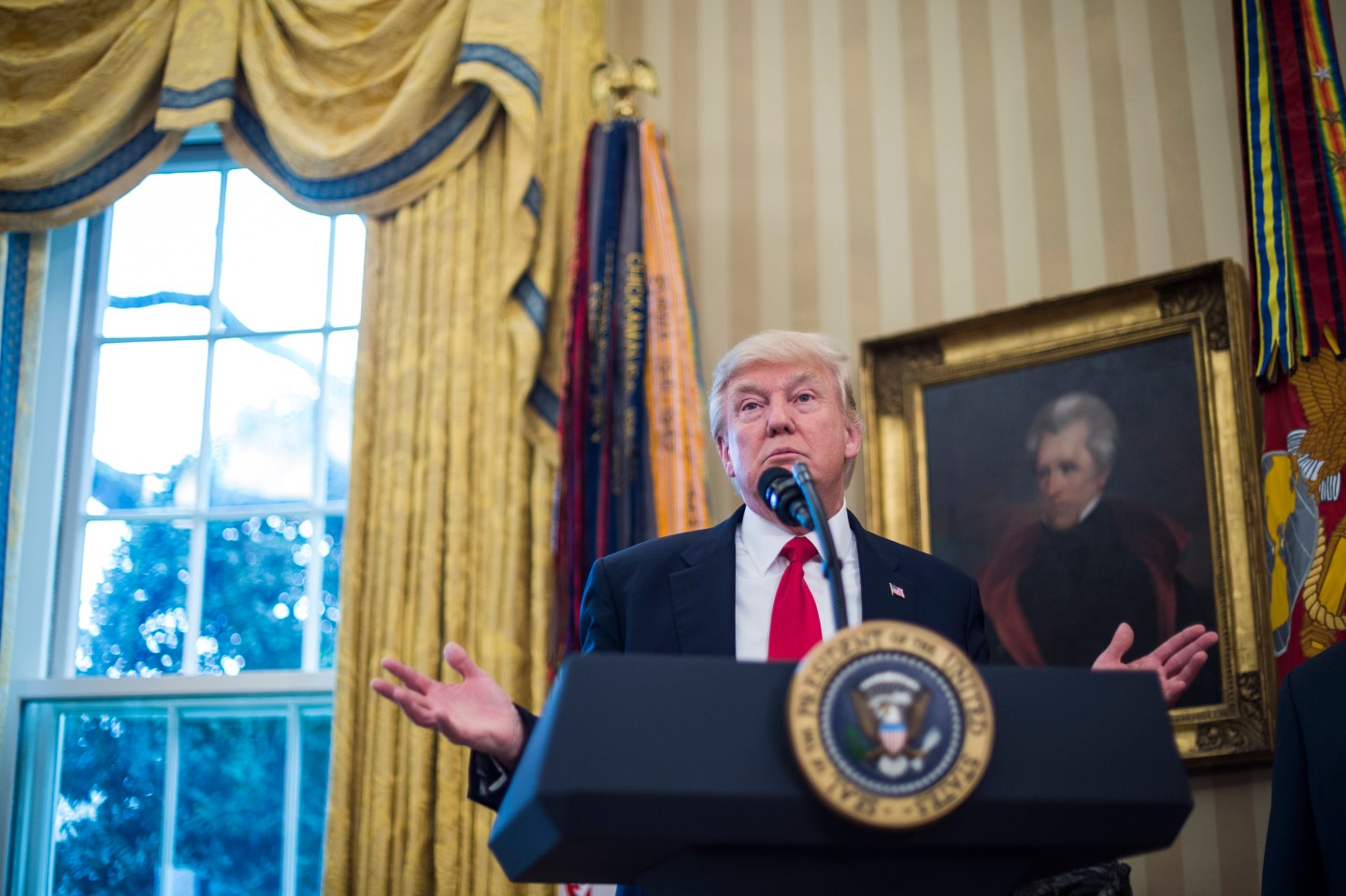
President Donald Trump
The Washington Post The Washington Post/Getty Images

President Trump continued with his promise to put “America First” recently when he withdrew the United States from the Paris Climate Accord. This followed his week of visits in Europe where he did not reaffirm the collective defense provision of NATO (later reaffirmed). Both of these policy positions, although shocking, were in line with what the President’s past views. The foreign reaction was swift . German Chancellor Angela Merkel summed it up by saying that Europe would have to look to its own devices and could no longer depend on the “others” – clearing meaning only one – the United States.

Lost in this high-profile series of steps where America was seemingly distancing itself from its allies in dealing with issues of common economic and security concern, was a positive statement on trade policy that the U.S. and its major allies issued at the G7 Summit meeting in Italy on May 26-27. The G7 unanimously condemned protectionism – something that the Trump administration had refused to do since it came into office on January 20. In international meeting after international meeting throughout the spring, the Trump administration had made a point of refusing to make this pledge.

For American business, what was vitally important in the G7 Summit declaration was the first view of the likely shape of U.S. trade policy in the Trump administration beyond the rhetoric. True, while condemning protectionism, the statement did not opt for total and unconditional free trade. Doing so would be hypocritical. Each of the G7countries, even if much more open than most of the other 157 members of the World Trade Organization (WTO), still protect some sensitive industries and agriculture.

What is noteworthy is that the G7 statement called for all seven nations to stand firm against unfair and trade distorting measures. It condemned dumping, forced technology transfer, subsidies, and non-tariff barriers. The Seven committed to strengthening their cooperation to address global excess capacity in “steel, aluminum and other key industrial sectors and to avoid its emergence in other areas, … viewing with concern market-distorting measures targeted at promoting key technologies.”

The Trump adminstration’s position is a change in course from past U.S. administrations. The usual condemnation of protection confuses actions taken to foster domestic industries at the expense of their foreign competitors—pure protectionism – with effective action tailored to offset foreign industrial policies that cause severe harm to U.S. communities, businesses and workers. This can occur, for example, when other countries support heavily subsidized government-controlled companies that create capacity that far exceeds anticipated market demand and then dump that excess supply in other countries markets. The G7 governments pledged to strengthen their cooperation to deal with the problems that these industrial policies create.

The Seven also re-affirmed their intent to work together to improve the functioning of the World Trade Organization (WTO). Here the G7 countries can provide real leadership. For this to occur, the indispensible country is the United States. The G7 leaders called for “a successful 11th Ministerial Conference” in December of this year. That end of the year conference is where the 164 WTO trade ministers gather to decide what the WTO will attempt to negotiate going forward. The issue most ripe for concerted action is the updating of the WTO to include new rules governing E-commerce, a vital part of world trade that hardly existed when the WTO rules were negotiated a quarter-century ago. Since this is a relatively new area for international trade, there is still time to seek to prevent government restrictions and other forms of industrial policy from distorting international trade in this area as they have in traditional industries.

Last week, the trade ministers of the 34 industrialized country trade ministers met in Paris. This was the first meeting where the newly confirmed, but highly experienced U.S. Trade Representative, Robert Lighthizer, met with all of these counterparts. The meeting ended with an unusual result. The meeting’s Chair issued one statement for most of the ministers and the United States issued its own separate statement. While the two statements are close in many respects, they differ in emphasis. Both express support for a successful WTO meeting in December. The Chair’s statement stresses the importance of open markets, and resisting “all forms of protectionism”. The U.S. statement points to the need for trade to be “free and fair”, calling for a push for “the removal of support by governments and related entities that distort markets.”

This need not be an unbreachable divide. There is no reason to believe that the Trump Administration is going to back away from pledging to use available tools to combat national measures that result in trade and investment distortions while still agreeing that there can be major benefits from expanded world commerce.

The G7 heads of state were able to find common ground. It is up to the trade ministers to see if, as they get into the details of policy, they can do so as well. Reaching consensus on the improvements needed to foster the continued growth of international commerce in a rules-based global trading system is vitally important.

Alan Wolff is Senior Counsel with Dentons. He served as a senior U.S. trade negotiator in Republican and Democratic administrations.


About the Author
By Alan Wolff
See full bioRight Arrow Button Icon

Latest in Commentary

Finance
Lorem ipsum dolor sit amet, consectetur adipiscing elit, sed do eiusmod tempor incididunt ut labore et dolore magna aliqua. Ut enim ad minim veniam
By Fortune Editors
October 20, 2025
Finance
Lorem ipsum dolor sit amet, consectetur adipiscing elit, sed do eiusmod tempor incididunt ut labore et dolore magna aliqua. Ut enim ad minim veniam
By Fortune Editors
October 20, 2025
Finance
Lorem ipsum dolor sit amet, consectetur adipiscing elit, sed do eiusmod tempor incididunt ut labore et dolore magna aliqua. Ut enim ad minim veniam
By Fortune Editors
October 20, 2025
Finance
Lorem ipsum dolor sit amet, consectetur adipiscing elit, sed do eiusmod tempor incididunt ut labore et dolore magna aliqua. Ut enim ad minim veniam
By Fortune Editors
October 20, 2025
Finance
Lorem ipsum dolor sit amet, consectetur adipiscing elit, sed do eiusmod tempor incididunt ut labore et dolore magna aliqua. Ut enim ad minim veniam
By Fortune Editors
October 20, 2025
Finance
Lorem ipsum dolor sit amet, consectetur adipiscing elit, sed do eiusmod tempor incididunt ut labore et dolore magna aliqua. Ut enim ad minim veniam
By Fortune Editors
October 20, 2025

Most Popular

Finance
Lorem ipsum dolor sit amet, consectetur adipiscing elit, sed do eiusmod tempor incididunt ut labore et dolore magna aliqua. Ut enim ad minim veniam
By Fortune Editors
October 20, 2025
Finance
Lorem ipsum dolor sit amet, consectetur adipiscing elit, sed do eiusmod tempor incididunt ut labore et dolore magna aliqua. Ut enim ad minim veniam
By Fortune Editors
October 20, 2025
Finance
Lorem ipsum dolor sit amet, consectetur adipiscing elit, sed do eiusmod tempor incididunt ut labore et dolore magna aliqua. Ut enim ad minim veniam
By Fortune Editors
October 20, 2025
Finance
Lorem ipsum dolor sit amet, consectetur adipiscing elit, sed do eiusmod tempor incididunt ut labore et dolore magna aliqua. Ut enim ad minim veniam
By Fortune Editors
October 20, 2025
Finance
Lorem ipsum dolor sit amet, consectetur adipiscing elit, sed do eiusmod tempor incididunt ut labore et dolore magna aliqua. Ut enim ad minim veniam
By Fortune Editors
October 20, 2025
Finance
Lorem ipsum dolor sit amet, consectetur adipiscing elit, sed do eiusmod tempor incididunt ut labore et dolore magna aliqua. Ut enim ad minim veniam
By Fortune Editors
October 20, 2025
Rankings
  • 100 Best Companies
  • Fortune 500
  • Global 500
  • Fortune 500 Europe
  • Most Powerful Women
  • Future 50
  • World’s Most Admired Companies
  • See All Rankings
Sections
  • Finance
  • Leadership
  • Success
  • Tech
  • Asia
  • Europe
  • Environment
  • Fortune Crypto
  • Health
  • Retail
  • Lifestyle
  • Politics
  • Newsletters
  • Magazine
  • Features
  • Commentary
  • Mpw
  • CEO Initiative
  • Conferences
  • Personal Finance
  • Education
Customer Support
  • Frequently Asked Questions
  • Customer Service Portal
  • Privacy Policy
  • Terms Of Use
  • Single Issues For Purchase
  • International Print
Commercial Services
  • Advertising
  • Fortune Brand Studio
  • Fortune Analytics
  • Fortune Conferences
  • Business Development
About Us
  • About Us
  • Editorial Calendar
  • Press Center
  • Work At Fortune
  • Diversity And Inclusion
  • Terms And Conditions
  • Site Map

© 2025 Fortune Media IP Limited. All Rights Reserved. Use of this site constitutes acceptance of our Terms of Use and Privacy Policy | CA Notice at Collection and Privacy Notice | Do Not Sell/Share My Personal Information
FORTUNE is a trademark of Fortune Media IP Limited, registered in the U.S. and other countries. FORTUNE may receive compensation for some links to products and services on this website. Offers may be subject to change without notice.


Latest in Commentary

Federal Reserve Gov. Chris Waller engages 200 top CEOs at the Yale CEO Summit in December, 2025. (Photo courtesy of the Yale Chief Executive Leadership Institute/Photographer Donovan Marks)
CommentaryFederal Reserve
Why over 80% of America’s top CEOs think Trump would be wrong not to pick Chris Waller for Fed chair
By Jeffrey Sonnenfeld and Steven TianDecember 27, 2025
20 hours ago
Kence Anderson is the founder and CEO of AMESA 
CommentarySoftware
I pioneered machine teaching at Microsoft. Building AI agents is like building a basketball team, not drafting a player 
By Kence AndersonDecember 27, 2025
21 hours ago
Butch Meily
Commentaryempathy
The global empathy crisis that confronts us this Christmas
By Butch MeilyDecember 25, 2025
3 days ago
economy
CommentaryGDP
Why 4.3% GDP growth proves the ‘vibecession’ theory is historically wrong
By Brian HamiltonDecember 24, 2025
4 days ago
students
CommentaryEducation
Why restricting graduate loans will bankrupt America’s talent supply chain
By Katica RoyDecember 23, 2025
5 days ago
Arnault
CommentaryLuxury
The secrets of what Arnault knows: How Bernard Arnault built the impossible, and his timeless, transferable lessons of leadership 
By Jeffrey Sonnenfeld and Steven TianDecember 23, 2025
5 days ago

Most Popular

placeholder alt text
Retail
Trump just declared December 26th a national holiday. What's open and closed?
By Dave SmithDecember 26, 2025
2 days ago
placeholder alt text
Success
As millions of Gen Zers face unemployment, CEOs of Amazon, Walmart, and McDonald's say opportunity is still there—if you have the right mindset
By Preston ForeDecember 26, 2025
2 days ago
placeholder alt text
Future of Work
Malcolm Gladwell tells young people if they want a STEM degree, 'don’t go to Harvard.' You may end up at the bottom of your class and drop out
By Sasha RogelbergDecember 27, 2025
22 hours ago
placeholder alt text
Europe
Christmas 500 years ago was a drunken 6-week feast that may have been considerably better than the modern holiday, medieval historian says
By Bobbi Sutherland and The ConversationDecember 25, 2025
3 days ago
placeholder alt text
Success
Billionaire philanthropy's growing divide: Mark Zuckerberg stops funding immigration reform as MacKenzie Scott doubles down on DEI
By Ashley LutzDecember 22, 2025
6 days ago
placeholder alt text
Commentary
Why over 80% of America's top CEOs think Trump would be wrong not to pick Chris Waller for Fed chair
By Jeffrey Sonnenfeld and Steven TianDecember 27, 2025
20 hours ago