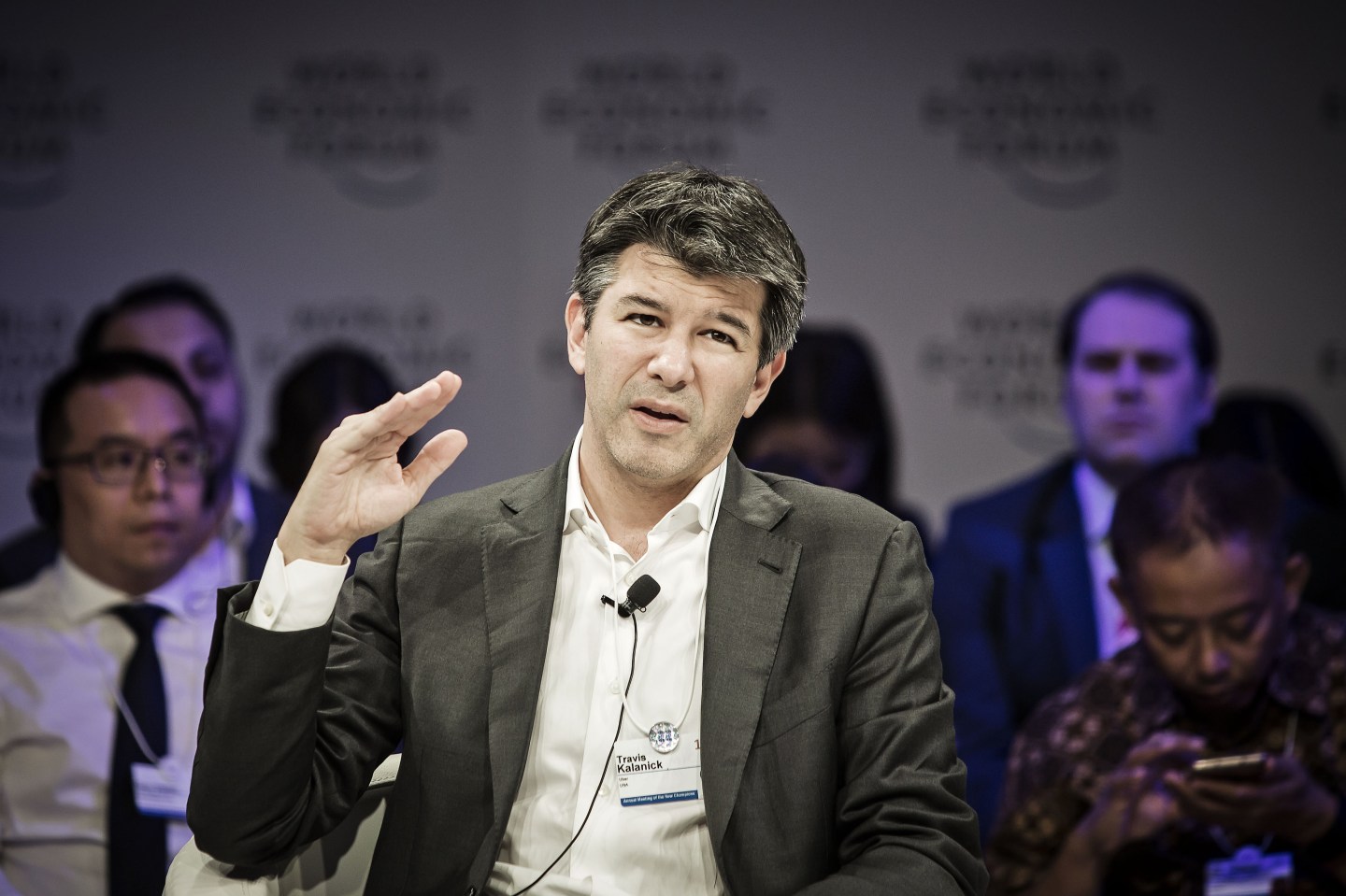
There is no question that the recent #DeleteUber campaign highlights the nuance and delicacy with which global corporations must approach their relationship with consumers. Social media gives consumer activist messages unprecedented power and reach, and digital platforms like Uber are especially susceptible to the fallout from this kind of call for a corporate boycott. But Uber CEO Travis Kalanick’s recent move away from the Trump administration’s business advisory council could have consequences for years to come.
Late last month, when the New York Taxi Workers Alliance called a strike at JFK airport, Uber’s seemingly innocuous choice to stay on the sidelines triggered a massive backlash against the platform. The Taxi Alliance’s hour-long action at 6 p.m. on Jan. 28 aimed to show solidarity with an ongoing protest at JFK Airport against the recent immigration ban. Uber chose to continue picking up JFK passengers during this time, even suppressing surge pricing a little later in the evening.
https://twitter.com/Uber_NYC/status/825502908926066688
Perhaps the intent was to help arriving passengers and avoid being accused of price gouging during a labor action, but these choices were instead interpreted as an attempt at “strike-breaking” on Uber’s part.
I'm a Lyft guy now. Lyft baby!!!!! #deleteuber pic.twitter.com/585D46XYSe
— Olive Rae Brinker (@olivebrinker) January 29, 2017
A blistering response on social media called for users to delete their Uber apps that evening. By Saturday night, #DeleteUber was the top-trending topic on Twitter, and had gone viral by Sunday morning, even as Uber’s key competitor Lyft deftly aligned itself in opposition to the ban with a $1 million donation to the ACLU. As thousands of users cancelled their Uber accounts, the platform had inadvertently placed itself center stage in the highly charged discussion about the immigration ban.
Efforts to manage this public relations crisis proved futile over the next few days. Despite announcing a $3 million legal fund for drivers and signing a letter of solidarity with NYC’s tech leaders, Kalanick’s company continued to bleed users. Meanwhile, downloads of the Lyft app skyrocketed, exceeding Uber’s for the first time on the iPhone app store, and smaller competitors like Juno also enjoyed modest gains from the droves of Uber deserters.
Even as its competitors’ actions fanned the flames of the #DeleteUber campaign, Uber’s losses may well have ended up being temporary: By the following week, the app was back up to No. 12 in the iPhone App Store, and Lyft’s was down to 30. The loss of 200,000 users may end up being a drop in the bucket of over 50 million Uber users.
Was Kalanick’s move an overreaction? Perhaps not. As The New Yorker’s James Surowiecki pointed out last month in an oddly prescient article, the United States has entered an era of heightened “political consumerism” under which corporations are increasingly held responsible for their “real or imagined political messages.” This responsibility is particularly onerous for the digital platforms like Google (GOOG), Facebook (FB), Apple (AAPL), and Uber that are increasingly interwoven into our everyday lives. Compared to other corporate giants like Walmart (WMT) or Exxon Mobil (XOM), interaction with these platforms feels closer and more direct, requiring a deeper level of faith as we entrust them, without hesitation, with information about our intentions, what’s on our minds, our friendships, and our daily movements.
And with this higher level of intimacy comes higher consumer expectations. A perceived breach of trust feels personal, leading to a backlash that is more vociferous and emotional. And Uber’s brash and confrontational image may make it especially susceptible to this kind of blowback.
Kalanick’s decision to distance himself from Trump now aligns him more closely with his Silicon Valley brethren who have collectively filed a motion opposing the immigration ban in the ongoing court battle between the Justice Department and a number of state attorney generals. But his departure from the Trump administration may have adverse longer-term consequences for his company. In the coming years, advances in artificial intelligence and robotics will threaten a number of jobs in the U.S. With the imminent arrival of fully autonomous vehicles, car and truck-driving jobs are among the most vulnerable. A narrative of opposing job displacement caused by technological progress will play well with Trump’s core political base. This looming wave of automation may therefore foreshadow a political battle that will pit the president against corporations in the transportation industry (like Uber) whose future business interests are tied to accelerating the pace of arrival of self-driving cars and trucks.
Granted, Mary Barra, CEO of General Motors (GM) (a company that owns 20% of Lyft), and Tesla’s (TSLA) Elon Musk, both proponents of automotive autonomy, remain on the council. But no other company’s future fortunes are tied as closely to the rapid emergence of self-driving technologies as Uber’s, whose aggressive pilots of these technologies have attracted widespread attention, and whose long-term expansion prospects rest heavily on getting fully autonomous cars on the road rapidly enough to expand meaningfully beyond densely populated cities. To justify and grow its current valuation, the company needs to make significant inroads into shifting suburban consumer spending away from purchasing automobiles and toward the platform’s on-demand mobility services. This is a business whose unit economics work far better with self-driving cars.
Had Uber been more thoughtful and deliberate in its reaction to the recent immigration ban, it may well have been able to state its opposition convincingly enough (like Tesla’s Musk has attempted to do) while allowing its CEO to remain at the president’s table. After all, when one examines its composition more closely, Trump’s business council is not without its share of Trump critics. For example, council member and Pepsico (PEP) CEO Indra Nooyi, a first-generation immigrant herself, was a visible Hillary Clinton supporter who, when asked in November how she was feeling about the election outcome, inquired, “Is there a box of tissues here?”
There is little doubt that, ideologically, stepping down from the council aligns Kalanick more closely with both his employees and with the broader tech industry. But down the road, when viewed through a more pragmatic business lens, it may end up being a move he looks back on with regret.
Arun Sundararajan is author of The Sharing Economy. He is also a professor and the Robert L. and Dale Atkins Rosen faculty fellow at New York University’s Stern School of Business.