• Home
  • News
  • Fortune 500
  • Tech
  • Finance
  • Leadership
  • Lifestyle
  • Rankings
  • Multimedia
Commentary

Overtime pay will boost America’s wages

By
Harry J. Holzer
Harry J. Holzer
and
Bethany Cianciolo
Bethany Cianciolo
Down Arrow Button Icon
By
Harry J. Holzer
Harry J. Holzer
and
Bethany Cianciolo
Bethany Cianciolo
Down Arrow Button Icon
July 2, 2015, 2:18 PM ET
Seattle Minimum Wage
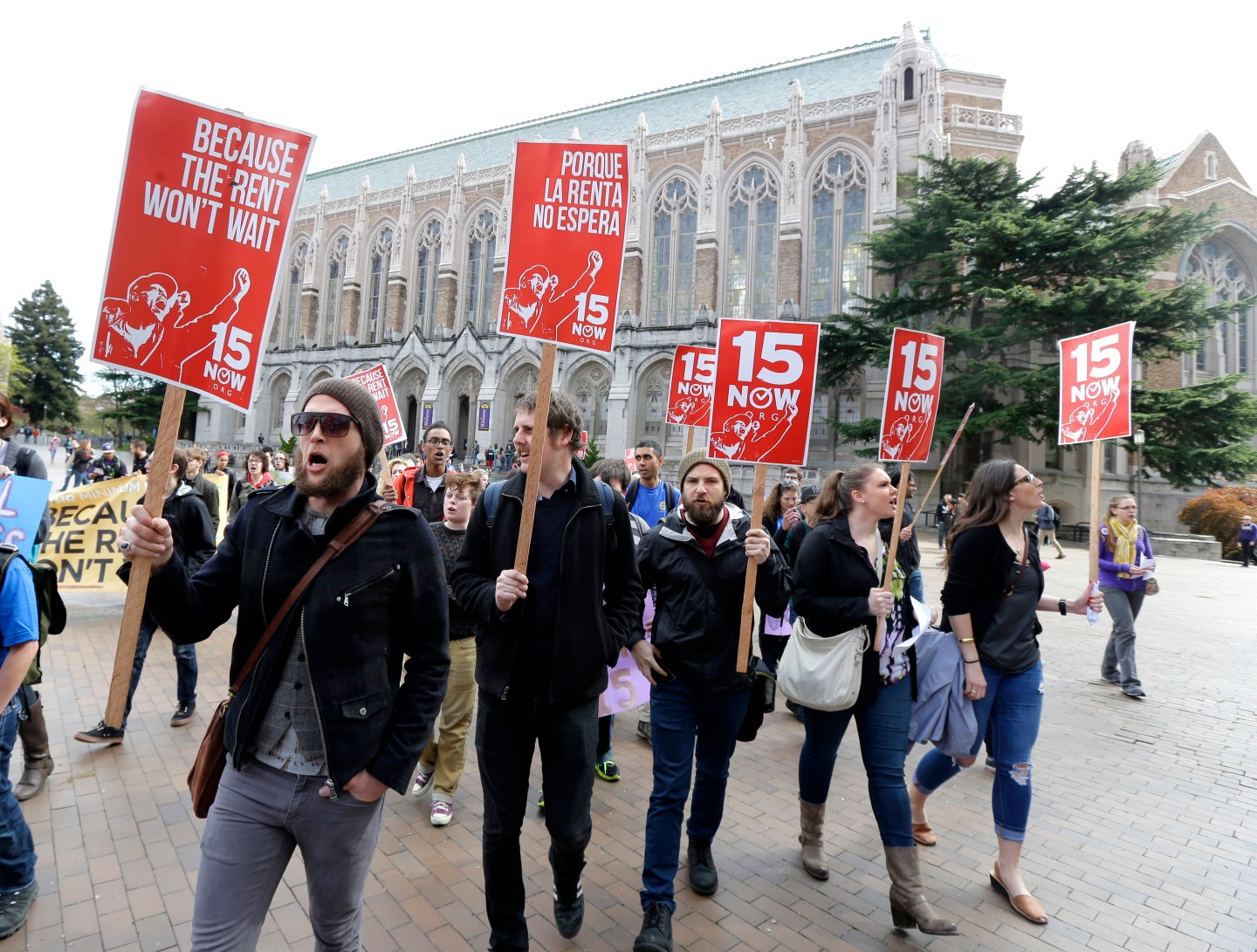
Students and other supporters protest, Wednesday, April 1, 2015, on the University of Washington campus in Seattle, in support of raising the minimum wage for campus workers to $15 an hour. (AP Photo/Ted S. Warren)Photograph by Ted S. Warren — AP

The June jobs report released on Friday shows an increase of 223,000 payroll jobs and a drop in the national unemployment rate to 5.3%. Unfortunately, wages were completely flat, remaining at $24.95 an hour.

So the job market continues to steadily improve, but is doing so too slowly to raise the earnings of workers, which have remained stagnant throughout the economic recovery and are lower than they were in 2000.

How much can policymakers do to raise worker earnings when the labor market remains too soft to do so directly?

In a move that is quite overdue, President Obama earlier this week announced that he will increase the number of workers eligible to receive the 50% premium on overtime work by about 5 million. He plans to raise the ceiling on the annual earnings of workers who can receive overtime pay to over $50,000. The current ceiling — at about $23,000 — hasn’t been adjusted for inflation in decades.

Not surprisingly, some employers complain that this is a burdensome move since it forces them to cut back on how much overtime they ask for from workers. But research suggests this response will be minimal — and not a terrible thing if it does happen — mainly because employers might actually hire more workers in the process. The higher overtime pay might even come out of workers’ regular hourly wages — which employers might now reduce somewhat — though most workers will still likely come out ahead after getting the overtime premium.

Another route to higher earnings, of course, is to raise the minimum wage. President Obama’s reasonable proposal for an increase in the federal minimum to $10 per hour is going nowhere in Congress. So many states and localities are moving ahead on their own, raising wages in their own jurisdictions above the current $7.25-per-hour federal level. While most such state-level increases are modest — in the range of $8 to $10 per hour — some localities are going as high as $15. In fact, three major cities — Los Angeles, San Francisco, and Seattle — have recently raised their minimum wages this high, and activists in other cities, like Washington, D.C., are clamoring for similar increases.

[fortune-brightcove videoid=4330852221001]

Once again, if employers find labor more expensive, they will “buy” less of it and hire fewer workers, though research suggests this effect will be modest if preceding minimum wage increases are modest to begin with. But increasing the minimum wage above the $10 level isn’t considered modest, and employers in these cities might begin to shave some numbers off of their new hiring — or perhaps relocate entirely to lower-wage jurisdictions. And, at best, these wage increases touch only the bottom 10 to 20% of workers and provide nothing to the vast majority whose wages have also stagnated or declined in recent years.

In my view, some policy efforts to raise worker earnings are warranted and sensible. But there is no substitute for a stronger labor market, which would raise wages across the board. Even at a 5.3% unemployment rate, employers seem to feel no pressure yet to increase workers’ earnings.

Harry J. Holzer is a Nonresident Senior Fellow in Economic Studies at the Brookings Institution and a professor at Georgetown University’s McCourt School of Public Policy.


About the Authors
By Harry J. Holzer
See full bioRight Arrow Button Icon
By Bethany Cianciolo
See full bioRight Arrow Button Icon

Latest in Commentary

Ayesha and Stephen Curry (L) and Arndrea Waters King and Martin Luther King III (R), who are behind Eat.Play.Learn and Realize the Dream, respectively.
Commentaryphilanthropy
Why time is becoming the new currency of giving
By Arndrea Waters King and Ayesha CurryDecember 2, 2025
4 hours ago
Trump
CommentaryTariffs and trade
The trade war was never going to fix our deficit
By Daniel BunnDecember 2, 2025
5 hours ago
Elizabeth Kelly
CommentaryNon-Profit
At Anthropic, we believe that AI can increase nonprofit capacity. And we’ve worked with over 100 organizations so far on getting it right
By Elizabeth KellyDecember 2, 2025
6 hours ago
Decapitation
CommentaryLeadership
Decapitated by activists: the collapse of CEO tenure and how to fight back
By Mark ThompsonDecember 2, 2025
6 hours ago
David Risher
Commentaryphilanthropy
Lyft CEO: This Giving Tuesday, I’m matching every rider’s donation
By David RisherDecember 1, 2025
1 day ago
college
CommentaryTech
Colleges risk getting it backwards on AI and they may be hurting Gen Z job searchers
By Sarah HoffmanDecember 1, 2025
1 day ago

Most Popular

placeholder alt text
Economy
Ford workers told their CEO 'none of the young people want to work here.' So Jim Farley took a page out of the founder's playbook
By Sasha RogelbergNovember 28, 2025
4 days ago
placeholder alt text
Success
Warren Buffett used to give his family $10,000 each at Christmas—but when he saw how fast they were spending it, he started buying them shares instead
By Eleanor PringleDecember 2, 2025
9 hours ago
placeholder alt text
Success
Forget the four-day workweek, Elon Musk predicts you won't have to work at all in ‘less than 20 years'
By Jessica CoacciDecember 1, 2025
1 day ago
placeholder alt text
Innovation
Google CEO Sundar Pichai says we’re just a decade away from a new normal of extraterrestrial data centers
By Sasha RogelbergDecember 1, 2025
1 day ago
placeholder alt text
Personal Finance
Current price of gold as of December 1, 2025
By Danny BakstDecember 1, 2025
1 day ago
placeholder alt text
Big Tech
Elon Musk, fresh off securing a $1 trillion pay package, says philanthropy is 'very hard'
By Sydney LakeDecember 1, 2025
1 day ago
Rankings
  • 100 Best Companies
  • Fortune 500
  • Global 500
  • Fortune 500 Europe
  • Most Powerful Women
  • Future 50
  • World’s Most Admired Companies
  • See All Rankings
Sections
  • Finance
  • Leadership
  • Success
  • Tech
  • Asia
  • Europe
  • Environment
  • Fortune Crypto
  • Health
  • Retail
  • Lifestyle
  • Politics
  • Newsletters
  • Magazine
  • Features
  • Commentary
  • Mpw
  • CEO Initiative
  • Conferences
  • Personal Finance
  • Education
Customer Support
  • Frequently Asked Questions
  • Customer Service Portal
  • Privacy Policy
  • Terms Of Use
  • Single Issues For Purchase
  • International Print
Commercial Services
  • Advertising
  • Fortune Brand Studio
  • Fortune Analytics
  • Fortune Conferences
  • Business Development
About Us
  • About Us
  • Editorial Calendar
  • Press Center
  • Work At Fortune
  • Diversity And Inclusion
  • Terms And Conditions
  • Site Map

© 2025 Fortune Media IP Limited. All Rights Reserved. Use of this site constitutes acceptance of our Terms of Use and Privacy Policy | CA Notice at Collection and Privacy Notice | Do Not Sell/Share My Personal Information
FORTUNE is a trademark of Fortune Media IP Limited, registered in the U.S. and other countries. FORTUNE may receive compensation for some links to products and services on this website. Offers may be subject to change without notice.