• Home
  • News
  • Fortune 500
  • Tech
  • Finance
  • Leadership
  • Lifestyle
  • Rankings
  • Multimedia
CommentaryCharleston church shooting

Obama’s Charleston euology, and why strong leaders aren’t afraid to show emotion

By
Mary Civiello
Mary Civiello
Down Arrow Button Icon
By
Mary Civiello
Mary Civiello
Down Arrow Button Icon
June 26, 2015, 7:32 PM ET
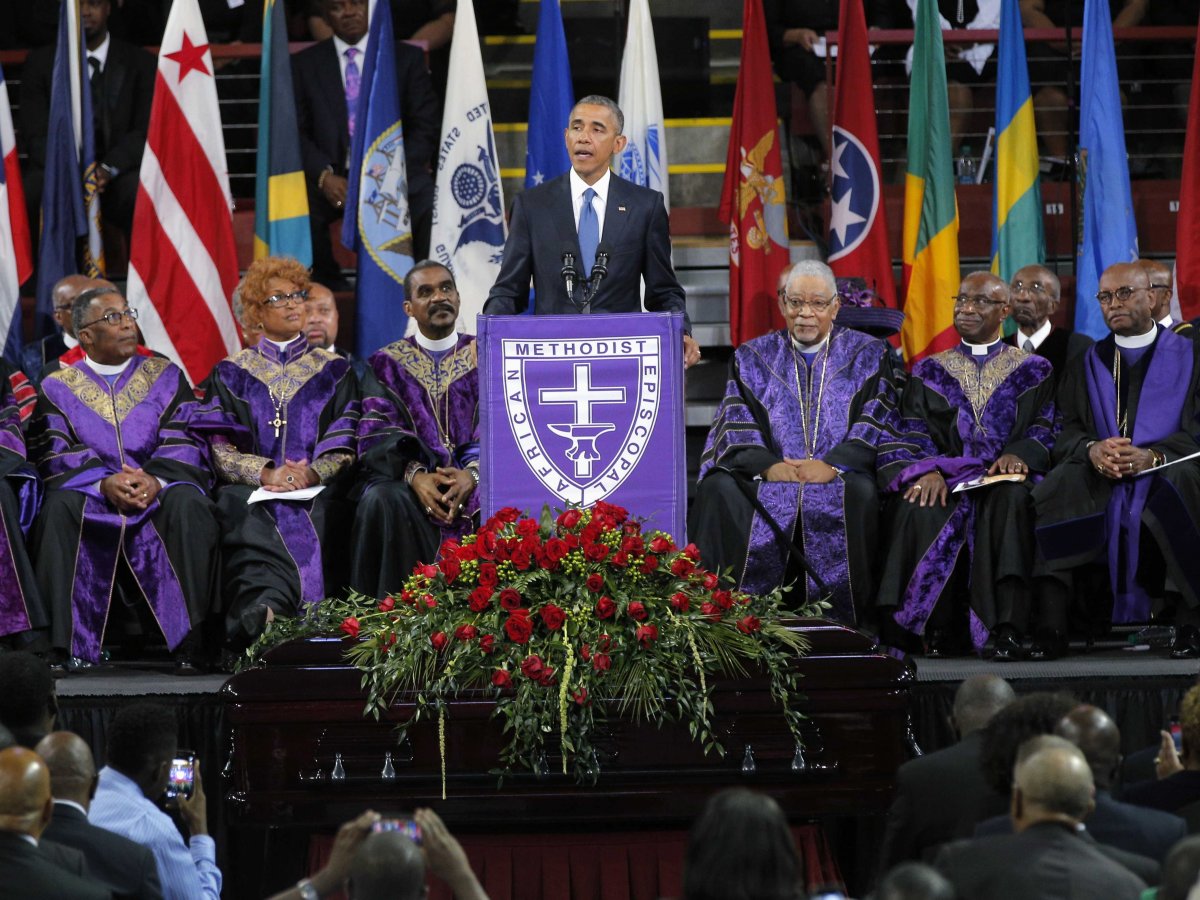
President Barack Obama speaks during funeral services for Rev. Clementa Pinckney.

President Obama’s cool style earned him the no-drama Obama moniker in his first term, but on Friday he delivered a eulogy worthy of an Academy Award. In remembering pastor Clementa Pinckney, who was gunned down last week by a racist terrorist in a South Carolina church, and addressing a wide array of issues from poverty to education and guns, the president showed a range of emotions. He was scripted but delivered his lines — as well as led a beautiful singalong of Amazing Grace — from the heart.

There is no question that the president has been showing more emotion in recent months, but the Charleston church shootings appeared to touch a particular nerve because they involve two difficult issues in his presidency: gun control, which he hasn’t managed to overhaul, and racial divide.

Emotion is an important weapon that the president hasn’t used enough. It plays a critical role in persuasion, whether it is getting lawmakers to support legislation or convincing employees and clients to go along with your plan. It engages audiences and makes a message memorable. Brain research confirms that memory works by attaching emotion to events. In my 15 years of coaching corporate executives, I’ve found that talking about feelings is one of the most difficult things to do for men and women. There are several reasons:

Many executives have a difficult time expressing emotion or even identifying feelings because work and feelings feel incongruous. I was recently helping a pharmaceutical executive who was preparing to talk about a failed clinical trial for a drug. He had mountains of data, but I asked how he felt about it. He paused and said, “Well it is unfortunate…”

Okay, I pushed to explain. Reluctantly, he discussed the years of his hard work. Pushed again, he elaborated — yes, disappointing because of the hope that it offered people suffering from cancer. He did care about patients, but they weren’t part of his everyday life. (Ultimately, he received wide praise for including those reactions because he needed to persuade senior leaders to allocate more resources to a related project and needed to win patient groups support.)

Still, other people are not naturally or culturally inclined to share emotions. I worked recently with an executive who was preparing to deliver a community talk on parenting. He said his father taught him hard work and perseverance, and he shared that his father, now in his late 80s, had recently undergone difficult surgery but was back in the gym just days later. He agreed that others might have given up, but he had a hard time saying how that feat made him feel. Finally, he confided that it was hard to applaud because in his world, it was what was expected.

There are other reasons executives don’t emote. Some fear it will make them look weak. A senior vice president of a financial firm told me that looking sympathetic when sharing a new strategy made her look open to alternatives when she was firmly resolved to make unpopular changes.

Still, others are afraid that opening an emotional door will produce a floodgate of feelings that will be embarrassing a la John Boehner or Steve Ballmer. They worry that emotions will alienate more than unify. In David Axelrod’s book, Believer: My Forty Years in Politics, the former senior advisor to Obama paints a picture of a president who talked policy but is more prickly and emotional than he lets on in public.

But when you are trying to win friends and influence people, there is nothing like sharing your feelings or acknowledging the feelings of others, even if you don’t share them. It warms you up, makes you human, makes you more likable.

It is hard to tell if Obama’s emotions will lead to the kinds of changes that he wants to be part of his legacy. But it will surely lead to a record that shows he really cared, just like the man he eulogized so eloquently on Friday.

Mary Civiello is president of Civiello Communications Group.

About the Author
By Mary Civiello
See full bioRight Arrow Button Icon

Latest in Commentary

Amit Walia
CommentaryM&A
Why the timing was right for Salesforce’s $8 billion acquisition of Informatica — and for the opportunities ahead
By Amit WaliaDecember 6, 2025
6 hours ago
Steve Milton is the CEO of Chain, a culinary-led pop-culture experience company founded by B.J. Novak and backed by Studio Ramsay Global.
CommentaryFood and drink
Affordability isn’t enough. Fast-casual restaurants need a fandom-first approach
By Steve MiltonDecember 5, 2025
1 day ago
Paul Atkins
CommentaryCorporate Governance
Turning public companies into private companies: the SEC’s retreat from transparency and accountability
By Andrew BeharDecember 5, 2025
1 day ago
Matt Rogers
CommentaryInfrastructure
I built the first iPhone with Steve Jobs. The AI industry is at risk of repeating an early smartphone mistake
By Matt RogersDecember 4, 2025
2 days ago
Jerome Powell
CommentaryFederal Reserve
Fed officials like the mystique of being seen as financial technocrats, but it’s time to demystify the central bank
By Alexander William SalterDecember 4, 2025
2 days ago
Rakesh Kumar
CommentarySemiconductors
China does not need Nvidia chips in the AI war — export controls only pushed it to build its own AI machine
By Rakesh KumarDecember 3, 2025
3 days ago

Most Popular

placeholder alt text
Economy
Two months into the new fiscal year and the U.S. government is already spending more than $10 billion a week servicing national debt
By Eleanor PringleDecember 4, 2025
2 days ago
placeholder alt text
Success
Nvidia CEO Jensen Huang admits he works 7 days a week, including holidays, in a constant 'state of anxiety' out of fear of going bankrupt
By Jessica CoacciDecember 4, 2025
2 days ago
placeholder alt text
Big Tech
Mark Zuckerberg rebranded Facebook for the metaverse. Four years and $70 billion in losses later, he’s moving on
By Eva RoytburgDecember 5, 2025
1 day ago
placeholder alt text
Success
‘Godfather of AI’ says Bill Gates and Elon Musk are right about the future of work—but he predicts mass unemployment is on its way
By Preston ForeDecember 4, 2025
2 days ago
placeholder alt text
Success
Nearly 4 million new manufacturing jobs are coming to America as boomers retire—but it's the one trade job Gen Z doesn't want
By Emma BurleighDecember 4, 2025
2 days ago
placeholder alt text
Real Estate
‘There is no Mamdani effect’: Manhattan luxury home sales surge after mayoral election, undercutting predictions of doom and escape to Florida
By Sasha RogelbergDecember 4, 2025
2 days ago
Rankings
  • 100 Best Companies
  • Fortune 500
  • Global 500
  • Fortune 500 Europe
  • Most Powerful Women
  • Future 50
  • World’s Most Admired Companies
  • See All Rankings
Sections
  • Finance
  • Leadership
  • Success
  • Tech
  • Asia
  • Europe
  • Environment
  • Fortune Crypto
  • Health
  • Retail
  • Lifestyle
  • Politics
  • Newsletters
  • Magazine
  • Features
  • Commentary
  • Mpw
  • CEO Initiative
  • Conferences
  • Personal Finance
  • Education
Customer Support
  • Frequently Asked Questions
  • Customer Service Portal
  • Privacy Policy
  • Terms Of Use
  • Single Issues For Purchase
  • International Print
Commercial Services
  • Advertising
  • Fortune Brand Studio
  • Fortune Analytics
  • Fortune Conferences
  • Business Development
About Us
  • About Us
  • Editorial Calendar
  • Press Center
  • Work At Fortune
  • Diversity And Inclusion
  • Terms And Conditions
  • Site Map

© 2025 Fortune Media IP Limited. All Rights Reserved. Use of this site constitutes acceptance of our Terms of Use and Privacy Policy | CA Notice at Collection and Privacy Notice | Do Not Sell/Share My Personal Information
FORTUNE is a trademark of Fortune Media IP Limited, registered in the U.S. and other countries. FORTUNE may receive compensation for some links to products and services on this website. Offers may be subject to change without notice.










