Don’t look now, but Bitcoin is back. This may come as a surprise to investors who wrote off crypto altogether after a spectacular series of frauds and mishaps led the value of the currency to plummet by around 75% from late 2021 through 2022.
Yet it’s hard to argue with recent numbers. Since it bottomed out at $16,000 in November 2022, Bitcoin has rebounded; in March it passed the $70,000 mark for the first time. Like it or not, the quirky currency stands as one of the best-performing assets of the year and of the decade—even after a recent pullback.
Many changes have driven this rally, but one of the biggest is the fact that you can now invest in Bitcoin through exchange-traded funds (ETFs)—a process that feels far safer and easier for newcomers. Long-established financial brands like BlackRock and Fidelity have jumped into the ETF game, conferring legitimacy on a sector still viewed by many as the province of rogues and gamblers. The halo effect of the giant asset managers may spread still further in coming months, as they begin including Bitcoin ETFs in some of the model portfolios they recommend to investment advisors.
But for the novice wondering if now’s the time to invest, it’s critical to understand how Bitcoin and other cryptocurrencies work—as well as the forces behind the recent rally.
Different this time?
Bitcoin first appeared in the wake of the 2008 financial crisis, when governments around the world printed massive amounts of money to prop up their banking systems. Pseudonymous founder Satoshi Nakamoto saw Bitcoin as a form of decentralized money with a fixed supply that would not be subject to inflation or political control. Its design calls for only 21 million Bitcoins to be minted by 2140. Over 90% of those have already been issued, and future supply is constrained even more after the latest so-called halving, which took place April 20, which substantially slowed the rate at which new coins are created.
This scarcity is a big part of Bitcoin’s appeal and why its boosters hail it as “digital gold.” Indeed, in March, the cryptocurrency’s market cap for the first time eclipsed that of silver, topping $1.4 trillion.
But Bitcoin is far more volatile than gold or silver, and subject to spectacular flameouts. The current bull market comes after three previous episodes of mania—each followed by a jaw-dropping crash.
It’s worth noting that each collapse roughly coincided with a significant news event. In 2014, it was a catastrophic hack that cleaned out an exchange called Mt. Gox, then the industry’s prime source of liquidity. A 2017 bubble popped not long after the Securities and Exchange Commission issued a report that foreshadowed a regulatory crackdown. Finally, a pandemic-era high of $69,000 was erased by a calamitous wipeout, triggered in part by a wave of fraud that culminated with the collapse of the FTX exchange and the December 2022 arrest of its founder, Sam Bankman-Fried.
All that said, the crypto market’s highs and lows have historically been driven by a constellation of factors rather than a single event (other factors have included high interest rates, leaps in technology, and investor herd mentality). The current rally, which began picking up steam last summer, likewise had several catalysts—notably a series of U.S. court decisions that undercut the anti-crypto policies of the SEC, and the November conviction of Bankman-Fried, which many viewed as a turning of the page for the beleaguered industry.
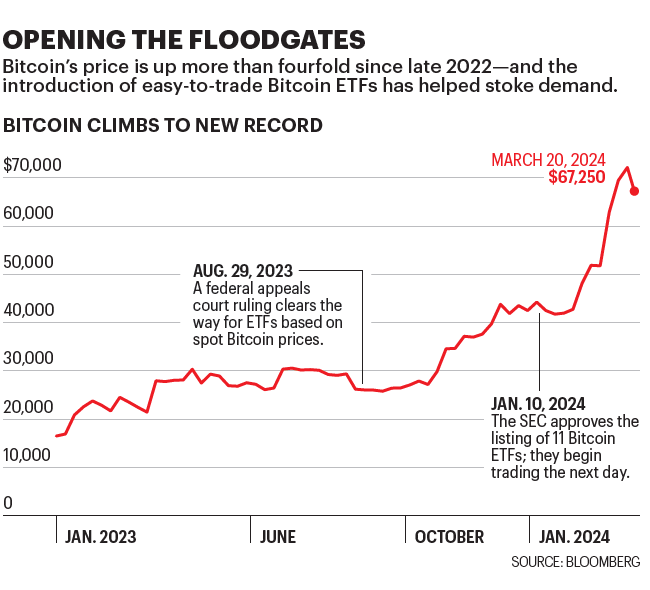
The biggest driver by far, however, is the launch in January of Bitcoin ETFs, which for the first time allowed investors to trade stakes in the cryptocurrency on major stock exchanges. The launch unleashed a wave of pent-up demand: By mid-March, the new ETFs had attracted more than $10 billion in net inflows, and Bitcoin’s price climbed 50% in just two months.
BlackRock’s IBIT, Fidelity’s FBTC, and ARK Invest’s ARKB have captured the biggest share of the money so far. Other companies offering Bitcoin ETFs include traditional-finance firms Franklin Templeton and Van Eck, and four crypto-native firms. Nearly all offer the ultralow fees characteristic of ETFs, ranging from 0.19% to 0.3% of assets invested.
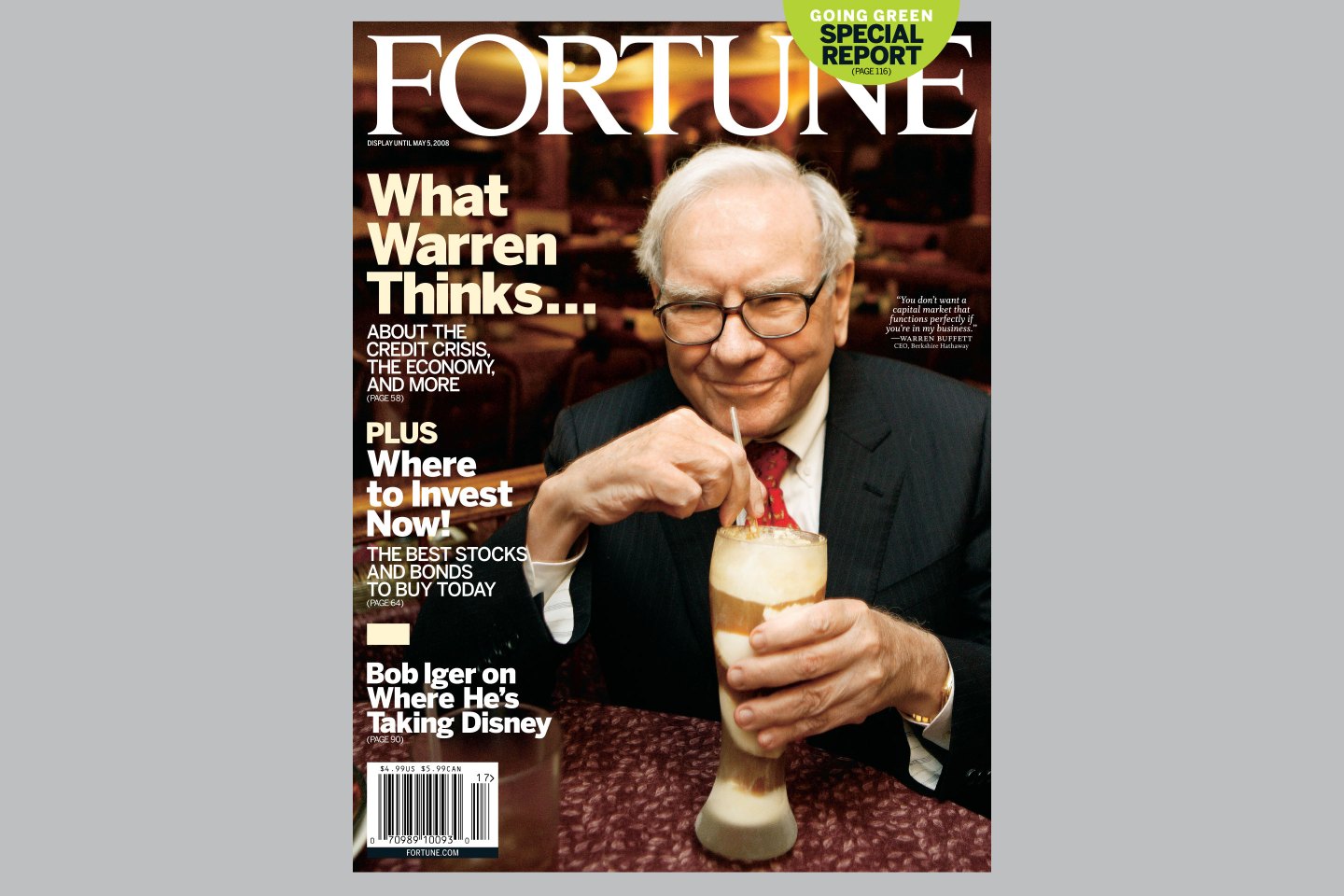
It helps that Bitcoin is now mainstream: While prominent critics remain, including Warren Buffett and JPMorgan Chase CEO Jamie Dimon, it’s hard to find any under age 50. For younger investors, 15-year-old Bitcoin no longer feels exotic or untried.
Not everyone on Wall Street, though, is convinced Bitcoin is a sound investment. Most notably, Vanguard is not only sitting out the parade, but also refuses to let clients buy ETFs launched by others. In a recent blog post, the nonprofit investment giant called Bitcoin “an immature asset class that has little history, no inherent economic value, no cash flow, and can create havoc within a portfolio.”
Gut check
Vanguard’s observations, while perhaps pessimistic, underscore why investors should proceed cautiously. The question of whether to join the latest rush ultimately depends on your stomach for risk and volatility.
It would be folly, of course, to sink all or most of your wealth into any cryptocurrency—or any single investment outside of a house. But even a very modest Bitcoin investment can have outsize consequences for your portfolio. Bryan Armour, director of passive strategies research at Morningstar, notes that equities are traditionally considered to be the most risky assets—but Bitcoin has been four times as volatile as U.S. stocks over the past five years. “Adding a 5% allocation of Bitcoin to a [60% stocks/40% bonds] portfolio gives it a risk profile closer to that of a 90/10 portfolio,” Armour explains, while one with a 10% allocation would “significantly outstrip the volatility of a 100% allocation to the S&P 500.”
Others argue that in truly bad economic conditions, Bitcoin should hold its value. Stéphane Ouellette, CEO of FRNT Financial, a trading platform focused on digital assets, says Bitcoin is right for anyone seeking a hedge against “disruptions in the incumbent financial system.”
For those inclined to take a flier, buying Bitcoin ETFs through a brokerage is likely the simplest option. Investors can also buy Bitcoin directly on platforms like Coinbase or Robinhood. For those who primarily want protection from a financial-system meltdown, it is possible to hold the asset directly on a flash drive; this requires technical acumen, and, of course, you’re on your own if crooks and hackers come for your crypto.
Finally, there’s the question of whether buying Bitcoin near an all-time high is a smart move. The recent run-up was fueled in part by the impending halving. But J.P. Morgan analysts cautioned in late February that potential gains from halving have been priced in, and that Bitcoin could fall to $42,000 once the ETF hype wears off.
Scarcity alone, meanwhile, won’t prop up the price if unforeseen events—a hack, a prosecution, a regulatory setback—undermine investors’ faith. With Bitcoin even more than with most investments, past performance is no guarantee of future results.
A version of this article appears in the April/May 2024 issue of Fortune with the headline, ”Is the Bitcoin bull market safe to buy?”