
It may take some time for Nvidia to see the upside from U.S. President Donald Trump’s unprecedented offer to allow AI chip sales to China in exchange for a 15% cut.
The deal could shake up an export control regime designed to maintain the U.S.’s edge in strategic technologies. Officials like Treasury Secretary Scott Bessent are already positioning the arrangement as a model for other companies hoping to sell sensitive technology to China.
But during Nvidia’s earnings call on Wednesday, CFO Colette Kress noted that while the U.S. government has expressed an “expectation” that it would get 15% of Nvidia’s H20 revenue, it “has not published a regulation codifying such requirement.”
In a later exchange filing, Nvidia warned that “any request for a percentage of the revenue by the USG may subject us to litigation, increase our costs, and harm our competitive position and benefit competitors that are not subject to such arrangements.”
The U.S.-China tech war casts a shadow on Nvidia’s otherwise surging business. The company dropped China sales from its forecast, and its 10-Q filing includes a litany of warnings about regulatory scrutiny from both Washington and Beijing.
And that’s a worry for Nvidia and its access to what CEO Jensen Huang described Wednesday as a $50 billion opportunity in the “second-largest computing market in the world.” Nvidia’s chips may be the world’s best AI processors—but Chinese competitors are catching up.
Nvidia reported $46.7 billion in quarterly revenue, a 56% jump year on year, even as Nvidia revealed that it didn’t ship any H20s to Chinese customers last quarter. Quarterly profit also jumped by 59% to hit $26.4 billion.
The company forecast $54 billion in revenue for the next quarter, which would represent a more than 50% jump from the same period a year earlier.
Nvidia did not include possible H20 sales to China as part of its forecast, citing “geopolitical issues.” Yet in her remarks, Kress said the company could see as much as $5 billion in H20 revenue in the coming quarter if geopolitical issues recede. “Every licensed sale we make will benefit the U.S. economy,” she said.
Sales to customers that use China as a billing location dropped to $2.8 billion, down from $3.7 billion a year ago.
Revenue from customers that invoice in Singapore rose 80% to $10.1 billion. In its stock filing, Nvidia clarified that revenue booked to Singapore involves products that are “almost always shipped elsewhere,” and added that 99% of its “controlled data center compute revenue” billed to Singapore came from U.S.-based customers last quarter.
Nvidia has been barred from selling its leading AI processors to China since 2022. Huang has been a longtime critic of U.S. export controls, complaining that they will instead encourage the growth of domestic Chinese alternatives and freeze U.S. companies out of the market.
In April, Nvidia revealed that it would need a license to sell the H20 processor, its latest attempt to make a processor that complies with U.S. law, to China. Then, in late July, the Trump administration reversed course: As part of its trade war truce with China, the U.S. signaled that it might allow H20 sales in China.
Shares slump
Despite the more than 50% jump in revenue, Nvidia shares dropped by 3.1% in extended trading, as data center revenue, at $41 billion, missed some of the more bullish estimates from analysts.
Asian tech had a mixed reaction to Nvidia’s earnings. Taiwan Semiconductor Manufacturing Co. fell by 2.5%. Foxconn, which makes AI services, dropped by 1.0%.
Yet SK Hynix, a Korean supplier of high-bandwidth memory to Nvidia, jumped by 3.3%. Tokyo Electron, a major manufacturer of chipmaking equipment, rose by 1.9%.
Chinese tech companies performed poorly. Alibaba plunged by 4.4%, though negative sentiment may have been owing to concerns over a fierce and expensive fight over food-delivery market share with Meituan and JD.com. Baidu, another leading Chinese AI developer, fell by 1.3%.
But Chinese chipmakers, increasingly viewed as real competitors to Nvidia’s AI chips—at least in China—performed well in Thursday trading. Semiconductor Manufacturing International Corp., China’s national champion chipmaker, rose by 10.4%. Cambricon, another local AI chipmaker, surged by 15.7%, and surpassed Kweichou Moutai as China’s most expensive stock.
Greater competition
In its stock filing, Nvidia gave another stark warning about its competitive position in China going forward. “We may be unable to create a competitive product for China’s data center market that receives approval from the USG,” it warned. “In that event, we would effectively be foreclosed from competing in China’s data center computing/compute market.”
Nvidia’s products—including its “fourth-best” H20 processor—are still ahead of what Chinese companies can produce. Yet domestic chipmakers, like Huawei and its Ascend chips, are starting to catch up, and more important, may soon offer better products than what Nvidia or its peers are allowed to sell in China.
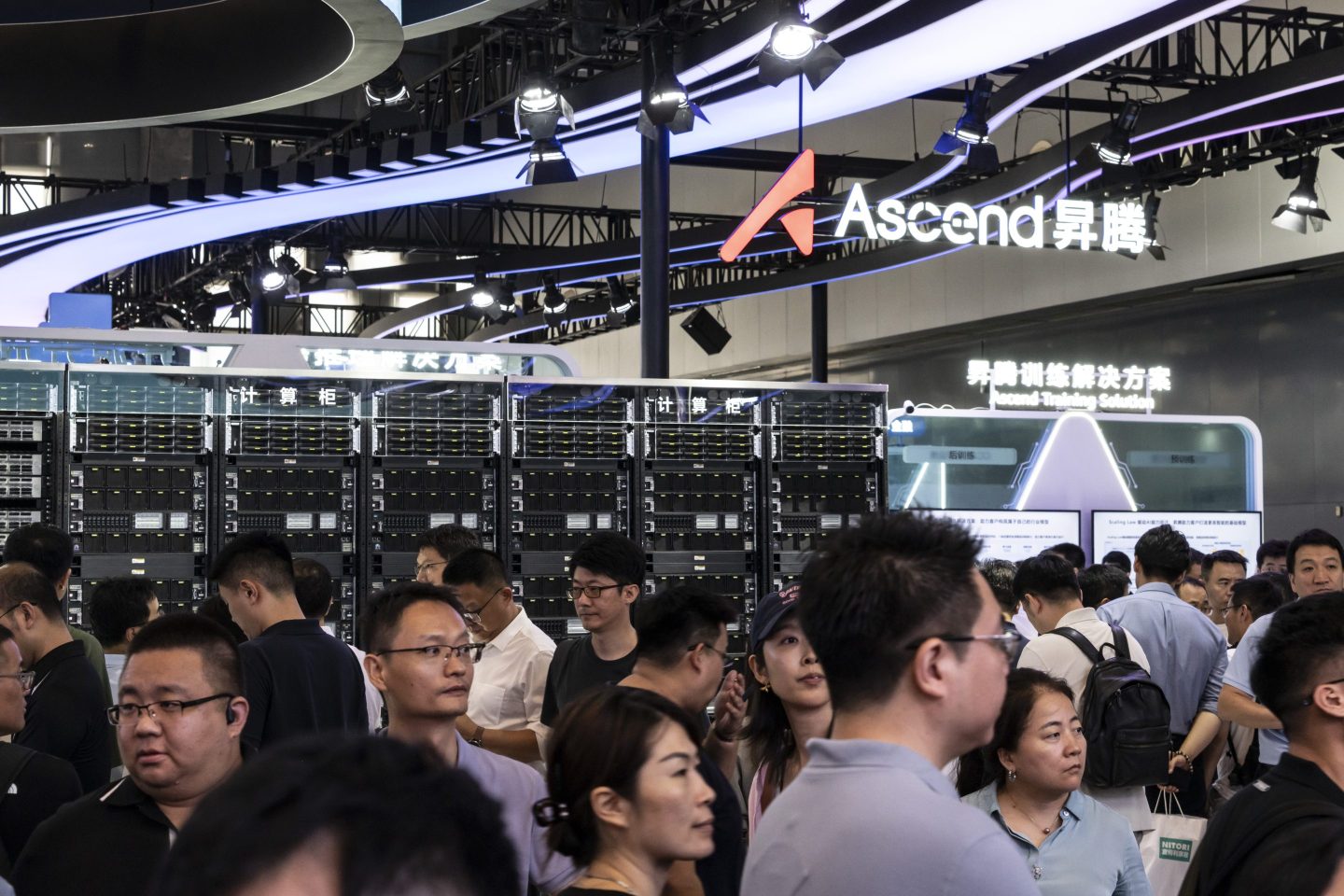
Beijing would be quite happy for Chinese companies to buy local alternatives. Earlier this month, both Bloomberg and the Financial Times reported that Chinese officials were pushing local companies, particularly those affiliated with the government, to halt their purchases of Nvidia chips. Officials have questioned whether Nvidia’s China chips pose a security risk, following U.S. discussions of including back doors and kill switches in Nvidia products to combat chip smudging.
Nvidia strongly denies including any such back doors in its products, and Huang has reiterated that Nvidia’s chips do not pose a threat to Chinese national security.
In its stock filing, Nvidia pointed out that China could exert its own regulatory pressure on the company, pointing to an antitrust investigation launched last year into its 2020 acquisition of Mellanox. (Beijing has often used antitrust measures as a way to retaliate against U.S. export controls). Beijing officials are also asking whether complying with U.S. export controls constitutes discrimination against Chinese customers.
China’s $50 billion opportunity
On Wednesday, Huang suggested that China could offer Nvidia a $50 billion opportunity for the year, “if we were able to address it with competitive products.”
U.S. tech shares have recovered since January’s DeepSeek shock, but China’s open-source models from companies like Alibaba, Moonshot AI, Z.ai, and DeepSeek have continued to impress outside observers. And it’s helped boost Chinese shares: Hong Kong’s Hang Seng Index is up by more than 25% for the year, compared with 10% for the S&P 500.
China’s embrace of open-source models is also changing how U.S. developers approach AI. In recent weeks, both OpenAI and xAI have released open-source versions of their proprietary models; OpenAI CEO Sam Altman even pointed to China as the reason behind his company’s return to open-source.
“The vast majority of the leading open-source markets are created in China, and so it’s fairly important, I think, for the American technology companies to be able to address that market,” Huang said Wednesday. “The open-source models that have come out of China are really excellent.”
Earlier this month, Trump suggested that he was open to Nvidia selling a version of its powerful Blackwell processor to the Chinese market. CEO Jensen Huang previously confirmed that discussions were taking place, and on Wednesday’s earnings call said, “The opportunity for us to bring Blackwell to the China market is a real possibility.
“We just have to keep advocating for the sensibility of and the importance of American tech companies to be able to lead and win the AI race and help make the American tech stack the global standard,” Huang said.
Nvidia may have less time than Huang hopes. Last week, DeepSeek unveiled V3.1, the latest version of its AI model—with a special feature that optimizes performance on Chinese-made chips.