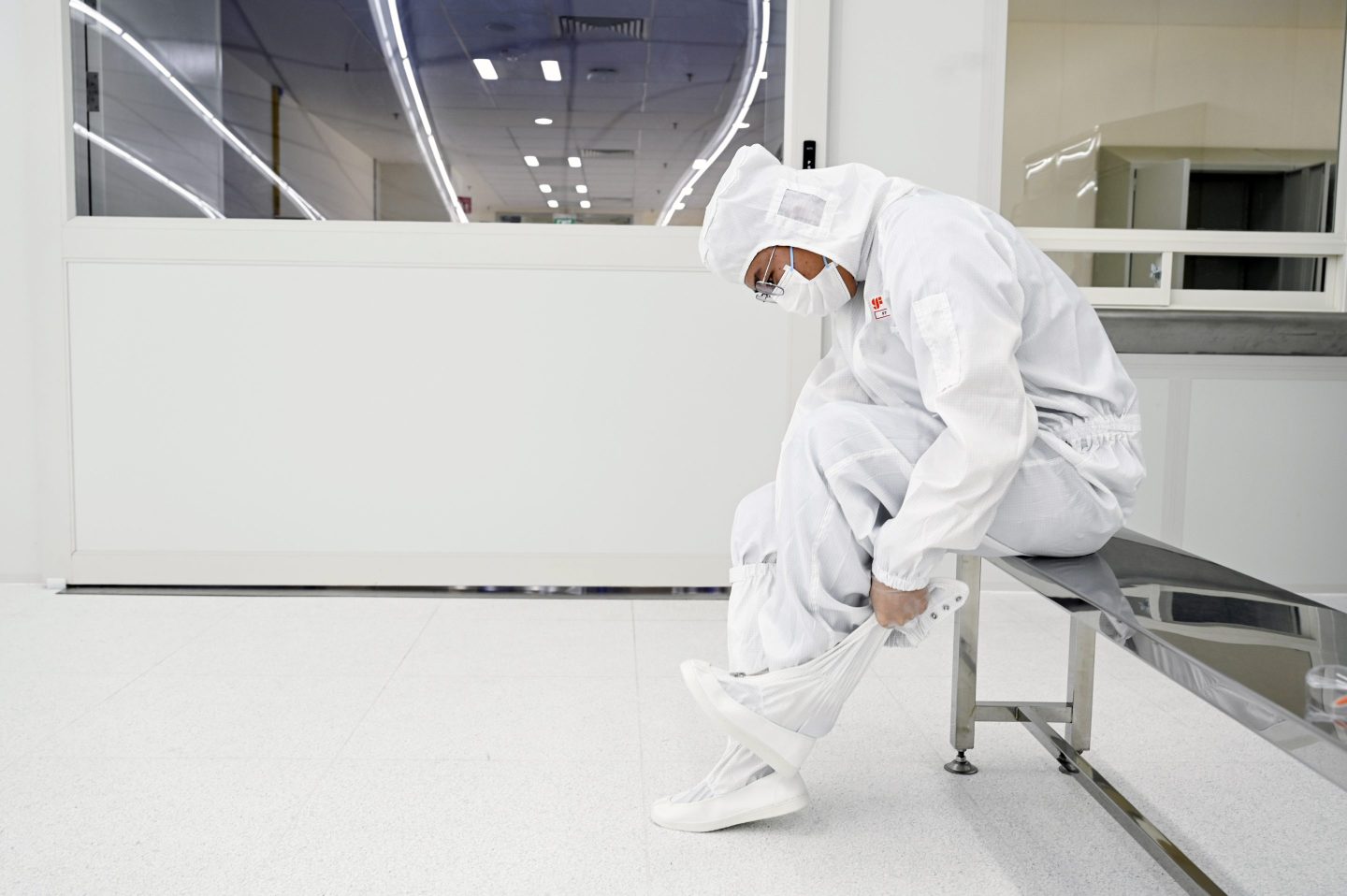
In mid September, GlobalFoundries, the world’s third-largest contract chip manufacturer, opened its new 23,000 square meter plant in a surprising location. Not the U.S., which is offering $52 billion in subsidies for domestic chip manufacturing. Not Japan nor Germany with their similar industrial policies. Not Taiwan, the home of the world’s most advanced chip plants from firms like Taiwan Semiconductor Manufacturing Company.
Instead, the facility—coming with 1,000 new high-skilled jobs—opened in Singapore, the small and highly-developed Southeast Asian country of just under six million.
Many major economies are trying to attract domestic chip manufacturing. But while Singapore can’t match the budgetary firepower of Washington or Berlin, it has something else: A consistent strategy for manufacturing and a mature ecosystem for semiconductors.
And that could be a lesson for other countries hoping to break into chips: Experience and expertise may be worth more than money.
Singapore attracted $8.6 billion and $16.4 billion in fixed asset investments for 2021 and 2022 respectively, according to the country’s Economic Development Board, a government agency focused on enhancing Singapore’s global attractiveness for business. Much of those commitments were driven by electronics and semiconductors, the EDB said.
“Singapore has this advantage of having a good trained workforce, as well as a good supporting ecosystem,” Rakesh Kumar, a professor in electrical and computer engineering at the University of Illinois Urbana-Champaign, says. “These are very significant advantages.”
GlobalFoundries’ latest plant in Singapore is part of a $4 billion expansion plan, announced back in June 2021. And another chip manufacturer, the Taiwan-headquartered United Microelectronics Corp, is investing $5 billion in a new advanced manufacturing facility, expected to start operations late next year.
Singapore has “a stable government, business-friendly environment, and comprehensive infrastructure required for semiconductor manufacturing, coupled with strong IP protection and a world-class education system,” Tan Yew Kong, senior vice president and general manager at GlobalFoundries Singapore, said in a statement, adding that the Singaporean government also provides “strong support.”
Other firms in the chip ecosystem—designers, manufacturers, packaging and testing firms, and equipment suppliers, among others—are expanding in Singapore too. AMD, a chip designer, said in September 2022 that it was investing more than $50 million to expand its R&D footprint in the country. Soitec, a French semiconductor materials supplier, broke ground on a $424 million extension of its plant in December last year. Ardentec, a provider of semiconductor test services, also started work on its new $182 million test facility that same month.
“The ecosystem is a must. You need to have other similar semiconductor companies,” Chitung Liu, UMC’s chief financial officer, says.
Getting off the ground
Subsidies aren’t enough to attract semiconductor companies, Kumar suggests. Economies with a large existing presence in chip supply chains tend to be the ones to attract manufacturing investments.
“Spinning things up from the ground is hard,” Kumar says. “Consider the case of India: They wanted to attract all these big players so they decided to throw in so many subsidies. But they have not succeeded in attracting any advanced chip manufacturing in spite of all the money they’ve thrown [at the issue]”, he says. India announced a $10 billion incentive plan to encourage chip manufacturing in late-2021 in hopes of making the country a key player in the global semiconductor supply chain.
Even developed economies like the U.S. are facing challenges in bringing semiconductor manufacturing back. TSMC’s Arizona plant, where it eventually hopes to make advanced chips for companies like Apple, will likely be delayed, as the Taiwanese company complains of a lack of local expertise, higher labor costs, and profit-sharing conditions from Washington. (The U.S. makes about 12% of chips today, down from a third in 1990.)
Singapore’s chipmaking history
Despite lacking an Intel, Samsung, or TSMC, Singapore has been a consistent player in the chip industry since 1968, when the U.S. microelectronics firm National Semiconductor Company set up operations at an EDB facility. A wave of Western companies followed, including Texas Instruments, Siemens and Infineon. And even as other economies like South Korea and Taiwan built up their own chip industries, Singapore started to expand into design and wafer fabrication.
That existing ecosystem gives real benefits to chipmakers looking to invest.
A company could save between 10 to 15% of the cost when it builds a second facility near a pre-existing fab, Peter Hanbury, a partner who looks at the semiconductor industry at the consultancy Bain & Co, suggests. Singapore’s pool of “highly educated talent” will make the city an attractive option going forward, he says.
Still, several of these newest chip facilities are coming online right as the market for mature chips is in a slump. With the significant exception of AI-focused chip firms like Nvidia and AMD, most chip companies have reported declining revenue as demand for consumer electronics like computers, laptops and smartphones slows down. (Chipmakers now hope that the consumer electronics market is stabilizing, as losses begin to narrow)
Yet the EDB is “confident of the sector’s long-term growth prospects,” a spokesperson from the agency says. The government plans to invest more in the semiconductor sector, which contributes about 7% of Singapore’s GDP. The country is committing $18 billion between 2021 and 2025 to support R&D and innovation, according to the EDB.
But to chipmakers like UMC, Singapore’s support goes beyond money. UMC’s competitors are getting 50% more money in Japan, Liu said, but Singapore helps “with working visas and regulation issues, and that has significantly elevated the whole project efficiency.”
And that attention could mean more investments for Singapore in the future. “The outlook is very bright,” he says, calling the recent $5 billion expansion plan a “first phase.”
“There will be a second phase in future,” he predicts.
Update, Nov 1, 2023: This article has been updated with a comment from GlobalFoundries.