
Welcome to Eye on AI. In today’s issue:
- Google DeepMind loses top AI talent, raising questions about its status in the AI race
- Intelligence chiefs warn about imminent AI-driven cyber risks
- OpenAI expands program for cyber defenders to use AI
- Lab makes RSI progress
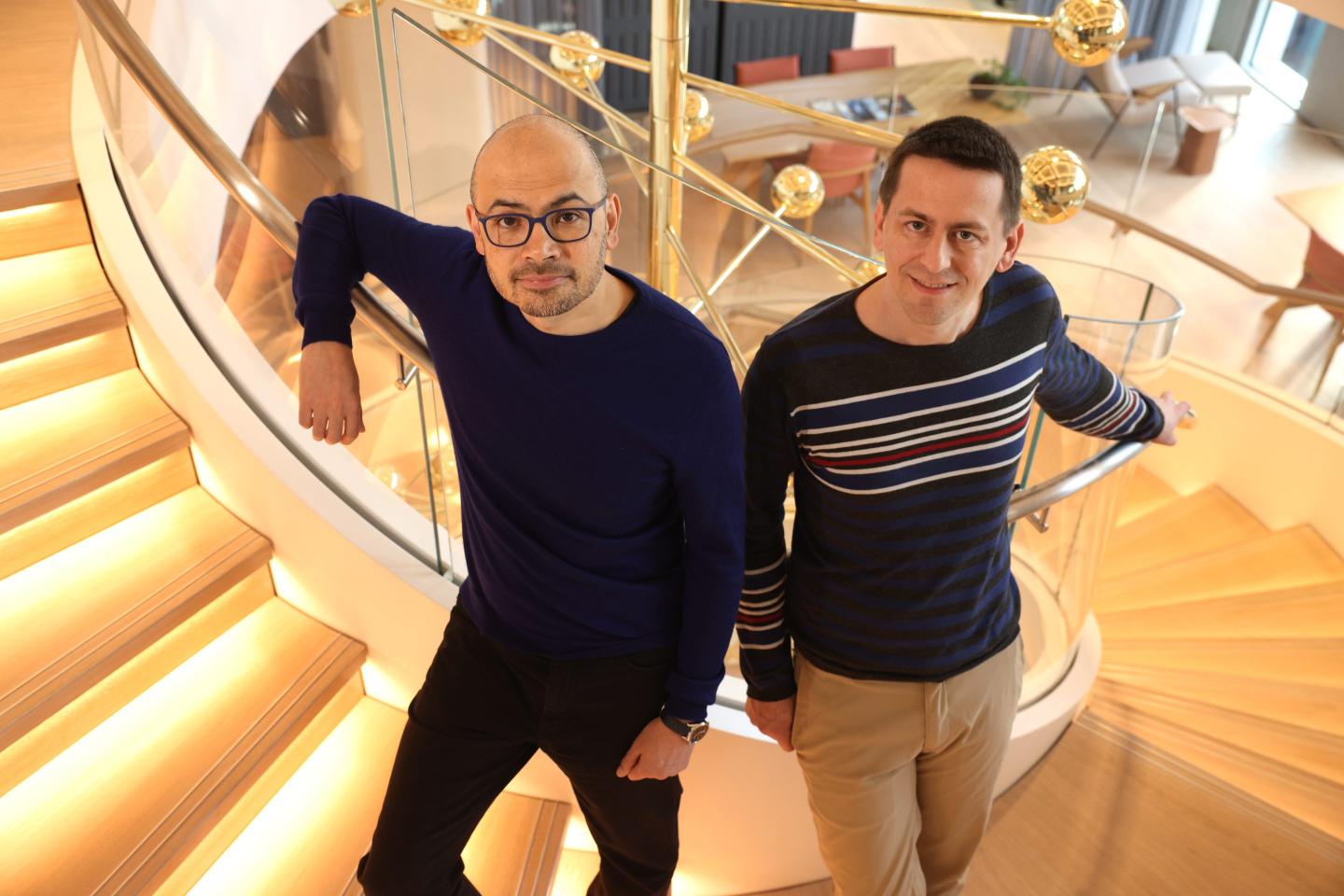
That giant sucking sound you hear? That’s the woosh of talent streaming out of Google DeepMind and flowing to OpenAI and Anthropic. There was a time when I can remember DeepMind bragging about how no one ever left the storied AI lab. That’s certainly not the case anymore.
In recent months, a stream of well-known researchers have departed. Some, such as David Silver, one of DeepMind’s earliest employees and one of the top reinforcement learning experts in the world, have decided to launch their own startups (Silver’s is called Ineffable Intelligence). But others have joined DeepMind’s chief rivals.
This past week, two Google DeepMind stars jumped ship in just 48 hours, both departures shocking in their own way for what they may say about Google DeepMind’s prospects in the AI race. That message was not lost on investors. News of their leaving sent Google’s shares tumbling more than 5% on Monday.
A chatbot pioneer and a Nobel laureate exit
First, on Thursday, Noam Shazeer announced he was leaving to go to OpenAI. Shazeer is the famed AI researcher who helped build Google’s earliest LLM-based chatbot system, LaMDA, in 2021, and then left in frustration when the internet giant dragged its feet in commercializing it. Before he left the first time, Shazeer is thought to have authored an anonymous memo, which later leaked, that criticized Google for having become too bureaucratic, slow-moving, and risk-adverse to succeed in AI against nimbler rivals, a critique that was seemingly validated when OpenAI launched the category defining ChatGPT in November 2022 and jumped out in front, at least in the public imagination, as the leading AI lab. Shazeer and Daniel de Freitas, another Google researcher who had helped build LaMDA, cofounded the viral chatbot startup Character.ai. But then they were lured back to Google in 2024 in a deal that saw Google license Character’s technology for a reported $2.7 billion payment. Now Shazeer is leaving again.
Just days after the Shazeer news, Google DeepMind researcher John Jumper announced he too was leaving—in this case, to join Anthropic. Jumper shared the 2024 Nobel Prize in chemistry with Google DeepMind CEO Demis Hassabis for their work creating AlphaFold, the AI system that could predict the shape of proteins from their DNA sequences, solving a 50-year grand challenge in biochemistry. After the Nobel win, Jumper had continued to work at DeepMind on AI models that could predict other properties of proteins—such as how they would bind to one another and how the small molecules often used for pharmaceuticals would likely bind to them—and he was also intrigued by the idea of using large language models, such as those that powered Google’s Gemini AI models, as tools for science.
While Google DeepMind continues to maintain a large team of AI researchers dedicated to applying AI to fundamental science challenges and has recently created a Gemini-powered system that can act as an “AI scientist” assisting researchers across different scientific domains, there is a sense that science is now less of a priority for Google DeepMind than it was in the years just prior to the launch of ChatGPT. (Isomorphic Labs, the AI drug discovery company that was spun out of DeepMind in 2021 and is also led by DeepMind CEO Demis Hassabis, is of course heavily focused on science—but with the aim of applying the research to commercial purposes rather than “blue-sky” scientific research). Meanwhile, Dario Amodei, Anthropic’s CEO, recently told Bloomberg’s Emily Chang that Anthropic intends to do more around biology; Jumper’s hiring is no doubt part of that plan.
Neither Shazeer or Jumper have said publicly why they’re leaving. The simplest explanation, of course, might simply be money, although there is little doubt that both Shazeer and Jumper were already extremely well-compensated. Shazeer is thought to have made hundreds of millions of dollars from the Character.ai licensing deal that brought him back to Google. (Presumably any required earn out period has ended.) And both Shazeer and Jumper were likely among the class of Google DeepMind researchers that have been awarded bushels of a special class of Google stock options that vest on an accelerated schedule, a tactic Google has had to adopt to prevent top talent from being lured away by gargantuan pay packages at places like Meta’s Superintelligence Lab. But, still, there’s a difference between being merely rich and the kind of generational wealth that the two might realize when Anthropic and OpenAI IPO, something both companies are expected to do in the coming months.
That said, money seems an unlikely explanation. I don’t know Shazeer, but as I said, he is likely already a multi-multi-millionaire. As for Jumper, I’ve interviewed him numerous times over the past four years, for both Fortune stories and for my book, Mastering AI. He doesn’t strike me as the kind of person who is primarily motivated by money and I don’t think he’d leave Google DeepMind unless he thought the scientific opportunity at Anthropic was actually better—which is much worse news for Google DeepMind.
Is Google DeepMind dropping out of the lead AI pack?
Industry watchers are wondering aloud whether the AI lab is slipping back from the lead pack in the AI race. Its top AI models, Gemini 3.5 Flash and Gemini 3.1 Pro, are often ranked outside the top five places on various AI benchmark leaderboards, having fallen behind models from Anthropic and OpenAI, as well as Chinese labs such as Zhipu AI and MiniMax. Meanwhile, its pace of model development seems to be lagging. At Google I/O in May, the company announced it was readying Gemini 3.5 Pro for wide release, targeting a June general availability date. But that means Gemini 3.5 Pro will be coming out about four months after Google DeepMind’s last frontier wide release, which was Gemini 3.1 Pro in February. By contrast, Anthropic has released not only two significant Claude Opus updates in that same time period, it also debuted a whole new class of AI models, Mythos, that is world-leading in its ability to complete long range tasks autonomously, particularly in coding and cyber domains.
Talking to both current and former GDM employees as well as others who know the lab well, there’s a sense Shazeer’s previous criticisms of Google remain valid. The place is burdened by its size, with a culture that current and former employees routinely describe as bureaucratic, sometimes bordering on sclerotic, and highly risk-adverse. Alphabet’s defenders say Google, with billions of users, can’t afford to take the same kinds of chances that OpenAI and Anthropic can. Unlike those money-losing, venture-funded startups, Alphabet actually has profits to defend, and it has a fiduciary duty to public market investors not to make risky bets that might needlessly jeopardize their returns.
There may even be some within Google’s upper echelons who believe the company doesn’t need to be particularly bold. The emergency created by ChatGPT’s launch in November 2022, kicked the company into a different gear. But, having seen off what at first seemed like a potentially existential threat to its core search business from ChatGPT, the company may have downshifted back into standard operating mode. Google has shown that as long as it can more or less match the technological advances of other players, its massive distribution advantage will probably carry it through. Recently, writing about Microsoft, I argued that company wasn’t necessarily playing to win the AI race. It was playing not to lose. Alphabet can also afford that kind of strategy. But, of course, that’s not the sort of culture that is likely to attract and retain the world’s leading AI researchers.
It’s also not the way Hassabis ever wants to play. The former child chess prodigy is nothing if not relentlessly competitive. He will likely be smarting from the loss of Shazeer and Jumper. And he will no doubt be doing his utmost to try to make sure Google DeepMind can get back to the front. How he will do that, though, remains to be seen.
With that, here’s more AI news.
Jeremy Kahn
jeremy.kahn@fortune.com
@jeremyakahn
FORTUNE ON AI
The week that changed AI: Inside Trump’s Anthropic crackdown, and how a phone call from Amazon CEO Andy Jassy triggered the chaos—by Sebastian Herrera and Beatrice Nolan
Anthropic launches Claude Tag, a tool that works like a virtual employee within Slack— by Beatrice Nolan
‘Make AI work for ordinary people’: Bernie Sanders wants to pay you $1,000 every year from a government stake in AI companies—by Jacqueline Munis
OpenAI’s new ‘super app’ boss hopes to persuade users and potential IPO investors that the company is about way more than just chat—by Beatrice Nolan
Renting AI from foreign providers is a national security risk, warns Cohere CEO—by Beatrice Nolan
Google DeepMind unveils plan to protect itself from its own rogue AI agents—by Jeremy Kahn
AI IN THE NEWS
Five Eyes intelligence agencies warn of AI-driven cyber attacks. The Five Eyes intelligence alliance—which consists of the U.S., U.K., Canada, Australia, and New Zealand—has warned that Western governments and companies may have only months before adversaries can use advanced AI to launch cyberattacks that overwhelm current defenses, the Financial Times reported. The cyber chiefs said AI is rapidly transforming both offensive and defensive cyber operations, citing evidence that state-linked actors from countries including Russia, China, and North Korea are already using AI to discover vulnerabilities and create more adaptive attacks. In response, they urged organizations to adopt AI-powered security tools quickly, framing cybersecurity as an escalating AI arms race.
OpenAI debuts Daybreak cybersecurity program... OpenAI on Monday expanded its Daybreak cybersecurity initiative, unveiling a full release of GPT-5.5-Cyber, new automation tools in Codex Security, and a partner ecosystem aimed at helping organizations move beyond simply finding software vulnerabilities to automatically patching them. The company said AI is compressing the time between when vulnerabilities are discovered and when attackers exploit those vulnerabilities, making faster remediation critical. It argued that frontier AI models can now help defenders not just find vulnerabilities, it can help them patch that software and test the updates. OpenAI also launched “Patch the Planet,” a program with security firm Trail of Bits to help open-source maintainers identify and repair vulnerabilities in widely used software. You can read more on OpenAI’s blog here.
...And the non-reaction from the U.S. government is telling. OpenAI is positioning Daybreak as its answer to Anthropic’s Project Glasswing, which is also a coalition of partner enterprises which had access to its Mythos model to help them find and patch cyber vulnerabilities. OpenAI’s discussion of GPT-5.5-Cyber says that the AI model can be used to discover vulnerabilities and potentially to test exploits, which was precisely the concern that prompted the U.S. government to yank Anthropic’s Fable and Mythos models. Yet OpenAI made it clear it has been working closely with the government on Daybreak (while also emphasizing that only a select group of partners will likely be approved to use GPT-5.5-Cyber), naming not just the Center for AI Standards and Innovation (CAISI) as its government interlocutor, but also the National Cyber Director and the Office of Science and Technology Policy. The fact there’s no talk of the government slapping export controls on GPT-5.5-Cyber as it did with Mythos and Fable is telling. It points to the fact that either Anthropic did not do a good enough job consulting across key government agencies on Mythos and Fable, or that the Trump administration really is singling Anthropic out mostly out of political animus. Or both.
Anthropic and the U.S. government may be working on jailbreak assessment framework. Anthropic’s Fable and Mythos models remain under export controls and, as a result, disabled for all users. But the White House and Anthropic are, according to a story in Politico, working on a shared framework for assessing the severity of various kinds of model guardrail jailbreaks as a condition of lifting those export restrictions. The discussions highlight how the U.S. is effectively developing AI governance through ad hoc negotiations with leading labs rather than through comprehensive legislation or rule-making. Some also pointed out that the U.S. Center for AI Standards and Innovation (CAISI) was already supposed to have developed exactly this kind of risk assessment framework.
Trump is leaning towards a plan that would give Americans stakes in leading AI labs. That’s according to an interview that Vice President JD Vance had with “Diary of CEO” podcast host Steve Barlett. Vance said the President is leaning towards perhaps creating a sovereign wealth fund that would hold equity stakes in the leading AI companies. You can view the interview here on YouTube. With socialist Sen. Bernie Sanders also endorsing the idea of giving Americans a stake in the profits of AI companies (see Fortune on AI section above), some form of this idea could receive bipartisan support.
Meta pauses AI training program that recorded employee keystrokes. Meta has paused a controversial internal AI-training program after a security lapse exposed sensitive employee data—including private conversations, performance information, prompts, and activity logs—to workers across the company. The program, known as the Model Capability Initiative, collected keystrokes, mouse movements, and other computer-usage data from U.S. employees to help train AI models, but had already faced internal opposition over privacy concerns. Meta says it has found no evidence of malicious access, but the incident has intensified scrutiny of the company’s efforts to use employee activity data to improve its AI systems. Read more here from Business Insider.
Microsoft CEO Satya Nadella raises alarm about AI power concentration. The CEO penned a blog post and gave an interview to the Wall Street Journal in which he said that the AI industry must become more democratized and less focused on displacing existing workers. He warned that the public will reject a future in which a handful of companies control the world’s most powerful AI models while also helping to usher in mass unemployment and demanding ever-greater energy resources. Microsoft has recently become alarmed that AI companies such as Anthropic and OpenAI wield too much power, particularly over pricing. In response, Microsoft has launched lower-cost AI models, expanded the models available on its Copilot platform, and is even considering hosting models from Chinese startup DeepSeek, moves that could intensify price competition with partners-turned-rivals OpenAI and Anthropic.
Amazon cancels distribution of Sam Altman film. Amazon has scrapped plans to release Artificial, a nearly completed film by Luca Guadagnino about the 2023 ouster and reinstatement of Sam Altman as CEO of OpenAI. It is instead seeking another distributor. According to people familiar with the project, Amazon executives grew concerned after the film evolved into a darker portrayal of Altman, depicting him as a manipulative figure who steered OpenAI away from its original mission. The decision has fueled speculation about whether Amazon’s growing business ties with OpenAI and the broader political influence of Altman played a role, though the company says it simply believes the film would be better served by another studio. You can read more from news site Puck here.
Google DeepMind inks a partnership with film studio A24. As part of the multi-year deal, Google DeepMind will invest $75 million to jointly develop AI filmmaking tools that A24 directors can use and that will also help improve DeepMind’s models. The deal gives DeepMind access to feedback from high-profile filmmakers while providing A24 with AI capabilities similar to initiatives already underway at studios such as Netflix and Lionsgate. You can read more from The Hollywood Reporter here.
Dean Ball, Trump AI policy advisor turned critic, joins OpenAI. Ball, a leading libertarian voice on AI policy, advised the Trump administration briefly on AI policy but has in recent months been fiercely critical of its actions against AI lab. Now Ball has announced he is joining OpenAI in a new policy role. He will be Head of AI Strategic Futures, a new policy unit focused on the risks of superpowerful AGI and superintelligence, and reporting to OpenAI chief strategy officer Jason Kwon. Ball said he will remain a nonresident senior fellow at the Foundation for American Innovation. You can read Ball’s blog post about his decision here.
Barret Zoph leaves OpenAI. Zoph had been a long-time OpenAI employee, serving as vice president of research (post-training), before he left in 2024 to co-found Thinking Machines Lab with former OpenAI CTO Mira Murati. Zoph was CTO at Thinking Machines, but landed back at OpenAI early this year after being fired from Thinking Machines, allegedly for poor performance and having a relationship with a junior colleague who did not report directly to him. (Zoph denies he was dismissed for unethical conduct or performance issues and said he was fired because Murati learned he had already planned to leave the company.) Zoph returned to OpenAI as head of enterprise sales, but now The Verge reports that he has left OpenAI again. Zoph could not be immediately reached for comment on the reasons for his departure.
EYE ON AI RESEARCH
Towards RSI. That would be “recursive self-improvement,” the idea of AI systems that can build the next generation of AI systems, which then build the next generation, and so. That’s a goal of many AI researchers. It’s also the stuff of many AI safety researchers’ nightmares, as it makes a “hard takeoff” scenario, where AI capabilities advance rapidly and quickly outpace any systems we might have for controlling these powerful intelligences, with potentially catastrophic results. Anthropic has declared that RSI is close to becoming a reality—although its not quite there yet. OpenAI and Google DeepMind are likewise thought to be pushing towards RSI. And then there’s Recursive Superintelligence, an AI neo-lab with some notable AI talent that is completely dedicated to the idea of bringing RSI about. And it has now published some initial results showing that on three benchmarks designed to test the abilities of relatively small LLMs using a fixed, small budget, AI models can produce impressive optimizations on tasks related to developing other AI models.
Recursive had the models run a self-contained loop: proposing optimization ideas, designing experiments to test those ideas, running the experiments, and then implementing what worked. The three benchmarks Recursive used involve training a small language model, improving AI training speed, and optimizing a GPU kernel, the tiny mathematical steps that a GPU has to perform to train or run an AI model. Recursive’s recursive AI loop achieved state of the art results on all three benchmarks. The kernel optimization was the most impressive, resulting in an 18% improvement in processing time across 235 different tasks.
“These results are an early sign that our system can push the frontier on AI training and infrastructure tasks, especially when the goal is well-defined, measurable, and quick enough to evaluate many times,” the authors wrote. As Jack Clark, Anthropic’s head of public benefit, wrote in discussing the results in his newsletter, Import AI, “the most important question for the future is whether such results can be repeated in domains where the goals are less well defined, harder to measure, and less efficient to evaluate.”
Another challenge: Recursive’s AI model was prone to “reward hacking”—finding ways to cheat on the benchmarks to get results that looked good, but did not involve improving the underlying AI systems in the way the researchers intended it to. Recursive had to change its evaluation metrics to be more resistant to this tendency but they warned this would likely continue to be a problem as these systems are scaled up. You can read Recursive’s blog post on the research here.
AI CALENDAR
July 6-11: International Conference on Machine Learning (ICML), Seoul, South Korea.
July 7-10: AI for Good Summit, Geneva, Switzerland.
Aug. 4-6: Ai4 2026, Las Vegas.
Nov. 16-17: Fortune 500 Innovation Forum, Detroit. Apply here to attend.
Dec. 6-12: Neural Information Processing Systems (Neurips) conference. Sydney, Australia.
Dec. 7-8: Fortune Brainstorm AI, San Francisco. Apply here to attend.
BRAIN FOOD
Deciphering ancient texts with AI. One of the most exciting uses of AI has to be helping historians and archaeologists decipher previously indecipherable or untranslatable ancient texts. One of the greatest mysteries of the classical Bronze Age is Linea A, a script used by the ancient Minoans on Crete between 1800 and 1450 B.C. Its successor script, Linea B, was also a mystery until it was deciphered in 1952 by an amateur linguist and cryptographer Michael Ventris with the help of classicist John Chadwick, both building on patterns in the script first identified by classicist Alice Kober. But Linea A has remained a mystery. Maybe until now. Tom Di Mino, another amateur linguist who is also a self-taught AI engineer claims to have used Anthropic’s Claude Code to crack Linear A. His results are currently being vetted by experts and peer-reviewed. But you can read more about the breakthrough on this blog.
Fortune AIQ Special Digital Issue: The AI Economy
From global corporations to local entrepreneurs, artificial intelligence is changing the way businesses operate, compete, and succeed. Explore all of Fortune AIQ, and read the latest collection of stories below:
–After AI stole his clients, one Big Tech ghostwriter is using AI to get them back
–Outnumbered: At $4 billion ClickUp, a 3:1 agent-to-human ratio is rewiring work itself
–How a mom-and-pop car wash chain went from sticky notes to AI-powered operations that are upleveling every part of the company
–Solo founders are using AI to do the work of entire teams—but going it alone has limits
–How EarthRanger uses AI to help protect endangered species—and boost the wildlife tourism industry
–The smartphone’s days are numbered. Meet the device that could come next