
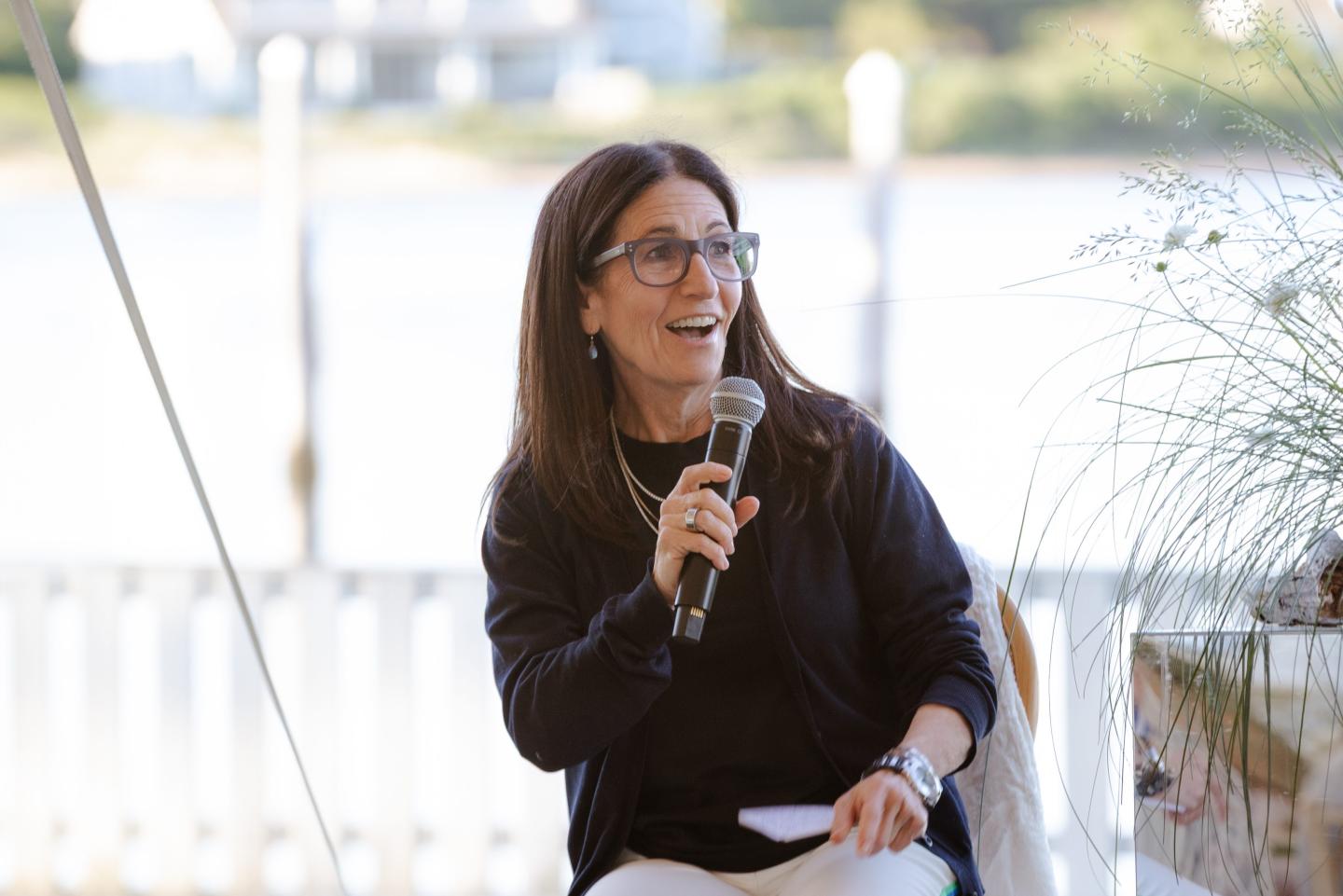
Earlier this month, I headed out east to the Hamptons with Female Founders Fund. The venture capital firm founded by Anu Duggal hosts a gathering each summer for the founders in its portfolio and others who make up the female founder universe. I was there to moderate a panel about what really happens after a founder sells their company. The moment when they look at their bank account and see a few more zeroes than usual, their biggest lifestyle changes since, how securing an exit changed their relationships with their friends and family—the real stuff. Sadly, the conversation was off the record so I can’t share too much more. But one theme translated to the rest of these three days in Montauk: the rise of the second-time founder.
On my panel were Gwen Whiting and Michelle Cordeiro Grant. Both sold companies, Whiting the cleaning brand the Laundress to Unilever (which didn’t go as she expected—my story on that saga is here). Cordeiro Grant sold the lingerie brand Lively to Wacoal for more than $85 million. And both are now building new brands, Whiting the cleaning club the Fill and Cordeiro Grant the energy drink Gorgie.
They’re hardly the only ones. Other second- or even third-time founders among this cohort include Mariah Chase (sold the plus-size brand Eloquii to Walmart; is now building the retail tech startup Ekyam.ai); Bobbi Brown (who of course went from her namesake brand to Jones Road Beauty, as I wrote about last week); retail and tech vet Julie Bornstein (sold The Yes to Pinterest; is now building fashion tech platform Daydream); and Audrey Gelman, who has moved on from the Wing to her hospitality business the Six Bells.
Female Founders Fund itself is now on its fourth fund, with a total of $140 million in capital under management; Chase was the first founder that Duggal invested in twice. While there have always been serial founders, the growing numbers of women in the category are a sign of the maturity of the female founder ecosystem. Enough female founders got funding the first time around to make it to a second act.
“It doesn’t get easier the second time,” Bornstein told me. “You either make new mistakes or you can’t help it, you still make the same mistakes.”
Some founders on the second go-around choose to self-fund and avoid the pitfalls of venture capital. Bornstein took the opposite lesson; “I realized how hard it is to raise again while you’re still finding product-market fit,” she says. So she raised more than she immediately needed—$50 million—as a seed round. Another practical tip: this time, Bornstein waited longer to hire marketing talent. After all, if the product isn’t up to snuff yet, there’s nothing for them to market. And she gave away more equity to her employees this time; at her prior company, she’d just followed industry standards for how much equity to share. Now she realized, “I don’t have to follow any rules, I can do it how I want.”
Another pair of second-time founders are Erica Cerulo and Claire Mazur. They were behind the indie ecommerce platform Of a Kind, which sold to Bed Bath & Beyond, and are now building 831 Stories, a trendy romance publisher that is tapping unexpected talent to write romance novellas. Their approach, with signature minimalist covers, is bringing new audiences to romance, and they inked a first-look deal with Hulu.
Even though Of a Kind eventually shut down under Bed Bath & Beyond, the outcome was still critical to building 831 Stories today. “We’re able to go to people, while starting a new business, and say we sold our first business to a Fortune 500 company,” Mazur says.
And it’s easier now to weather the ups and downs. Cerulo and Mazur built Of a Kind in their 20s; now they’re in their 40s. “We worry a lot less,” Mazur says. “Disasters happen every day. That is part of building a business. Nothing feels as much like a crisis as it used to.” “There’s a certain amount of uncertainty we’re more comfortable with now,” says Cerulo. “It’s less existential.”
Emma Hinchliffe
emma.hinchliffe@fortune.com
The Most Powerful Women Daily newsletter is Fortune’s daily briefing for and about the women leading the business world. Subscribe here.
ALSO IN THE HEADLINES
GRWM for an IPO. The clothing retailer Reformation, led by CEO Hali Borenstein, is planning to go public as soon as July, the WSJ reports. Its revenue this year is on track to hit about $500 million. The brand is 17 (!) years old; it launched in 2009. In 2019, PE firm Permira acquired a majority stake.
A Taliban exception. Despite stringent rules on the behavior of women and girls, the number of women with business licenses in Afghanistan has increased 10 times over the past five years, to 10,000. Allowing women to start businesses "wards off economic collapse and isolation"—but their options are still limited. Instead of becoming lawyers, engineers, or professors, women are starting businesses weaving carpets or selling makeup. And women with businesses still can't speak with male clients or suppliers.
What is going on with Tulsi Gabbard? A new Washington Post investigation examines thousands of pages of documents tied to the the Science of Identity Foundation (SIF), the religious group Gabbard grew up in that some describe as a cult. Going back to her time as a Democratic congresswoman, well before she joined the Trump administration, the records show Gabbard receiving policy guidance from people connected to the group—some of which she took action on the next day. Gabbard's team and a spokesperson for SIF called the reporting anti-Hindu religious bigotry.
Ina Garten gets into podcasting. The Barefoot Contessa's interest in starting a video podcast launched a seven-figure bidding war. Vox Media won (and had to assuage Garten's concerns after its partial sale to James Murdoch); Happy Hour With Ina Garten will debut in September, with help from the producer behind Good Hang With Amy Poehler.
Jane Fraser is among the top 10 highest-paid CEOs. The Citigroup CEO (and No. 1 on the 2026 Most Powerful Women list) is the only woman among the bunch; her $96 million in compensation last year place her at No. 9. Elon Musk is No. 1—and his $158 billion compensation is more than that of 391 other CEOs' combined.
ON MY RADAR
Making peace with my surrogacy The Cut
Scary Mommy founder Jill Smokler dies at 48 Today
How remote work has helped a generation of working parents NYT
PARTING WORDS
"Stepping into shoes that are enormous and pink and six inches tall can be scary."
— Lexi Minetree, who plays a young Elle Woods (aka Reese Witherspoon) in the new Legally Blonde prequel and Prime Video series Elle