• Home
  • Latest
  • Fortune 500
  • Finance
  • Tech
  • Leadership
  • Lifestyle
  • Rankings
  • Multimedia
CommentaryCorporate Governance

Corporate board service isn’t charity. It’s risk capital

By
Jane Sadowsky
Jane Sadowsky
Down Arrow Button Icon
By
Jane Sadowsky
Jane Sadowsky
Down Arrow Button Icon
December 30, 2025, 8:30 AM ET
Elon Musk
Elon Musk, chief executive officer of Tesla Inc., during the US-Saudi Investment Forum at the Kennedy Center in Washington, DC, US, on Wednesday, Nov. 19, 2025. Stefani Reynolds/Bloomberg via Getty Images

Recent headlines about a major technology company’s board compensation have reignited a familiar, and often reflexive, debate: how much is too much? It is an easy question, and the wrong one. 

Recommended Video

The more consequential issue for boards and shareholders alike is whether director compensation frameworks are still “fit for purpose” in a governance environment that has grown materially more complex, more adversarial, and more global. If board service has quietly evolved into a role that requires greater time, sharper judgment, and higher reputational risk, then our assumptions about compensation deserve a closer look. 

For decades, we have wrapped board service in the language of altruism. Directors “give  back.” They “serve.” Compensation is something one accepts politely, not something one interrogates. That framing may once have reflected reality. It no longer does. 

The quiet transformation of board service 

Modern independent directors are underwriting risk with three forms of capital: time, judgment, and reputation. 

The workload has expanded dramatically. Boards now oversee cyber and AI risk, geopolitical exposure, regulatory volatility, activist preparedness, executive succession under pressure, and culture as a leading indicator of enterprise risk. Learning curves are  shorter. Expectations are higher. Mistakes, especially visible ones, come with greater consequences. 

The environment has also changed. Outside actors: proxy advisory firms, activists,  plaintiffs’ lawyers, and social media have made board service more personal.  Disagreements over judgment are increasingly framed as failures of character. Reputational exposure is no longer a remote concern; it is part of the job. 

And the market has changed. Independent directorships are no longer filled primarily  through CEO relationships. They are globally competed-for roles, with real scarcity around  directors who combine operating credibility, risk fluency, the ability to govern under stress and the required bandwidth to meet the moment. 

All of this matters when we talk about compensation. 

Compensation as a decision factor, not the decision itself

None of this suggests that board service should be motivated primarily by money. It should not be. Purpose, curiosity, and stewardship still matter deeply. But it is no longer credible to pretend that compensation should not matter at all. 

In any rational market, sought-after professionals weigh the full equation: time  commitment, risk exposure, reputational stakes, and opportunity cost. Board service should be no different. All else being equal, compensation should be a legitimate, albeit secondary, factor in deciding whether to accept a role. 

The prevailing governance posture: “you get what you get and you don’t get upset”, is increasingly misaligned with reality. That posture is further strained by the fact that boards  set their own pay, creating awkwardness within the board and the compensation committee and understandable skepticism among investors. 

The answer, however, is not denial. It is design and transparency. 

A comparative reality check 

Looking across major governance markets reveals a tension that deserves more scrutiny than it receives.
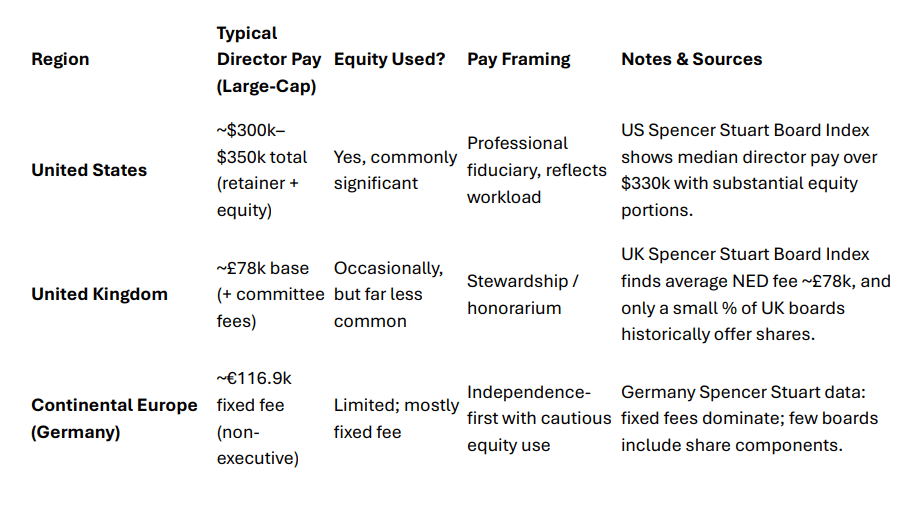
This is not a moral judgment about which system is “right.” Structural differences matter. Two-tier boards are different animals. Equity alignment raises legitimate independence  concerns in some jurisdictions. 

But capital markets are global, board recruitment is increasingly global, and enterprise risk does not respect national compensation norms. 

Vignette: Global strategy, local pay norms 

Consider a UK-based public company with a growth strategy centered on the United States. 

Its ambition is real: U.S. customers, U.S. regulators, U.S. capital markets, and potential U.S. acquisitions. The board understands that success will require directors with first-hand experience navigating American regulatory complexity, activist dynamics, litigation  exposure, and market expectations. 

The nominating committee identifies several outstanding candidates, current and former executives with deep U.S. operating and governance experience. Each is intrigued by the strategy. 

And each pauses. 

Not because of purpose. Not because of interest. But because the expectations — time,  travel, committee workload, crisis availability, reputational exposure — are unmistakably global, while the compensation framework remains firmly local. 

The board fills the seat. It always does. But the unanswered question is whether it filled the seat with the best director for the strategy, or simply the best director willing to accept the terms. 

Where shareholder value is quietly at risk 

This is not about fairness to directors. It is about outcomes for shareholders. 

Persistently underpricing board work does not show up immediately in TSR. It shows up indirectly: in narrower talent pools, overstretched committee chairs, slower escalation during crises, and reduced willingness or capacity to rigorously challenge management as  complexity increases.  

These are not failures of character. They are failures of design. 

What this moment actually teaches 

The compensation controversy is instructive not because it proves directors are overpaid, but because it highlights how poorly structured pay can undermine trust, invite litigation and headline risk, and distract from effective oversight. 

Excessive, opaque, or option-heavy compensation can compromise perceived  independence just as surely as underpayment can hollow out accountability. Alignment matters, but so does restraint. 

The lesson is not escalation, it is intentionality. 

A better governance standard 

Boards that want to address compensation credibly should anchor to a few principles:

  • Benchmark for complexity, not just size 
  • Distinguish base service from incremental burden 
  • Align with equity thoughtfully and simply 
  • Explain the rationale in plain language 
  • Engage shareholders early 

The closing truth 

We still call it board service, and we should. But service does not mean self-denial. Good stewardship includes confronting governance design risks, including whether board structures and compensation remain fit for today’s demands. 

Directors are not being paid for prestige. They are being paid to absorb complexity, shoulder accountability, and lend reputations built over decades to enterprises that need them. 

Boards don’t need to justify paying directors more. 

They need to justify paying them appropriately. 

Questions Boards Should Ask About Director Compensation 

  • What assumptions are embedded in our compensation model about time, availability, and crisis work? Are they still accurate? 
  • Does our pay structure reflect committee leadership as a materially heavier role?
  • Are we implicitly narrowing our talent pool by underpricing the skills we say we  need? 
  • How does our compensation signal seriousness about governance to candidates and shareholders? 
  • Could we explain our approach clearly and confidently to our largest investors?

The opinions expressed in Fortune.com commentary pieces are solely the views of their authors and do not necessarily reflect the opinions and beliefs of Fortune.


Join us at the Fortune Workplace Innovation Summit May 19–20, 2026, in Atlanta. The next era of workplace innovation is here—and the old playbook is being rewritten. At this exclusive, high-energy event, the world’s most innovative leaders will convene to explore how AI, humanity, and strategy converge to redefine, again, the future of work. Register now.
About the Author
By Jane Sadowsky
See full bioRight Arrow Button Icon

Latest in Commentary

Finance
Lorem ipsum dolor sit amet, consectetur adipiscing elit, sed do eiusmod tempor incididunt ut labore et dolore magna aliqua. Ut enim ad minim veniam
By Fortune Editors
October 20, 2025
Finance
Lorem ipsum dolor sit amet, consectetur adipiscing elit, sed do eiusmod tempor incididunt ut labore et dolore magna aliqua. Ut enim ad minim veniam
By Fortune Editors
October 20, 2025
Finance
Lorem ipsum dolor sit amet, consectetur adipiscing elit, sed do eiusmod tempor incididunt ut labore et dolore magna aliqua. Ut enim ad minim veniam
By Fortune Editors
October 20, 2025
Finance
Lorem ipsum dolor sit amet, consectetur adipiscing elit, sed do eiusmod tempor incididunt ut labore et dolore magna aliqua. Ut enim ad minim veniam
By Fortune Editors
October 20, 2025
Finance
Lorem ipsum dolor sit amet, consectetur adipiscing elit, sed do eiusmod tempor incididunt ut labore et dolore magna aliqua. Ut enim ad minim veniam
By Fortune Editors
October 20, 2025
Finance
Lorem ipsum dolor sit amet, consectetur adipiscing elit, sed do eiusmod tempor incididunt ut labore et dolore magna aliqua. Ut enim ad minim veniam
By Fortune Editors
October 20, 2025

Most Popular

Finance
Lorem ipsum dolor sit amet, consectetur adipiscing elit, sed do eiusmod tempor incididunt ut labore et dolore magna aliqua. Ut enim ad minim veniam
By Fortune Editors
October 20, 2025
Finance
Lorem ipsum dolor sit amet, consectetur adipiscing elit, sed do eiusmod tempor incididunt ut labore et dolore magna aliqua. Ut enim ad minim veniam
By Fortune Editors
October 20, 2025
Finance
Lorem ipsum dolor sit amet, consectetur adipiscing elit, sed do eiusmod tempor incididunt ut labore et dolore magna aliqua. Ut enim ad minim veniam
By Fortune Editors
October 20, 2025
Finance
Lorem ipsum dolor sit amet, consectetur adipiscing elit, sed do eiusmod tempor incididunt ut labore et dolore magna aliqua. Ut enim ad minim veniam
By Fortune Editors
October 20, 2025
Finance
Lorem ipsum dolor sit amet, consectetur adipiscing elit, sed do eiusmod tempor incididunt ut labore et dolore magna aliqua. Ut enim ad minim veniam
By Fortune Editors
October 20, 2025
Finance
Lorem ipsum dolor sit amet, consectetur adipiscing elit, sed do eiusmod tempor incididunt ut labore et dolore magna aliqua. Ut enim ad minim veniam
By Fortune Editors
October 20, 2025
Rankings
  • 100 Best Companies
  • Fortune 500
  • Global 500
  • Fortune 500 Europe
  • Most Powerful Women
  • Future 50
  • World’s Most Admired Companies
  • See All Rankings
Sections
  • Finance
  • Leadership
  • Success
  • Tech
  • Asia
  • Europe
  • Environment
  • Fortune Crypto
  • Health
  • Retail
  • Lifestyle
  • Politics
  • Newsletters
  • Magazine
  • Features
  • Commentary
  • Mpw
  • CEO Initiative
  • Conferences
  • Personal Finance
  • Education
Customer Support
  • Frequently Asked Questions
  • Customer Service Portal
  • Privacy Policy
  • Terms Of Use
  • Single Issues For Purchase
  • International Print
Commercial Services
  • Advertising
  • Fortune Brand Studio
  • Fortune Analytics
  • Fortune Conferences
  • Business Development
About Us
  • About Us
  • Editorial Calendar
  • Press Center
  • Work At Fortune
  • Diversity And Inclusion
  • Terms And Conditions
  • Site Map
  • Facebook icon
  • Twitter icon
  • LinkedIn icon
  • Instagram icon
  • Pinterest icon
Jane Sadowsky has served as an independent director on corporate and non-profit boards for more than a decade and currently serves on three global boards. She retired from a career in investment banking as a Senior Managing Director and head of the Power & Utility Group for Evercore Partners and is currently a Senior Advisor at Moelis & Co. 

Latest in Commentary

ready
CommentaryPinterest
Pinterest CEO: the Napster phase of AI needs to end
By Bill ReadyJanuary 19, 2026
12 hours ago
mohamad ali
CommentaryConsulting
I lead IBM Consulting, here’s how AI-first companies must redesign work for growth
By Mohamad AliJanuary 19, 2026
13 hours ago
CommentaryLetter from London
I have been coming to Davos for 16 years. I have never seen such a crisis in U.S./European relations 
By Kamal AhmedJanuary 19, 2026
16 hours ago
ravi
Commentaryinformation technology
Learning and work are converging in an integrated new life template for the AI era 
By Ravi Kumar SJanuary 19, 2026
17 hours ago
posnett
Commentaryinvestment banking
Goldman investment banking co-head Kim Posnett on the year ahead, from an IPO ‘mega-cycle’ to another big year for M&A to AI’s ‘horizontal disruption’
By Nick LichtenbergJanuary 19, 2026
17 hours ago
dusek
CommentaryDavos
Geoeconomics is the new geopolitics: Playing offense in the new economy
By Mirek DusekJanuary 19, 2026
17 hours ago

© 2025 Fortune Media IP Limited. All Rights Reserved. Use of this site constitutes acceptance of our Terms of Use and Privacy Policy | CA Notice at Collection and Privacy Notice | Do Not Sell/Share My Personal Information
FORTUNE is a trademark of Fortune Media IP Limited, registered in the U.S. and other countries. FORTUNE may receive compensation for some links to products and services on this website. Offers may be subject to change without notice.


Most Popular

placeholder alt text
Investing
Stocks sell off globally as traders digest Trump message saying he wants Greenland because ‘your Country decided not to give me the Nobel’ 
By Jim EdwardsJanuary 19, 2026
15 hours ago
placeholder alt text
Politics
Army readies 1,500 paratroopers specializing in arctic operations for possible deployment to Minnesota if Trump invokes Insurrection Act
By Konstantin Toropin and The Associated PressJanuary 18, 2026
1 day ago
placeholder alt text
Economy
Making billionaires illegal by taxing their wealth wouldn’t even fund the government for a year, budget expert says
By Nick LichtenbergJanuary 17, 2026
3 days ago
placeholder alt text
Politics
The U.S. Supreme Court could throw a wrench into Trump’s plan to take Greenland as soon as Tuesday
By Jim EdwardsJanuary 19, 2026
12 hours ago
placeholder alt text
AI
Ford CEO warns there's a dearth of blue-collar workers able to construct AI data centers and operate factories: 'Nothing to backfill the ambition'
By Sasha RogelbergJanuary 18, 2026
2 days ago
placeholder alt text
Commentary
I oversee a lab where engineers try to destroy my life’s work. It's the only way to prepare for quantum threats
By Bernard VianJanuary 18, 2026
2 days ago