• Home
  • News
  • Fortune 500
  • Tech
  • Finance
  • Leadership
  • Lifestyle
  • Rankings
  • Multimedia
CommentaryTariffs and trade

The trade war was never going to fix our deficit

By
Daniel Bunn
Daniel Bunn
Down Arrow Button Icon
By
Daniel Bunn
Daniel Bunn
Down Arrow Button Icon
December 2, 2025, 9:30 AM ET
Daniel Bunn is president and CEO of the Tax Foundation.
Trump
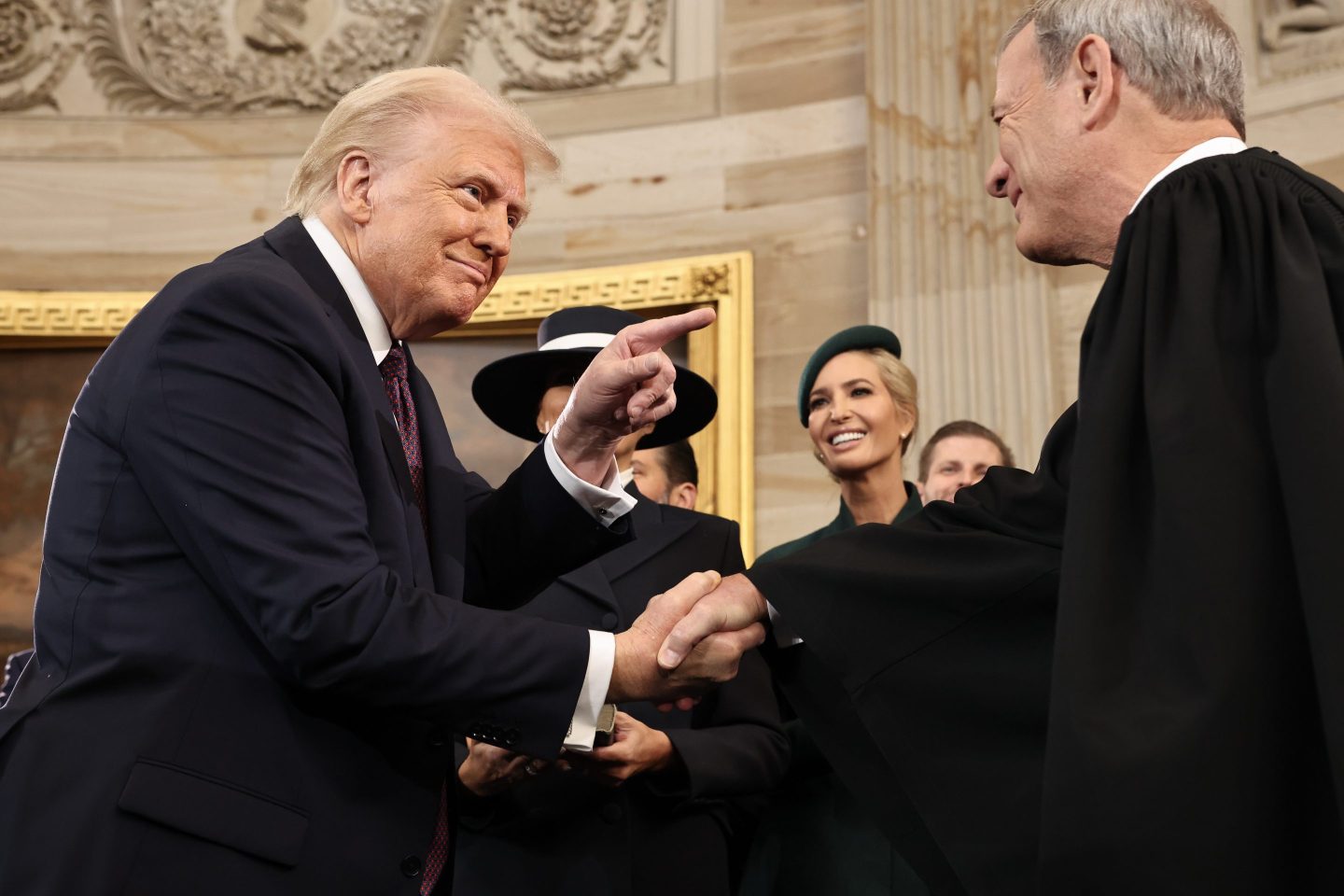
President Donald Trump gestures to U.S. Supreme Court Chief Justice John Roberts after he was sworn in during inauguration ceremonies in the Rotunda of the U.S. Capitol on January 20, 2025 in Washington, DC. Chip Somodevilla/Getty Images

The Supreme Court recently heard arguments in a case that will decide whether the president overstepped his authority by invoking an old war law to justify imposing tariffs on seemingly every country and product under the sun. Though White House lawyers changed their tune in front of the justices, up till this point, one of the administration’s defenses throughout this trade war is that these tariffs are needed because they bring in substantial revenue for the country, money that could be used to help turn the tide on Social Security’s and Medicare’s fiscal outlooks.

Recommended Video

But whether the administration actually believes this tariff revenue is “incidental” to their larger goal, the truth is these tariffs will not alter the trajectory of our national debt or entitlement programs. In many cases, it may make their outlook worse.

For the sake of the economy, SCOTUS should put an end to this abuse of power.

In their official brief to the Court, White House officials claimed that if the courts decide that the law in question, the International Emergency Economic Powers Act (IEEPA), can’t be used for unilaterally levying tariffs, the lost revenue would “lead to financial ruin.”

A spade should be called a spade, and it’s true that if SCOTUS rules against the White House, there would be a negative fiscal impact. Tax Foundation finds that the IEEPA tariffs will raise about $1.8 trillion over the next decade if they stay in place. Though Republicans once balked at tax hikes of that size, this one in particular needs to be considered in the context of the other ills these tariffs bring.

To begin, Trump’s trade war will shrink the economy by nearly 0.4 percent, per our estimates. That hit alone reduces the tariffs’ revenue potential by more than $400 billion. All in all, when you look at the revenue window for the next 10 years, even a best-case scenario leads to the IEEPA tariffs accounting for less than 2 percent of the country’s total revenue.

That amount of money is not going to be the solution to Social Security’s and Medicare’s dire outlook.

By 2034, due in part to the extension of the 2017 Trump tax cuts through this year’s One Big Beautiful Bill Act (OBBBA), the amount of debt held by the public will rise from a projected baseline of 117.1 percent to 124.6 percent. It will only fall to 122.3 percent if the IEEPA tariff revenue is fully collected over that time period.  

These are astonishing, scary outlooks. Publicly held debt is set to rise to a higher share of GDP than ever recorded over the next few years, and the IEEPA tariffs would do little to move the needle. Absent any major changes, Medicare’s and Social Security’s trust funds are set to run dry by 2033.

Social Security and Medicare are funded by payroll taxes, meaning we need an active and growing workforce to help keep their wheels turning. The IEEPA tariffs would have the opposite effect: before factoring in retaliation from other countries, we estimate that these tax hikes would lead to a loss of nearly 428,000 workers.

Big problems require big solutions. And maybe it’s admirable that the president believes his trade war could improve our fiscal outlook. If the simple solution to the crisis facing Social Security and Medicare were simply more money, perhaps tariffs could be a topic worthy of debate.

But in that debate, it becomes clear that the trade-offs aren’t worth the risk.

This trade war is a jobs crusher. It’s a strain on our diplomatic relationships. And it’s one of the largest tax hikes in American history, costing the average household $1,300 per year.

The IEEPA tariffs cannot save our entitlement programs, which may be why White House lawyers backed off their revenue argument in front of the Justices, but they will be another blow to our workforce and pocketbooks. Limitations on the president’s power to unilaterally impose significant tax hikes would be a welcome decision.

The opinions expressed in Fortune.com commentary pieces are solely the views of their authors and do not necessarily reflect the opinions and beliefs of Fortune.

About the Author
By Daniel Bunn
See full bioRight Arrow Button Icon

Latest in Commentary

Trump
CommentaryTariffs and trade
The trade war was never going to fix our deficit
By Daniel BunnDecember 2, 2025
35 minutes ago
Elizabeth Kelly
CommentaryNon-Profit
At Anthropic, we believe that AI can increase nonprofit capacity. And we’ve worked with over 100 organizations so far on getting it right
By Elizabeth KellyDecember 2, 2025
1 hour ago
Decapitation
CommentaryLeadership
Decapitated by activists: the collapse of CEO tenure and how to fight back
By Mark ThompsonDecember 2, 2025
1 hour ago
David Risher
Commentaryphilanthropy
Lyft CEO: This Giving Tuesday, I’m matching every rider’s donation
By David RisherDecember 1, 2025
1 day ago
college
CommentaryTech
Colleges risk getting it backwards on AI and they may be hurting Gen Z job searchers
By Sarah HoffmanDecember 1, 2025
1 day ago
Jacqueline Novogratz is the founder and CEO of Acumen
Commentaryphilanthropy
Philanthropy isn’t fading. It’s evolving
By Jacqueline NovogratzNovember 30, 2025
2 days ago

Most Popular

placeholder alt text
Economy
Ford workers told their CEO 'none of the young people want to work here.' So Jim Farley took a page out of the founder's playbook
By Sasha RogelbergNovember 28, 2025
4 days ago
placeholder alt text
Success
Forget the four-day workweek, Elon Musk predicts you won't have to work at all in ‘less than 20 years'
By Jessica CoacciDecember 1, 2025
22 hours ago
placeholder alt text
Innovation
Google CEO Sundar Pichai says we’re just a decade away from a new normal of extraterrestrial data centers
By Sasha RogelbergDecember 1, 2025
21 hours ago
placeholder alt text
Success
Warren Buffett used to give his family $10,000 each at Christmas—but when he saw how fast they were spending it, he started buying them shares instead
By Eleanor PringleDecember 2, 2025
4 hours ago
placeholder alt text
Success
Trump’s new tax policies will cut the wealthy’s philanthropy by over $4 billion—and middle-class donors can't match the donations of MacKenzie Scott
By Emma BurleighDecember 1, 2025
23 hours ago
placeholder alt text
Big Tech
Elon Musk, fresh off securing a $1 trillion pay package, says philanthropy is 'very hard'
By Sydney LakeDecember 1, 2025
23 hours ago
Rankings
  • 100 Best Companies
  • Fortune 500
  • Global 500
  • Fortune 500 Europe
  • Most Powerful Women
  • Future 50
  • World’s Most Admired Companies
  • See All Rankings
Sections
  • Finance
  • Leadership
  • Success
  • Tech
  • Asia
  • Europe
  • Environment
  • Fortune Crypto
  • Health
  • Retail
  • Lifestyle
  • Politics
  • Newsletters
  • Magazine
  • Features
  • Commentary
  • Mpw
  • CEO Initiative
  • Conferences
  • Personal Finance
  • Education
Customer Support
  • Frequently Asked Questions
  • Customer Service Portal
  • Privacy Policy
  • Terms Of Use
  • Single Issues For Purchase
  • International Print
Commercial Services
  • Advertising
  • Fortune Brand Studio
  • Fortune Analytics
  • Fortune Conferences
  • Business Development
About Us
  • About Us
  • Editorial Calendar
  • Press Center
  • Work At Fortune
  • Diversity And Inclusion
  • Terms And Conditions
  • Site Map

© 2025 Fortune Media IP Limited. All Rights Reserved. Use of this site constitutes acceptance of our Terms of Use and Privacy Policy | CA Notice at Collection and Privacy Notice | Do Not Sell/Share My Personal Information
FORTUNE is a trademark of Fortune Media IP Limited, registered in the U.S. and other countries. FORTUNE may receive compensation for some links to products and services on this website. Offers may be subject to change without notice.