• Home
  • Latest
  • Fortune 500
  • Finance
  • Tech
  • Leadership
  • Lifestyle
  • Rankings
  • Multimedia
CommentaryFinance

How to restore confidence in the U.S. dollar—and why it’s faltering in the first place

By
Steve H. Hanke
Steve H. Hanke
and
Matt Sekerke
Matt Sekerke
Down Arrow Button Icon
By
Steve H. Hanke
Steve H. Hanke
and
Matt Sekerke
Matt Sekerke
Down Arrow Button Icon
April 16, 2025, 10:00 AM ET
Sheldon Cooper/SOPA Images/LightRocket via Getty Images

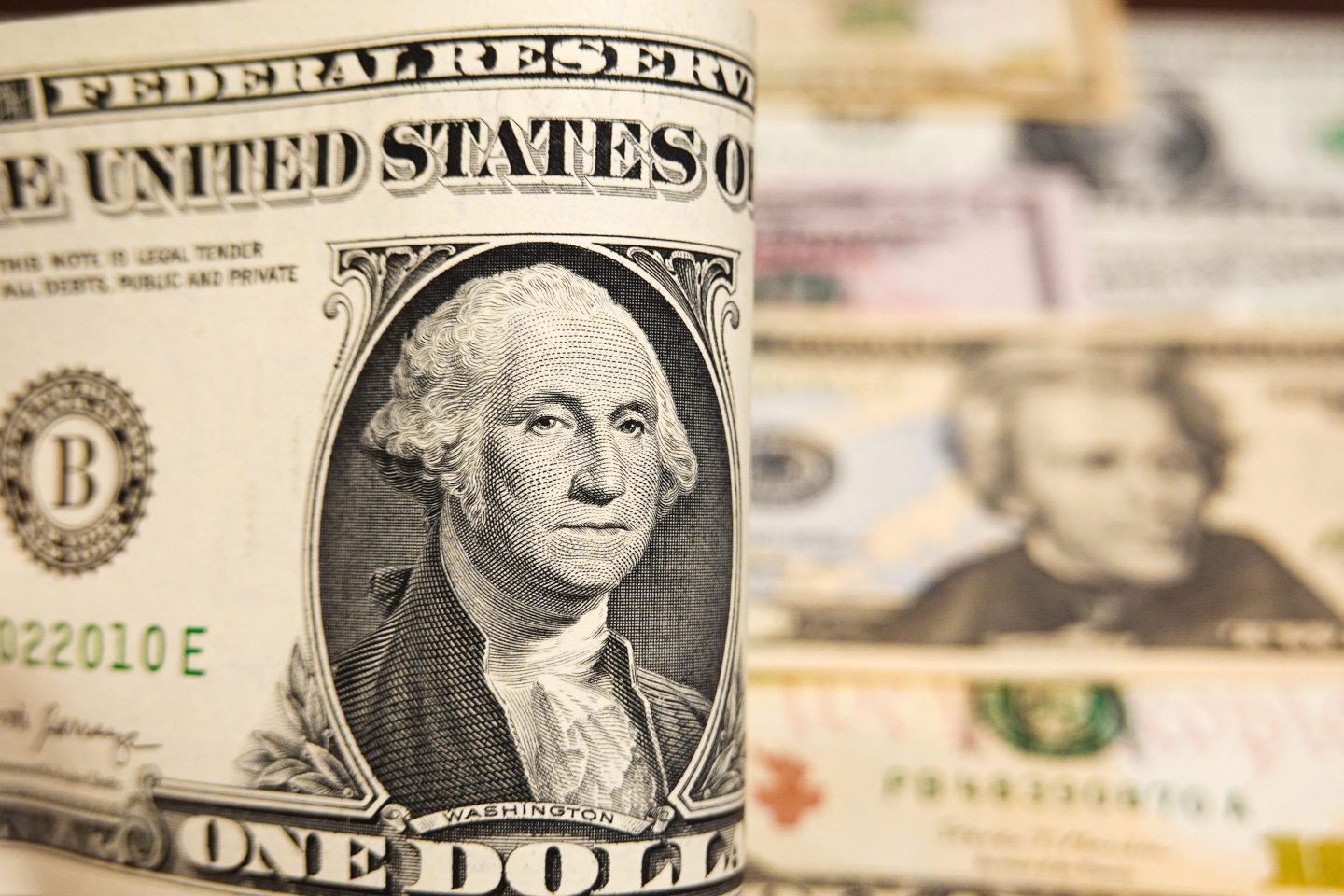
Last week, President Trump announced a 90-day pause on his escalated tariff regime for all countries but China. Despite the apparent relief, it became clear that damage had already been done to America’s place in global financial markets. The dollar continued to lose value, extending its decline against a trade-weighted basket of currencies to 10% for the year. Last Thursday’s 10-year Treasury auction was awful, with yields on 10-year debt spiking by amounts not seen in 40 years to 4.5%. The 30-year Treasury yield is now approaching 5%. Last Friday, the price of gold hit an all-time high.

Investors around the world fear that the United States is no longer a safe haven for capital. For some time, the executive power in the United States has been growing beyond its constitutional bounds. Until the government plots a clear course forward for economic policy, confidence will continue to drain from American financial markets, with disastrous consequences for the government budget, the financial conditions faced by American business, and American leadership in the world.

In our new book, Making Money Work, we explain how the monetary system depends on the responsible behavior of the institutions that create the money supply—the government and the banking system. The value of money is underwritten by these institutions. To recover from the blow dealt to confidence in the dollar, American monetary institutions need to reaffirm their commitment to maintaining the dollar’s purchasing power. Here’s what the government needs to do to restore confidence in the dollar.

Pass a credible budget

When the government runs a budget deficit, investors in government debt part with their money to sterilize the impact of higher spending. The price investors charge to part with their money is the Treasury bond rate, which is the sum of the real interest rate, inflation, and a country risk premium.

Larger budget deficits raise the rate needed to finance Treasury debt. They breed additional large deficits by raising interest costs. Today, interest expense accounts for a whopping 13.1% of the federal budget. Instead of facing facts about current budget deficits, Congress is pretending that only new deficits count so they can pass a budget through the reconciliation process. It is time for Congress to get serious about negotiating a budget that reduces the deficit without fanciful accounting games and smoke and mirrors.

Rein in executive power

The country risk premium for the United States has long been zero, but it now has the potential to turn positive due to President Trump’s tariff whims. Congress should act to reduce the country risk premium by reducing the power of the executive in making economic policy, particularly with respect to setting tariffs and trade policy. A bill recently introduced by senators Chuck Grassley (R-IA) and Maria Cantwell (D-WA), which would expand the role of Congress in setting trade policy, is a concrete step in the right direction. We must be a nation of rules rather than a nation of corrupt deals spawned by executive orders.

Close the loop on bank regulation

Prudential bank regulation ensures that money creation by the banking system—the bulk of all money creation in the United States—doesn’t outrun the returns of bankable investment projects, and that banks’ other risk-taking activities don’t threaten the redemption of deposit balances at par. The broad parameters for prudential bank regulation are agreed globally through the Basel Committee on Bank Supervision (BCBS). The latest product of the BCBS, known informally as “Basel III,” has been implemented by every other major economy except the United States.

Congress should direct federal banking regulators to use the break with Basel III to correct and improve upon the BCBS regime. Our book shows how to set regulatory credit risk weights without distorting the allocation of bank lending. And instead of penalizing banks’ internal models, regulators should encourage banks to take greater responsibility for measuring and managing risks across their enterprises. This agenda would underline America’s commitment to a strong, well-managed banking system that is ready to do business with the entire world. It also goes without saying that proposals to eliminate the Federal Deposit Insurance Corporation and pull bank regulation away from the Federal Reserve should be permanently shelved.

Stop promoting and placating the crypto industry

Crypto is marketed through dubious promises of ever-appreciating value and fear about the integrity of the dollar and other currencies. It is unabashedly opposed to the existing institutions that create the money supply. Spending precious legislative energy to create new legal channels for crypto undermines government’s role in protecting the monetary system.

The executive branch’s capture by the crypto lobby further undermines responsible monetary management. Gambling on a “strategic crypto reserve” to reduce the national debt does not inspire confidence that the debt can be controlled through normal channels. And letting crypto companies off the hook for money laundering violations does not suggest vigilance in maintaining the integrity of the financial system.

Congress must take the initiative to repair confidence in the dollar. Above all, a clear-eyed and responsible budgeting process will signal seriousness about controlling debt and the value of the dollar. Congress must also act to take back economic policy powers that President Trump has arrogated to the executive. The Constitution never intended that the president would rule by decree on matters as important as the monetary standard, the budget, and trade policy. The public wants sound money, low inflation, and free trade. If President Trump’s trade agenda continues, the U.S. will eventually abdicate its role as the stable reserve currency and safe haven for capital. What’s more, Americans will never see it coming. Exchange rates decline two ways—gradually, and then suddenly.

Steve H. Hanke is a Professor of Applied Economics at The Johns Hopkins University. Matt Sekerke is a Managing Director at SEDA Experts and Senior Macro Advisor at Hiddenite Capital Partners. They are the co-authors of Making Money Work: How to Rewrite the Rules of Our Financial System (forthcoming, Wiley, 2025).


Join us at the Fortune Workplace Innovation Summit May 19–20, 2026, in Atlanta. The next era of workplace innovation is here—and the old playbook is being rewritten. At this exclusive, high-energy event, the world’s most innovative leaders will convene to explore how AI, humanity, and strategy converge to redefine, again, the future of work. Register now.
About the Authors
Steve H. Hanke
By Steve H. Hanke
Twitter icon
See full bioRight Arrow Button Icon
By Matt Sekerke
See full bioRight Arrow Button Icon

Latest in Commentary

Finance
Lorem ipsum dolor sit amet, consectetur adipiscing elit, sed do eiusmod tempor incididunt ut labore et dolore magna aliqua. Ut enim ad minim veniam
By Fortune Editors
October 20, 2025
Finance
Lorem ipsum dolor sit amet, consectetur adipiscing elit, sed do eiusmod tempor incididunt ut labore et dolore magna aliqua. Ut enim ad minim veniam
By Fortune Editors
October 20, 2025
Finance
Lorem ipsum dolor sit amet, consectetur adipiscing elit, sed do eiusmod tempor incididunt ut labore et dolore magna aliqua. Ut enim ad minim veniam
By Fortune Editors
October 20, 2025
Finance
Lorem ipsum dolor sit amet, consectetur adipiscing elit, sed do eiusmod tempor incididunt ut labore et dolore magna aliqua. Ut enim ad minim veniam
By Fortune Editors
October 20, 2025
Finance
Lorem ipsum dolor sit amet, consectetur adipiscing elit, sed do eiusmod tempor incididunt ut labore et dolore magna aliqua. Ut enim ad minim veniam
By Fortune Editors
October 20, 2025
Finance
Lorem ipsum dolor sit amet, consectetur adipiscing elit, sed do eiusmod tempor incididunt ut labore et dolore magna aliqua. Ut enim ad minim veniam
By Fortune Editors
October 20, 2025

Most Popular

Finance
Lorem ipsum dolor sit amet, consectetur adipiscing elit, sed do eiusmod tempor incididunt ut labore et dolore magna aliqua. Ut enim ad minim veniam
By Fortune Editors
October 20, 2025
Finance
Lorem ipsum dolor sit amet, consectetur adipiscing elit, sed do eiusmod tempor incididunt ut labore et dolore magna aliqua. Ut enim ad minim veniam
By Fortune Editors
October 20, 2025
Finance
Lorem ipsum dolor sit amet, consectetur adipiscing elit, sed do eiusmod tempor incididunt ut labore et dolore magna aliqua. Ut enim ad minim veniam
By Fortune Editors
October 20, 2025
Finance
Lorem ipsum dolor sit amet, consectetur adipiscing elit, sed do eiusmod tempor incididunt ut labore et dolore magna aliqua. Ut enim ad minim veniam
By Fortune Editors
October 20, 2025
Finance
Lorem ipsum dolor sit amet, consectetur adipiscing elit, sed do eiusmod tempor incididunt ut labore et dolore magna aliqua. Ut enim ad minim veniam
By Fortune Editors
October 20, 2025
Finance
Lorem ipsum dolor sit amet, consectetur adipiscing elit, sed do eiusmod tempor incididunt ut labore et dolore magna aliqua. Ut enim ad minim veniam
By Fortune Editors
October 20, 2025
Rankings
  • 100 Best Companies
  • Fortune 500
  • Global 500
  • Fortune 500 Europe
  • Most Powerful Women
  • Future 50
  • World’s Most Admired Companies
  • See All Rankings
Sections
  • Finance
  • Leadership
  • Success
  • Tech
  • Asia
  • Europe
  • Environment
  • Fortune Crypto
  • Health
  • Retail
  • Lifestyle
  • Politics
  • Newsletters
  • Magazine
  • Features
  • Commentary
  • Mpw
  • CEO Initiative
  • Conferences
  • Personal Finance
  • Education
Customer Support
  • Frequently Asked Questions
  • Customer Service Portal
  • Privacy Policy
  • Terms Of Use
  • Single Issues For Purchase
  • International Print
Commercial Services
  • Advertising
  • Fortune Brand Studio
  • Fortune Analytics
  • Fortune Conferences
  • Business Development
About Us
  • About Us
  • Editorial Calendar
  • Press Center
  • Work At Fortune
  • Diversity And Inclusion
  • Terms And Conditions
  • Site Map

Latest in Commentary

sudhakar
CommentaryM&A
I’m the SolarWinds CEO. Here’s why a $4.4 billion move to go private was right for us
By Sudhakar RamakrishnaJanuary 8, 2026
13 hours ago
Jerome Adams
CommentaryVaccines
Trump’s former surgeon general: One year in, the war on vaccination is undoing the Trump administration’s health agenda
By Jerome AdamsJanuary 8, 2026
13 hours ago
kappos
CommentaryEconomics
The Nobel Prize winners have a lesson for us all
By David J. KapposJanuary 8, 2026
14 hours ago
Mark DesJardine
CommentaryM&A
Warner Bros. Discovery’s board isn’t choosing a deal — it’s avoiding one
By Mark DesJardineJanuary 8, 2026
14 hours ago
A woman stands in front of a whiteboard speaking to a table of people.
Commentaryenterprise technology
AI isn’t failing your company. Your operating model is
By Katerin Le FolcalvezJanuary 8, 2026
16 hours ago
goodwin
CommentaryCorporate Governance
Tesla’s vote wasn’t about pay. It was about who really runs the company
By Shane GoodwinJanuary 8, 2026
17 hours ago

Most Popular

placeholder alt text
Law
Amazon is cutting checks to millions of customers as part of a $2.5 billion FTC settlement. Here's who qualifies and how to get paid
By Sydney LakeJanuary 6, 2026
3 days ago
placeholder alt text
Future of Work
AI layoffs are looking more and more like corporate fiction that's masking a darker reality, Oxford Economics suggests
By Nick LichtenbergJanuary 7, 2026
1 day ago
placeholder alt text
Success
Diary of a CEO founder says he hired someone with 'zero' work experience because she 'thanked the security guard by name' before the interview
By Emma BurleighJanuary 8, 2026
15 hours ago
placeholder alt text
Workplace Culture
Amazon demands proof of productivity from employees, asking for list of accomplishments
By Jake AngeloJanuary 8, 2026
14 hours ago
placeholder alt text
Future of Work
'Employers are increasingly turning to degree and GPA' in hiring: Recruiters retreat from ‘talent is everywhere,’ double down on top colleges
By Jake AngeloJanuary 6, 2026
3 days ago
placeholder alt text
Real Estate
Google billionaire Larry Page copies the Jeff Bezos playbook, buying a $173 million Miami compound that will save him millions in taxes
By Nick LichtenbergJanuary 8, 2026
12 hours ago

© 2025 Fortune Media IP Limited. All Rights Reserved. Use of this site constitutes acceptance of our Terms of Use and Privacy Policy | CA Notice at Collection and Privacy Notice | Do Not Sell/Share My Personal Information
FORTUNE is a trademark of Fortune Media IP Limited, registered in the U.S. and other countries. FORTUNE may receive compensation for some links to products and services on this website. Offers may be subject to change without notice.