- In today’s CEO Daily: Most of the tariffs may be gone but CEOs tell Diane Brady they don’t appreciate the chaos and disruption they caused.
- The big story: The bond market forces Trump to capitulate.
- The markets: Relief rally!
- Analyst notes from Wells Fargo, UBS, Goldman Sachs, and Wedbush on the tariff fiasco and Bank of America on digital media adspend.
- Plus: All the news and watercooler chat from Fortune.
Good morning. I was chatting (about tariffs, of course) with the CEO of a major multinational company on Wednesday when the news broke that President Trump had decided to halt reciprocal tariffs on America’s trading partners for 90 days (resetting back to a universal 10% on non-retaliating countries), while raising tariffs on China to 125%. This CEO has staff on the ground in China. His reaction: “My head is spinning right now.”
The same could be said for investors, who raced back into the stock market, having stomped out earlier in the week. Companies big and small are feeling the impact of Trump’s policies, with leaders trying to set long-term strategies in an environment that’s anything but predictable.
The consensus among most business leaders is that escalating tariffs are bad for everyone. Delta Air Lines CEO Ed Bastian criticized tariffs as the “wrong approach,” noting that his bookings are in decline. Customers act “as if we’re going into a recession,” he said. Indeed, JPMorgan Chase CEO Jamie Dimon warned this week that the U.S. will have a recession if the Administration doesn’t swiftly get those trade deals done. And Walmart CEO Doug McMillon has tried to calm fears about rising costs for the world’s largest retailer by saying they had a plan. “There will be a Christmas, and people will celebrate Christmas, and they will buy items, and we will sell them those items,” he told attendees at the company’s Investor Day yesterday.
It’s not clear what the deciding factor was that motivated the president to reverse course. Some say that bond yields were a bigger factor than falling stock prices. Groups like the Business Roundtable and U.S. Chamber of Commerce have exerted pressure, as have many prominent donors and political allies. The threat of yet more policy changes isn’t going away, and nobody is talking about tariff threats as mere rhetoric or a negotiating tactic now.
What’s clear is that the business environment has fundamentally shifted in the last three months in ways that could have a long-term impact. Veteran biotech executive Doug Williams told me Wednesday that cuts to the FDA and research funding have “completely disrupted the ecosystem that led to US dominance in biotech. At a time when the industry was struggling, this will gift biotech dominance to China because they have discipline, they plan long term, and they’ve learned from the U.S.”
I’d love to hear from you about how you think the trade war and other policies are likely to play out. How is this impacting your business? And what are you doing to protect yourself? Just email me at the address below and let me know if you’re comfortable being quoted or would like your name withheld.
More news below.
Contact CEO Daily via Diane Brady at diane.brady@fortune.com
Top news
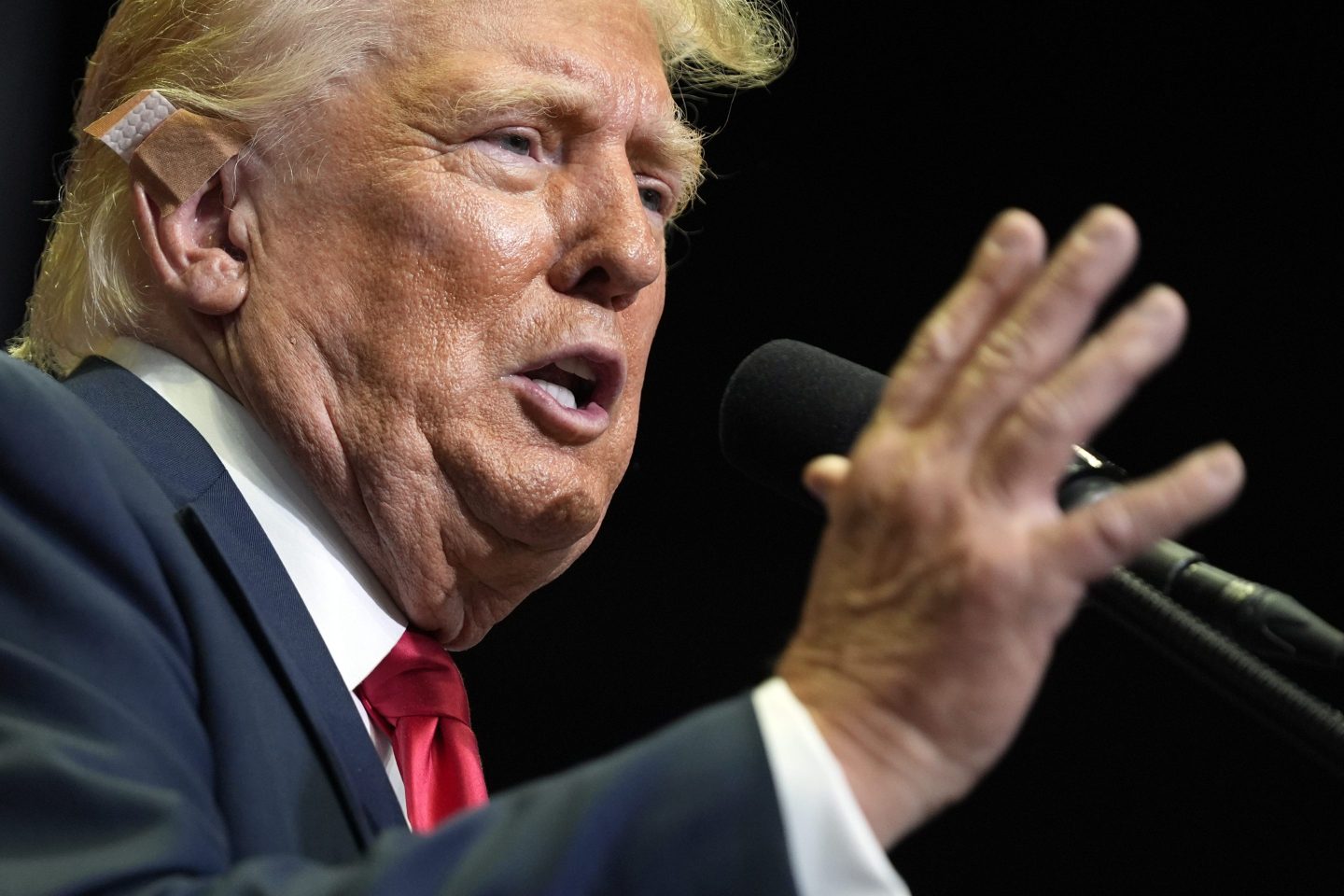
Trump backs down. As you no doubt already know, the president reversed course on his tariff plan, resetting all countries except China to a 10% tax on trade. China will get 125% “based on the lack of respect,” the president said.
The S&P 500 jumped 10% by the end of the day. Context: the index is still down 7% YTD and down 11% from its high in February.
Yes, it was the bond market. Trump wasn’t as bothered by the precipitous drop in equities as he was by falling bond prices. “He is obsessed with rates on 10-year Treasury bonds. To him, this is the measure that matters because so many things are tied to that benchmark,” writes Shawn Tully. Remember: The stock market reacts to things but the bond market decides things.
How the chaos unfolded. Treasury Secretary Scott Bessent was overwhelmed with phone calls from business leaders and Wall Street execs worried that the president was driving the U.S. toward an economic catastrophe on the scale of the 2008 financial crisis, the WSJ reports. “Executives and lobbyists had flooded White House chief of staff Susie Wiles’ phone, according to a person close to her.”
Bessent moves: On Sunday, Bessent told the president in a “private audience” that investors were expecting a “Black Monday” when markets opened the next day, per the NYT. Behind the scenes, White House staff were panicking, the paper reports.
Trump watched TV and was persuaded by Jamie Dimon. “When Trump woke up Wednesday morning, the warning seemed to be playing out in real time. The president started his day monitoring the reaction on Fox Business, where a parade of executives and traders on the normally friendly network sounded alarm,” Bloomberg says. He was particularly persuaded by the misgivings of JPMorgan Chase CEO Jamie Dimon, apparently.
“Permanent damage”: Though markets jolted up following the pause of tariffs, portfolio manager Jake Schurmeier argued that “permanent damage has been done” to equities.
China tariffs are still going to hurt. Casey Ames runs a $5 million business that makes products for special needs children and sells on Amazon. He told Fortune’s Jason Del Rey this week that “the business just won’t work” given the tariffs on China.
No help for Apple. Analysts estimate moving even one-tenth of Apple’s supply chain out of China to the U.S. would cost $30 billion and take three years. The price of an iPhone 16 Pro Max could jump from $1,599 to about $2,300, the analysts estimated.
OpenAI has countersued Elon Musk, claiming he is out to destroy the company.
DOGE cuts jobs at self-driving traffic regulator. The layoffs have “disproportionately” affected officials who would regulate Elon Musk’s Tesla, the FT claims.
DOGE scans for anti-Trump feelings. The Department of Government Efficiency has reportedly started using AI to scan for anti-Trump sentiment in communications between federal employees.
The markets
- The Nasdaq Composite rose 12% yesterday in a relief rally on the news that Trump’s tariffs won’t be as bad as feared. This morning, indexes in Japan closed up 9%. Europe was up more than 5% in early trading. Even China rose 1%. But … S&P futures contracts are in the red this morning.
From the analysts
- Wells Fargo: “The harsh reality is that tariffs have been implemented and there is likely to be an economic cost, not just to the American economy but the global economy as a whole. Our view is that tariffs are going to result in slower GDP growth and slightly higher inflation than previously expected,” per Scott Wren.
- UBS: “Effective tariffs are still about 20 percentage points higher than at the start of the year. That translates into an increase of about 2-2.5% in US price levels … Recession risk in the US is lower than yesterday, but remains high. The big lessons from this: policy remains very (very) erratic; policy competence will be questioned by markets—chaotic confusion about the tariffs on Mexico and Canada suggests the lack of a masterplan; the winning strategy for everyone else is to hang tough and wait for Trump to retreat. Repeated policy uncertainty will hamper investment into the U.S.,” per Paul Donovan.
- Goldman Sachs: “Together, these tariffs are likely to sum to something close to our previous expectation of a 15pp increase in the effective tariff rate. As a result, we are reverting to our previous non-recession baseline forecast with GDP growth of 0.5% and a 45% probability of recession,” per Jan Hatzius et al.
- Wedbush: “[This] will go down as the worst US policy mistake since Smoot-Hawley in 1930 … A US tech company CEO cannot decide last night.... ‘Let’s call Smith Semi Fab Operations in the Midwest to get those semi chips’....as there is one slight problem....IT DOES NOT EXIST. … we do not expect any tech companies to give any guidance on the 1Q conference calls over the next month including Apple given too much uncertainty,” per Daniel Ives et al.
- Bank of America on digital media: “As advertising spend is cyclical and depends, in part, on business confidence, we expect some weakness in 2Q brand advertising (see Lowering ’25 ad spend by $21bn). We believe the announced tariff pause could help soften the potential impact in 2Q and drive some upside to our recently revised estimates, benefitting the entire sector,” per Justin Post et al.
Around the watercooler
Russian economy grows at slowest pace in 2 years—a plunge in oil prices could make things much worse by Ryan Hogg
SEC lawyer heading case on Elon Musk’s Twitter acquisition resigns, cites “heartbreaking” decision by Leo Schwartz
Apple CEO Tim Cook is facing the most daunting moment of his career, but the former COO might be uniquely suited to navigate a tariff meltdown by Lila MacLellan
Meta whistleblower claims tech giant built $18 billion business by aiding China in AI race and undermining U.S. national security by the Associated Press