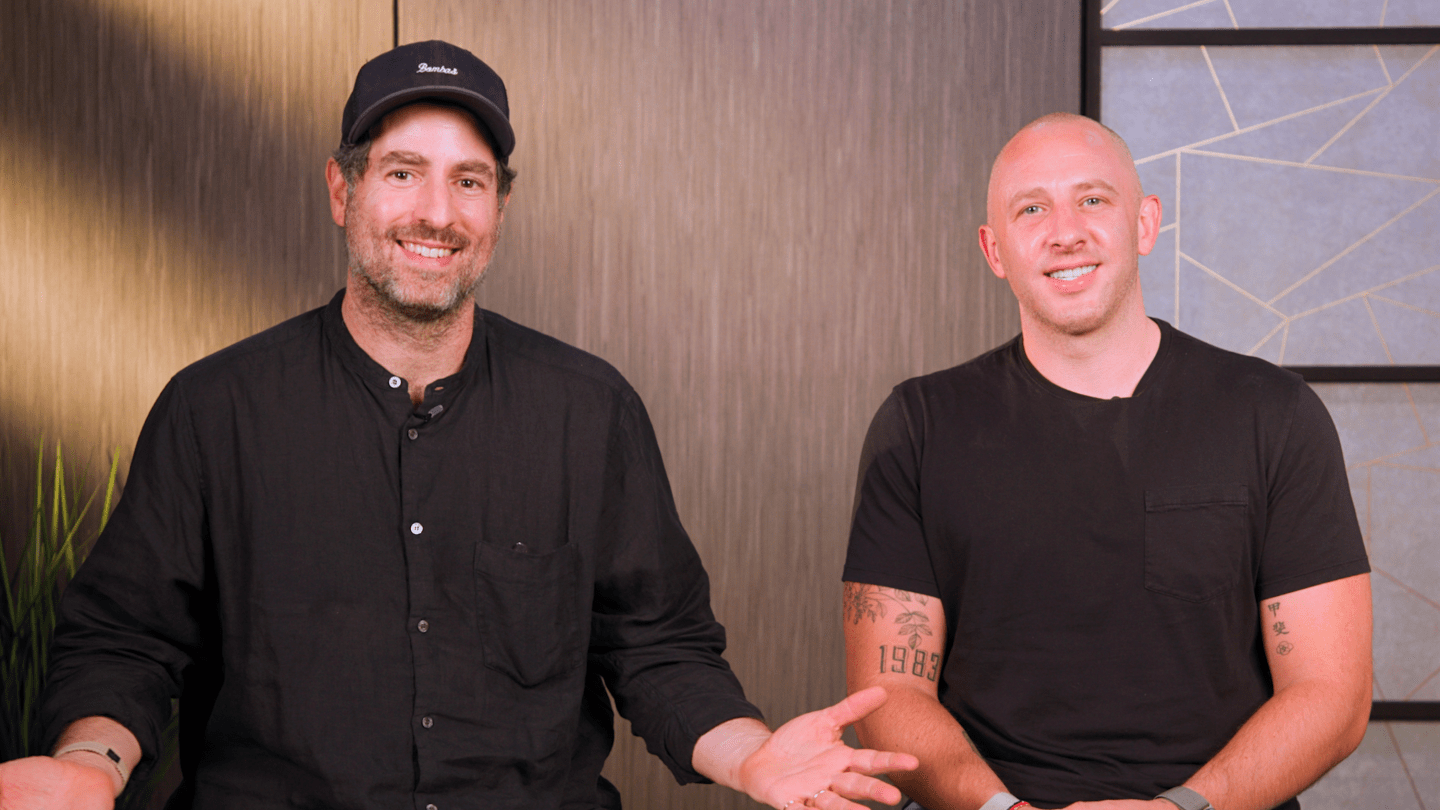
Don’t let their bombshell Shark Tank appearance from 2014 fool you. Randy Goldberg and David Heath weren’t an overnight success.
The duo are the co-founders of Bombas, the brand best known for donating one pair of socks (or underwear, or slippers, or T-shirt) for each pair purchased. It’s the all-time best-selling product to appear before the panel of Sharks, and received an investment from Daymond John, the Shark with the strongest track record of apparel success. The pair says they prepared for Shark Tank by rehearsing 200 questions they imagined the sharks would ask.
John had the right idea; as of October 2023, Bombas—still a private company—has done $1.3 billion in retail sales and its products are on the shelves at DICK’S Sporting Goods. The company also donated over 100 million articles of clothing to those in need. The New York City-headquartered business is a Certified B-Corp and currently employs about 200 workers.
In an interview with Fortune, Goldberg and Heath detailed their winding road to the top—which began with layoffs and dead-end jobs, and ended with the conviction to address a universally pressing need. (Their idea to start the company came from learning that socks are the most requested clothing item in homeless shelters.)
Heath was emboldened by his dad, an entrepreneur, who started his business (a provider of wood-chip surfacing for playgrounds) in the family basement. “I watched him grow it over 35 years,” Heath recalled. “So I think that’s probably where I get a lot of my inspiration from.”
He went on to study entrepreneurship as an undergrad at Babson College, but that’s not where he learned the fundamentals.
What you learn as a door-to-door salesman
“I think one of the most profound jobs that I had, with the most impact on my career long-term, was a summer job during college,” he said. “I worked for Cutco Knives, where I would sell kitchen cutlery door to door to people in my town and my neighborhood.”
That job taught him the art of selling—which he says is crucial to the CEO role of galvanizing and mobilizing a sales force of your own—which mostly means handling rejections and understanding the consumer. Much like observing his dad’s steady growth, “I think that that job had a really large impact on me,” Heath told Fortune.
Goldberg, like his co-founder, was raised in an entrepreneurial household; his parents owned a business together that manufactured and sold eyeglasses to big retailers like LensCrafters.
Goldberg’s father had been a long-time entrepreneur, in the nightlife space and even as an owner of racehorses. (His mom was a special education teacher.) They went into business together when they met.
“When my sister and I were growing up, we were always around their business, and it was a very entrepreneurial family,” Goldberg recalled. “Hence, I was always doing something as well— hustling, washing cars, shoveling snow. I sold watches at a flea market that may or may not have been real. I was always doing something. I worked at a bagel shop.”
Formative beginnings as coworkers
Goldberg then landed at Georgetown, where he studied finance, but it didn’t scratch the itch in the same way. Case in point: he hasn’t worked in finance “for a day in my life” since undergrad.
Instead, he took a job in consulting after graduation, but owing to a recession, he was laid off within seven months. That disappointment led him back in an entrepreneurial, open-minded direction.
“I had to kind of figure out my path—what I wanted to do,” he said. “I didn’t love what I had been doing, so I just got a job at a restaurant waiting tables, and I worked in a wine shop, and just pieced it together. And while I was doing that, I became friends with some people who worked at an ad agency, and they thought I’d be good at what they do.”
Those friends gave Goldberg the chance to work on a branding project for Johnston & Murphy Shoes, a large manufacturer “who had kind of lost their way” and were looking to rediscover their company identity.
“I got to work on this project, and got to understand the world of branding and advertising, and realized that this was a great fit for me, and I was good at it, and I loved the work,” he said. He then moved to freelance copywriting and brand strategy, eventually landing a full-time agency gig, before pivoting to a media company where he ran the editorial department—and met Heath.
Heath worked in sales at a large software company before abandoning large businesses altogether, trying his hand at founding a company of his own, before moving into media himself.
“We realized we both had a passion for entrepreneurship and wanted to start our own business someday,” Goldberg said. “We were working full-time, and then also working on the side, and then just friends in New York trying to figure out what we were going to do with our life. We decided we wanted to start a business together before we had an idea.”
Keeping your head down
Naturally, not every idea is a winner, but the best business advice the duo has received is to remain focused—even when all different kinds of opportunities come knocking.
“When you’re starting out, there are so many opportunities in front of you, and the best advice that we kept getting was, if you’ve got something that’s working, focus on that,” Heath said. “Put all of your time and energy into what you know is working, and double down, rather than chase every new shiny object.”
In other words: do one thing really, really well, rather than a bunch of things poorly.
The worst advice—which Bombas avoided succumbing to—was to partner with a venture capital firm, raise a bunch of money, and “figure out profitability later.”
“I go back to the brands we always admired; they didn’t raise a bunch of money,” Heath recalled. “They were always profitable from day one; they built these businesses brick by brick over many, many, many years, rather than try to grow a business very quickly in a short amount of time.”
At least in the apparel industry, “you can’t necessarily force building a brand quickly,” he added. “I think a brand requires customer loyalty and delivering a very consistent experience and product time and time again, and that relationship takes time to build. We had a much longer-term view, rather than trying to maximize some return for some venture capitalist.”
As for their secret to continued success, Goldberg credits it to their stringent balance between working really hard and taking time away from the desk.
“It’s a balance between our product and our mission, a balance between taking the work seriously but not taking ourselves too seriously,” he said. “A balance between growth and profitability. Everything in a business is a balance, and if things get too out of whack in one direction, everybody feels it.”
Too many businesses end up creating a strain by overemphasizing the deadlines and the margins. “We try to keep things light, even though we deal with a heavy topic, right?” Goldberg said. “It’s a big topic at Bombas, and something I think about a lot as we build the company and the culture.”