• Home
  • Latest
  • Fortune 500
  • Finance
  • Tech
  • Leadership
  • Lifestyle
  • Rankings
  • Multimedia
CommentaryInflation

Fed Chair Jerome Powell is trying to explain away the inflation rollercoaster—but money supply is absent from his script

By
John Greenwood
John Greenwood
and
Steve H. Hanke
Down Arrow Button Icon
August 2, 2024, 8:33 AM ET
John Greenwood is a fellow at the Johns Hopkins Institute for Applied Economics, Global Health and the Study of Business Enterprise. Steve H. Hanke is a professor of applied economics at Johns Hopkins University.
Federal Reserve Chairman Jerome Powell speaks at a news conference following a Federal Open Market Committee meeting on July 31.
Federal Reserve Chairman Jerome Powell speaks at a news conference following a Federal Open Market Committee meeting on July 31.Andrew Harnik - Getty Images

Since the COVID-19 pandemic o­­f 2020, most countries have witnessed a rapid runup in inflation followed by hasty retreat. For some nations, the trip’s been a wild rollercoaster ride, a lurching ascent towards a summit where the houses below look like Monopoly pieces, followed by a steep, head-spinning drop. For others, the journey has resembled a snowmobile’s wintry climb up a low, sloping hill, and the gliding descent down the other side. Only the general, up-and-down pattern is the same. But some nations never experienced a steep inflation jump at all. Put simply, “Big Inflation” wasn’t a global phenomenon.

Our research into the link between money supply and inflation in 27 countries since 2020 shows that where the roller-coaster scourge happened, as in the U.S., the cause was a huge, misguided spike in the money supply. In countries where M2 (a measure of the money supply that includes cash, checking deposits, and other deposits readily convertible to cash) rose only gradually, the price rise proved moderate and didn’t require draconian, potentially growth-crushing measures to correct.

While the inflation rides have varied a great deal across geographies, the refrains about their sources have not. Officialdom and the chattering classes have all sung the same song: Inflation was caused by a plethora of non-monetary factors, ranging from supply chain glitches to COVID-19 lockdowns to oil price spikes. Once these factors receded, so did inflation.

Absent from the standard script is the role of money. For example, the Bank for International Settlements (BIS), in its recent Annual Economic Report, highlights five lessons learned from the post-COVID waves of inflation. But nowhere to be found is the role money supply played.

Such a reaction by central bankers is typical. After all, no one likes to take the blame for causing inflation. For central bankers, it’s the old adage: It’s not me, it’s the guy behind the tree.

Academic cover for the central bankers’ version is provided by the current fashion in macroeconomics. Money is absent from the post-Keynesian models that have been en vogue for the past 30 years. That wasn’t always the case. Back in 1985, when Gottfried Haberler penned his influential The Problem of Stagflation, he wrote: “I fully agree with the monetarists that inflation, including stagflation, is basically a monetary phenomenon, in the sense that there has never been a significant inflation or stagflation—prices rising, say, by 4 percent or more a year for two or more years—without a significant growth in the stock of money.” What Haberler wrote in 1985 is as true today as it was then.
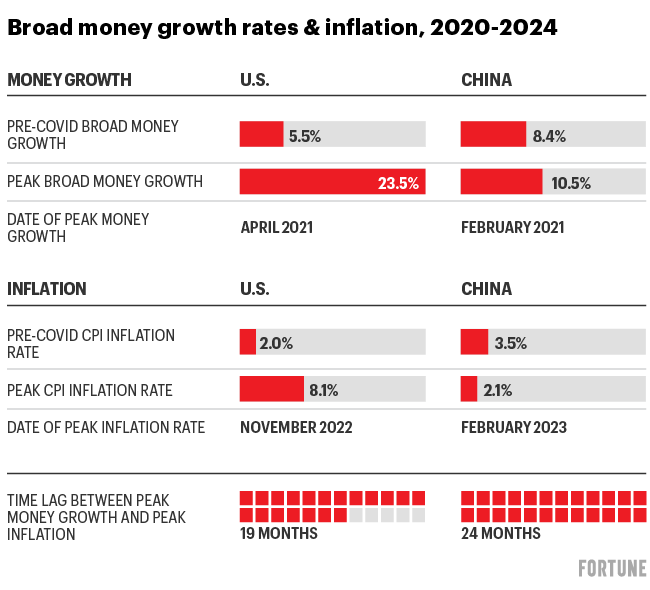
Source: Greenwood and Hanke analysis of publicly available data

We examined the link between changes in the stock of broad money and inflation in 27 countries during the 2020-24 period. These countries account for over 75% of the world’s GDP. They range from large developed to smaller emerging market nations. To compare money supply and inflation data, we used a 12-month moving average of the year-over-year percentage changes.

We found a very clear pattern in all cases. First, the rate of growth in the money supply changed. Then, with a lag, inflation changed its course. The amplitude of the inflationary ramp varied from wild to mild. The wild upward swings happened in the U.S., U.K., Eurozone, Denmark, Sweden, Canada, Australia, New Zealand, Argentina, Brazil, Egypt, Ghana, Israel, Mexico, Nigeria, Peru, Philippines, Sri Lanka, Thailand, and Turkey. The up-and-down ride was mild in China, Japan, Switzerland, Malaysia, India, Indonesia, and South Africa.

The two largest economies in the world, the U.S. and China, illustrate that inflation isn’t universal but rather dependent on the rate of growth in each country’s money supply. In the U.S., we find that the rate of growth in the money supply soared after COVID-19 hit, peaking in April 2021 at a pace over four times more rapid than pre-COVID. Nineteen months later, the U.S. inflation rate peaked at 8.1% and was also over four times higher than its pre-COVID rate. That’s a theme park-level, rollercoaster liftoff skyward that leaves the whole family breathless.

In contrast, China didn’t experience much of an upward ride at all. Its money supply growth rate didn’t change much after the pandemic hit, reaching its peak in February 2021. With a 24-month lag, China’s annual inflation rate peaked at only 2.1%.

The recent ups and downs in inflation echo Milton Friedman’s dictum: “Inflation is always and everywhere a monetary phenomenon.” They also mirror Friedman’s findings on the lag of roughly two years between changes in the stock of money and changes in inflation. In the 27 countries we studied, the mean and median lags witnessed in the 2020-24 inflation rollercoaster were 23.9 and 23 months, respectively.

Having failed to predict the recent ups and downs in the course of inflation, central bankers and contemporary macroeconomists should throw away their scripts and models and start paying attention to the strong causal link between changes in the stock of money and inflation.

More must-read commentary published by Fortune:

  • Forget the pundits and polls—internet prediction markets anticipated Biden’s withdrawal weeks ago
  • Private equity is devouring the economy as boomer entrepreneurs exit—but a new approach to employee ownership can change that
  • Gen Z’s enthusiasm for all things touchable is resurrecting the analog economy—and costing parents
  • Nokia CEO: Europe shouldn’t be afraid to back its innovation champions

The opinions expressed in Fortune.com commentary pieces are solely the views of their authors and do not necessarily reflect the opinions and beliefs of Fortune.

Join us at the Fortune Workplace Innovation Summit May 19–20, 2026, in Atlanta. The next era of workplace innovation is here—and the old playbook is being rewritten. At this exclusive, high-energy event, the world’s most innovative leaders will convene to explore how AI, humanity, and strategy converge to redefine, again, the future of work. Register now.
About the Authors
By John Greenwood
See full bioRight Arrow Button Icon
Steve H. Hanke
By Steve H. Hanke
Twitter icon
See full bioRight Arrow Button Icon

Latest in Commentary

Finance
Lorem ipsum dolor sit amet, consectetur adipiscing elit, sed do eiusmod tempor incididunt ut labore et dolore magna aliqua. Ut enim ad minim veniam
By Fortune Editors
October 20, 2025
Finance
Lorem ipsum dolor sit amet, consectetur adipiscing elit, sed do eiusmod tempor incididunt ut labore et dolore magna aliqua. Ut enim ad minim veniam
By Fortune Editors
October 20, 2025
Finance
Lorem ipsum dolor sit amet, consectetur adipiscing elit, sed do eiusmod tempor incididunt ut labore et dolore magna aliqua. Ut enim ad minim veniam
By Fortune Editors
October 20, 2025
Finance
Lorem ipsum dolor sit amet, consectetur adipiscing elit, sed do eiusmod tempor incididunt ut labore et dolore magna aliqua. Ut enim ad minim veniam
By Fortune Editors
October 20, 2025
Finance
Lorem ipsum dolor sit amet, consectetur adipiscing elit, sed do eiusmod tempor incididunt ut labore et dolore magna aliqua. Ut enim ad minim veniam
By Fortune Editors
October 20, 2025
Finance
Lorem ipsum dolor sit amet, consectetur adipiscing elit, sed do eiusmod tempor incididunt ut labore et dolore magna aliqua. Ut enim ad minim veniam
By Fortune Editors
October 20, 2025

Most Popular

Finance
Lorem ipsum dolor sit amet, consectetur adipiscing elit, sed do eiusmod tempor incididunt ut labore et dolore magna aliqua. Ut enim ad minim veniam
By Fortune Editors
October 20, 2025
Finance
Lorem ipsum dolor sit amet, consectetur adipiscing elit, sed do eiusmod tempor incididunt ut labore et dolore magna aliqua. Ut enim ad minim veniam
By Fortune Editors
October 20, 2025
Finance
Lorem ipsum dolor sit amet, consectetur adipiscing elit, sed do eiusmod tempor incididunt ut labore et dolore magna aliqua. Ut enim ad minim veniam
By Fortune Editors
October 20, 2025
Finance
Lorem ipsum dolor sit amet, consectetur adipiscing elit, sed do eiusmod tempor incididunt ut labore et dolore magna aliqua. Ut enim ad minim veniam
By Fortune Editors
October 20, 2025
Finance
Lorem ipsum dolor sit amet, consectetur adipiscing elit, sed do eiusmod tempor incididunt ut labore et dolore magna aliqua. Ut enim ad minim veniam
By Fortune Editors
October 20, 2025
Finance
Lorem ipsum dolor sit amet, consectetur adipiscing elit, sed do eiusmod tempor incididunt ut labore et dolore magna aliqua. Ut enim ad minim veniam
By Fortune Editors
October 20, 2025
Rankings
  • 100 Best Companies
  • Fortune 500
  • Global 500
  • Fortune 500 Europe
  • Most Powerful Women
  • Future 50
  • World’s Most Admired Companies
  • See All Rankings
Sections
  • Finance
  • Leadership
  • Success
  • Tech
  • Asia
  • Europe
  • Environment
  • Fortune Crypto
  • Health
  • Retail
  • Lifestyle
  • Politics
  • Newsletters
  • Magazine
  • Features
  • Commentary
  • Mpw
  • CEO Initiative
  • Conferences
  • Personal Finance
  • Education
Customer Support
  • Frequently Asked Questions
  • Customer Service Portal
  • Privacy Policy
  • Terms Of Use
  • Single Issues For Purchase
  • International Print
Commercial Services
  • Advertising
  • Fortune Brand Studio
  • Fortune Analytics
  • Fortune Conferences
  • Business Development
About Us
  • About Us
  • Editorial Calendar
  • Press Center
  • Work At Fortune
  • Diversity And Inclusion
  • Terms And Conditions
  • Site Map

© 2025 Fortune Media IP Limited. All Rights Reserved. Use of this site constitutes acceptance of our Terms of Use and Privacy Policy | CA Notice at Collection and Privacy Notice | Do Not Sell/Share My Personal Information
FORTUNE is a trademark of Fortune Media IP Limited, registered in the U.S. and other countries. FORTUNE may receive compensation for some links to products and services on this website. Offers may be subject to change without notice.


Most Popular

placeholder alt text
Success
Billionaire philanthropy's growing divide: Mark Zuckerberg stops funding immigration reform as MacKenzie Scott doubles down on DEI
By Ashley LutzDecember 22, 2025
1 day ago
placeholder alt text
Success
Former U.S. Secret Service agent says bringing your authentic self to work stifles teamwork: 'You don’t get high performers, you get sloppiness'
By Sydney LakeDecember 22, 2025
2 days ago
placeholder alt text
Travel & Leisure
After pouring $450 million into Florida real estate, Larry Ellison plans to lure the ultrarich to an exclusive town just minutes from Mar-a-Lago
By Marco Quiroz-GutierrezDecember 22, 2025
2 days ago
placeholder alt text
Success
The average worker would need to save for 52 years to claw their way out of the middle class and be classified as wealthy, new research reveals
By Orianna Rosa RoyleDecember 23, 2025
12 hours ago
placeholder alt text
Success
'When we got out of college, we had a job waiting for us': 80-year-old boomer says her generation left behind a different economy for her grandkids
By Mike Schneider and The Associated PressDecember 23, 2025
14 hours ago
placeholder alt text
Success
OpenAI's CEO Sam Altman says in 10 years' time college graduates will be working 'some completely new, exciting, super well-paid' job in space
By Preston ForeDecember 23, 2025
13 hours ago

Latest in Commentary

students
CommentaryEducation
Why restricting graduate loans will bankrupt America’s talent supply chain
By Katica RoyDecember 23, 2025
14 hours ago
Arnault
CommentaryLuxury
The secrets of what Arnault knows: How Bernard Arnault built the impossible, and his timeless, transferable lessons of leadership 
By Jeffrey Sonnenfeld and Steven TianDecember 23, 2025
14 hours ago
beer
CommentaryFood and drink
Supporting moderation: beer’s structural advantage in the no-alcohol space
By Justin KissingerDecember 23, 2025
15 hours ago
Chris Nicholas
CommentaryLeadership
I’m the Sam’s Club CEO and I’ve got an AI leadership reality check: let purpose, not promise, guide investment
By Chris NicholasDecember 22, 2025
2 days ago
Geoff Green
Commentarymortgages
Your mortgage likely cost $11,500 to originate—and reams of paperwork. How Salesforce Agentforce is helping improve the process
By Geoff GreenDecember 22, 2025
2 days ago
sustainability
CommentarySustainability
2025: the year sustainability didn’t die 
By Andrew WinstonDecember 21, 2025
3 days ago