• Home
  • Latest
  • Fortune 500
  • Finance
  • Tech
  • Leadership
  • Lifestyle
  • Rankings
  • Multimedia
EnvironmentAgriculture

Kenya launched a fertilizer subsidy in 2008 and now farmers say the soil is dying and chemical fertilizers that make the land acidic are to blame

By
Evelyne Musambi
Evelyne Musambi
and
The Associated Press
Down Arrow Button Icon
By
Evelyne Musambi
Evelyne Musambi
and
The Associated Press
Down Arrow Button Icon
July 24, 2024, 6:47 AM ET
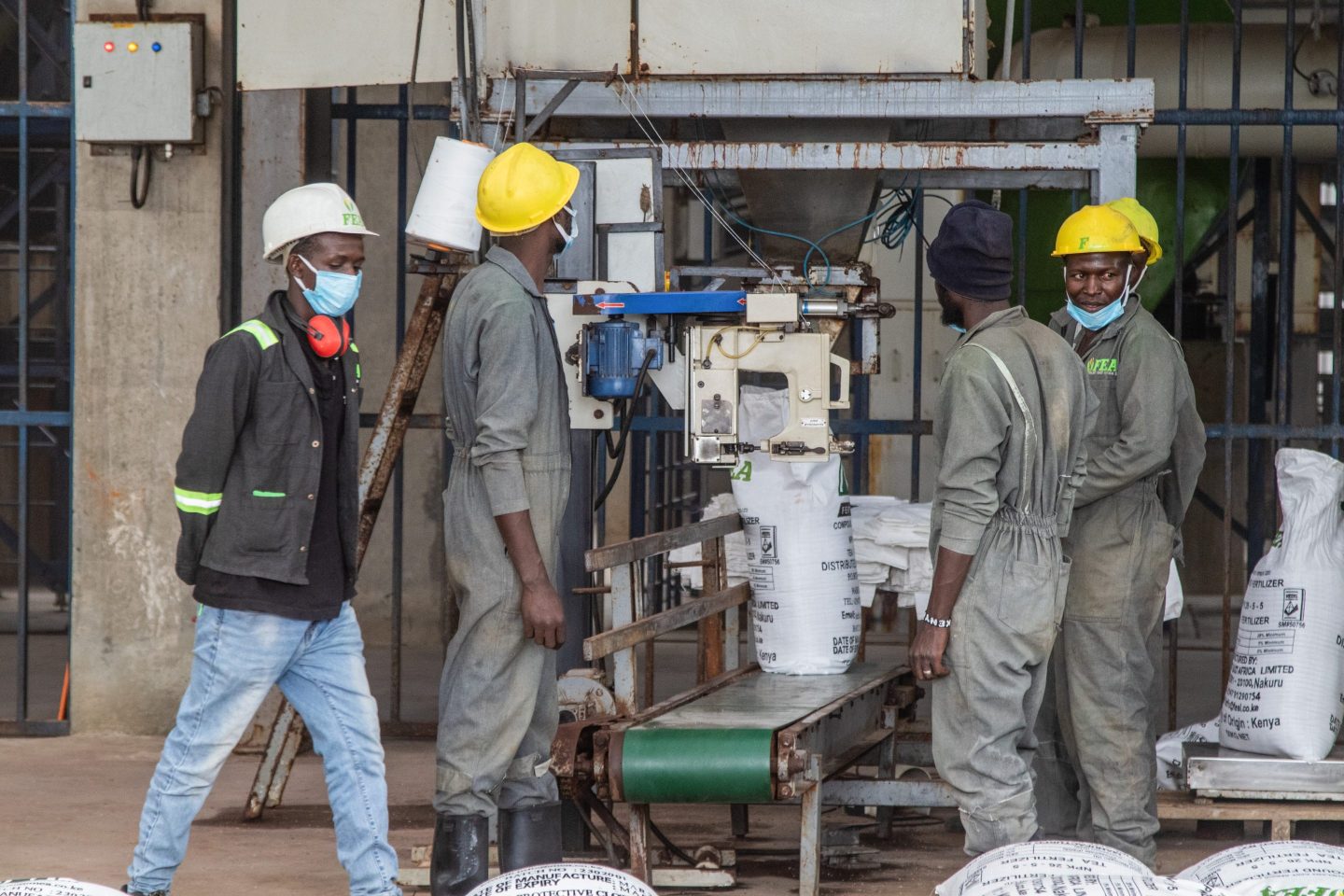
Workers operate a fertilizer packaging unit at the Fertiplant granulation Factory in Nakuru, Kenya on March 3, 2023.
Workers operate a fertilizer packaging unit at the Fertiplant granulation Factory in Nakuru, Kenya on March 3, 2023.James Wakibia—SOPA Images/LightRocket via Getty Images

When Benson Wanjala started farming in his western Kenya village two and a half decades ago, his 10-acre farm could produce a bountiful harvest of 200 bags of maize. That has dwindled to 30. He says his once fertile soil has become a nearly lifeless field that no longer earns him a living.

Recommended Video

Like many other farmers, he blames acidifying fertilizers pushed in Kenya and other African countries in recent years. He said he started using the fertilizers to boost his yield and it worked — until it didn’t. Kenya’s government first introduced a fertilizer subsidy in 2008, making chemical fertilizers more accessible for smaller-scale farmers.

About 63% of arable land in Kenya is now acidic, according to the agriculture ministry, which has been recording a decline in production of staples such as maize and leading exports of horticulture and tea. The production of maize declined by 4% to 44 million tons in 2022, according to the Food and Agriculture Organization, which didn’t say why.

The agriculture ministry didn’t respond to questions, especially after a scandal over fake fertilizer in April. The fertilizer was found to be quarry dirt in misleadingly labelled bags that were distributed to farmers through a national subsidy program. President William Ruto said about 7,000 farmers bought the fake fertilizer and would be compensated with the correct product.

Problems with soil health are growing as the African continent struggles to feed itself. Africa has 65% of the world’s remaining uncultivated arable land but has spent about $60 billion annually to import food, according to the African Development Bank. The spending is estimated to jump to $110 billion by 2025 due to increased demand and changing consumption habits.

In May, Kenya hosted an Africa-wide soil health summit to discuss declining production, climate change and other issues that have increased food security concerns. Agriculture is a key part of the economy in Kenya, making up more than a quarter of the GDP.

At the summit, Stephen Muchiri, executive director of the Eastern Africa Farmers Federation, advocated for a return to traditional farming practices to replenish lifeless soils, including planting a variety of crops and doing as little as possible to disturb the land.

“Inorganic fertilizers were never meant to be the foundation of crop production,” he said, later adding that because of “commercially inclined farming, our soils are now poor, acidic, and low in biomass resources, and without life!”

He said farmers should rotate crops on their land and source compost material from livestock such as goats: “There must be some kind of transition and adaptation for our soils to revert back to fertility.”

Experts say soil acidity causes land degradation by decreasing the availability of plant and essential nutrients, making soil more vulnerable to structure decline and erosion.

The program coordinator for the Alliance for Food Sovereignty in Africa, Bridget Mugambe, advised the phasing out of chemical fertilizers.

“Soil health goes beyond the quick fixes provided by chemical fertilizers. In fact, chemical fertilizers have extensively damaged our soils in Africa. We need to think of our soils in a more holistic way,” she said.

The soil health summit by the African Union — which in 2006 recommended that members use more chemical fertilizers — adopted a 10-year plan that calls for increased investment to produce both organic and chemical fertilizers locally and triple their use for increased production.

During the summit, AU commissioner for agriculture Josefa Leonel Correia Sacko asserted that the continent was “losing over $4 billion worth of soil nutrients each year.”

Kenya heavily relies on imported fertilizer due to low local production. The main supplier is the European Union, followed by Saudi Arabia and Russia.

The Alliance for a Green Revolution in Africa’s Kenya manager, John Macharia, said Kenya’s recent fertilizer scandal should not discourage farmers.

“It’s still imperative that we are able to work with the government to actually ensure that we have the right fertilizers coming to our stores,” Macharia said. He recommended both chemical and organic ones as long as they address the specific issue in the soil, and said soil analysis would guide farmers.

Declining soil quality is a food security concern across Africa.

In Zimbabwe, once a regional breadbasket, about 70% of soils are acidic, according to the government. The government in the past introduced chemical fertilizers in an attempt to strengthen soils, but wrong usage caused a decline in organic matter.

“Before the introduction of mineral fertilizers, our forefathers had the knowledge and understanding that if you add organic manure, the soil becomes fertile, and crops perform better,” said Wonder Ngezimana, a crop science associate professor at Zimbabwe’s Marondera University of Agricultural Sciences and Technology. “That has been a traditional norm in Zimbabwe and elsewhere in Africa where people scavenge for any kind of organic matter to add to the soil.”

That includes animal manure, grass, leaves and twigs, crop residue, ash and compost. But many farmers in Zimbabwe no longer have cattle because of recent drought, Ngezimana said: “Farmers are struggling to maintain soil health because they can’t generate enough quantities of organic matter.”

AGRA recommended that farmers test their soil’s acidity and apply lime to reverse high acidity.

But farmers say both are limited and costly. Soil testing services are available in government agricultural agencies, public universities and private organizations at prices ranging from $20 to $40.

Wanjala, the farmer, said he cannot even find the money cattle for manure, and barely for seeds.

“I cannot afford more expenses,” he said.
Join us at the Fortune Workplace Innovation Summit May 19–20, 2026, in Atlanta. The next era of workplace innovation is here—and the old playbook is being rewritten. At this exclusive, high-energy event, the world’s most innovative leaders will convene to explore how AI, humanity, and strategy converge to redefine, again, the future of work. Register now.
About the Authors
By Evelyne Musambi
See full bioRight Arrow Button Icon
By The Associated Press
See full bioRight Arrow Button Icon

Latest in Environment

Finance
Lorem ipsum dolor sit amet, consectetur adipiscing elit, sed do eiusmod tempor incididunt ut labore et dolore magna aliqua. Ut enim ad minim veniam
By Fortune Editors
October 20, 2025
Finance
Lorem ipsum dolor sit amet, consectetur adipiscing elit, sed do eiusmod tempor incididunt ut labore et dolore magna aliqua. Ut enim ad minim veniam
By Fortune Editors
October 20, 2025
Finance
Lorem ipsum dolor sit amet, consectetur adipiscing elit, sed do eiusmod tempor incididunt ut labore et dolore magna aliqua. Ut enim ad minim veniam
By Fortune Editors
October 20, 2025
Finance
Lorem ipsum dolor sit amet, consectetur adipiscing elit, sed do eiusmod tempor incididunt ut labore et dolore magna aliqua. Ut enim ad minim veniam
By Fortune Editors
October 20, 2025
Finance
Lorem ipsum dolor sit amet, consectetur adipiscing elit, sed do eiusmod tempor incididunt ut labore et dolore magna aliqua. Ut enim ad minim veniam
By Fortune Editors
October 20, 2025
Finance
Lorem ipsum dolor sit amet, consectetur adipiscing elit, sed do eiusmod tempor incididunt ut labore et dolore magna aliqua. Ut enim ad minim veniam
By Fortune Editors
October 20, 2025

Most Popular

Finance
Lorem ipsum dolor sit amet, consectetur adipiscing elit, sed do eiusmod tempor incididunt ut labore et dolore magna aliqua. Ut enim ad minim veniam
By Fortune Editors
October 20, 2025
Finance
Lorem ipsum dolor sit amet, consectetur adipiscing elit, sed do eiusmod tempor incididunt ut labore et dolore magna aliqua. Ut enim ad minim veniam
By Fortune Editors
October 20, 2025
Finance
Lorem ipsum dolor sit amet, consectetur adipiscing elit, sed do eiusmod tempor incididunt ut labore et dolore magna aliqua. Ut enim ad minim veniam
By Fortune Editors
October 20, 2025
Finance
Lorem ipsum dolor sit amet, consectetur adipiscing elit, sed do eiusmod tempor incididunt ut labore et dolore magna aliqua. Ut enim ad minim veniam
By Fortune Editors
October 20, 2025
Finance
Lorem ipsum dolor sit amet, consectetur adipiscing elit, sed do eiusmod tempor incididunt ut labore et dolore magna aliqua. Ut enim ad minim veniam
By Fortune Editors
October 20, 2025
Finance
Lorem ipsum dolor sit amet, consectetur adipiscing elit, sed do eiusmod tempor incididunt ut labore et dolore magna aliqua. Ut enim ad minim veniam
By Fortune Editors
October 20, 2025
Rankings
  • 100 Best Companies
  • Fortune 500
  • Global 500
  • Fortune 500 Europe
  • Most Powerful Women
  • Future 50
  • World’s Most Admired Companies
  • See All Rankings
Sections
  • Finance
  • Leadership
  • Success
  • Tech
  • Asia
  • Europe
  • Environment
  • Fortune Crypto
  • Health
  • Retail
  • Lifestyle
  • Politics
  • Newsletters
  • Magazine
  • Features
  • Commentary
  • Mpw
  • CEO Initiative
  • Conferences
  • Personal Finance
  • Education
Customer Support
  • Frequently Asked Questions
  • Customer Service Portal
  • Privacy Policy
  • Terms Of Use
  • Single Issues For Purchase
  • International Print
Commercial Services
  • Advertising
  • Fortune Brand Studio
  • Fortune Analytics
  • Fortune Conferences
  • Business Development
About Us
  • About Us
  • Editorial Calendar
  • Press Center
  • Work At Fortune
  • Diversity And Inclusion
  • Terms And Conditions
  • Site Map
  • Facebook icon
  • Twitter icon
  • LinkedIn icon
  • Instagram icon
  • Pinterest icon

Latest in Environment

PoliticsGavin Newsom
Newsom pleads with U.S. allies in Europe to see Trump as temporary
By Maria Paula Mijares Torres and BloombergFebruary 14, 2026
1 day ago
EnergyFusion
Sam Altman’s fusion startup Helion Energy hits 150 million degree plasma temperature—a milestone that could bring first grid power in 2028
By Jordan BlumFebruary 13, 2026
3 days ago
farley
BankingAutos
Ford CEO Jim Farley knew the EV pain would be bad, but the ‘punch line’ is a $4.8 billion loss: ‘The customer has spoken’
By Nick LichtenbergFebruary 12, 2026
3 days ago
drought
EnvironmentDrought
Rural America’s $23.6 billion wipeout: the drought that wouldn’t quit
By Joel Lisonbee, William Baule and The ConversationFebruary 12, 2026
4 days ago
profusek
CommentaryCorporate Governance
It isn’t partisan politics to admit that stakeholder capitalism went too far, too fast 
By Robert ProfusekFebruary 11, 2026
5 days ago
obama
Environmentclimate change
Trump to stick it to Obama by reversing 2009 finding that climate change is real
By Matthew Daly, Seung Min Kim and The Associated PressFebruary 10, 2026
6 days ago

Most Popular

placeholder alt text
Real Estate
A billionaire and an A-list actor found refuge in a 37-home Florida neighborhood with armed guards—proof that privacy is now the ultimate luxury
By Marco Quiroz-GutierrezFebruary 15, 2026
16 hours ago
placeholder alt text
Success
Meet the grandmother living out of a 400-ft ‘granny pod’ to save money and help with child care—it’s become an American ‘economic necessity’
By Emma BurleighFebruary 15, 2026
17 hours ago
placeholder alt text
AI
Microsoft AI chief gives it 18 months—for all white-collar work to be automated by AI
By Jake AngeloFebruary 13, 2026
2 days ago
placeholder alt text
Future of Work
Malcolm Gladwell tells young people if they want a STEM degree, 'don’t go to Harvard.' You may end up at the bottom of your class and drop out
By Sasha RogelbergFebruary 14, 2026
2 days ago
placeholder alt text
Economy
A U.S. 'debt spiral' could start soon as the interest rate on government borrowing is poised to exceed economic growth, budget watchdog says
By Jason MaFebruary 14, 2026
1 day ago
placeholder alt text
Big Tech
Analog-obsessed Gen Zers are buying $40 app blockers to limit their social media use and take a break from the ‘slot machine in your pocket’
By Marco Quiroz-GutierrezFebruary 13, 2026
2 days ago

© 2026 Fortune Media IP Limited. All Rights Reserved. Use of this site constitutes acceptance of our Terms of Use and Privacy Policy | CA Notice at Collection and Privacy Notice | Do Not Sell/Share My Personal Information
FORTUNE is a trademark of Fortune Media IP Limited, registered in the U.S. and other countries. FORTUNE may receive compensation for some links to products and services on this website. Offers may be subject to change without notice.