• Home
  • News
  • Fortune 500
  • Tech
  • Finance
  • Leadership
  • Lifestyle
  • Rankings
  • Multimedia
FinanceDow Jones Industrial Average

The Dow topped 40,000 for the first time, but the S&P 500 is thrashing the blue-chip index. Here’s why

By
Stan Choe
Stan Choe
and
The Associated Press
Down Arrow Button Icon
By
Stan Choe
Stan Choe
and
The Associated Press
Down Arrow Button Icon
May 18, 2024, 10:53 AM ET
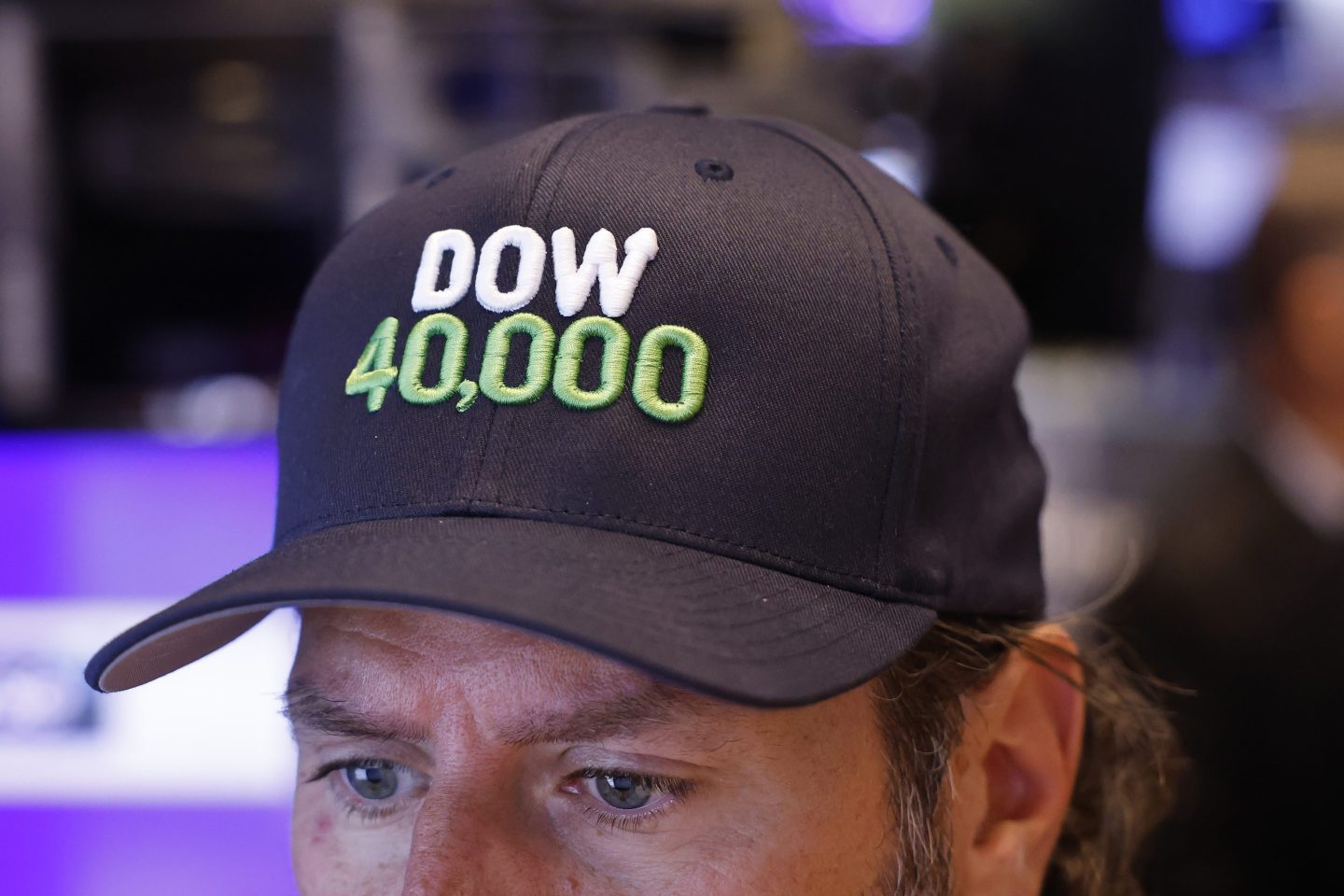
stock trader wears Dow 40,000 cap
The Dow Jones Industrial Average has gained about 20% over the last 12 months.Michael M. Santiago—Getty Images

The Dow Jones Industrial Average just closed above 40,000 for the first time, the latest pop in what’s been a surprisingly good year for Wall Street.

Recommended Video

But just like New Year’s represents an arbitrary point in time in the Earth’s revolution around the sun, such milestones for the Dow don’t mean much inherently.

For one, with just 30 companies, the Dow represents a tiny slice of Corporate America. For another, almost no one’s 401(k) account sees its performance depend on the Dow, which has become more of a relic used for historical comparisons.

What’s more important is that the Dow at 40,000 is one example of how the broader U.S. stock market is setting records.

Here’s a look at what the Dow is, how it got here and how its use among investors is on the wane:

WHAT IS THE DOW?

It’s a measure of 30 established, well-known companies. These stocks are sometimes known as “blue chips,” which are supposed to be on the steadier and safer side of Wall Street.

WHAT’S IN THE DOW?

Not just industrial companies like Caterpillar and Honeywell, despite the name.

The roster has changed many times since the Dow began in 1896 as the U.S. economy has transformed. Out, for example, was Standard Rope & Twine, and in recently have been big technology companies.

Apple, Intel and Microsoft are some of the newer-economy names currently in the Dow. The financial industry also has a healthy representation with American Express, Goldman Sachs, JPMorgan Chase and Travelers. So does health care with Amgen, Johnson & Johnson, Merck and UnitedHealth Group.

WHAT’S ALL THE HUBBUB NOW?

The Dow crossed its latest 10,000 point threshold briefly on Thursday and closed above 40,000 Friday — at 40,003.59 to be exact. It took about three and a half years to make the leap from 30,000 points, which it first crossed in November 2020.

It’s kept chugging mostly higher despite the worst inflation in decades, painfully high interest rates meant to get inflation under control and worries that high rates would make a recession inevitable for the U.S. economy.

Companies are now in the midst of reporting their best profit growth in nearly two years, and the economy has managed to avoid a recession, at least so far.

IS THE DOW THE MAIN MEASURE OF WALL STREET?

No. The Dow represents only a narrow slice of the economy. Professional investors tend to look at broader measures of the market, such as the S&P 500 index, which has nearly 17 times the number of companies within it.

More than $11.2 trillion in investments were benchmarked to the S&P 500 at the end of 2019, according to estimates from S&P Dow Jones Indices. That’s 350 times more than the $32 billion benchmarked to the Dow Jones Industrial Average.

Investors’ 401(k) accounts are much more likely to include an S&P 500 index fund than anything tied to the Dow. The S&P 500 crossed above its own milestone Wednesday, topping 5,300 points for the first time.

That’s what more investors care about. Well, 100-point milestones matter for the S&P 500 as little as others, but the fact that the S&P 500 is higher than ever matters a lot.

HOW DIFFERENT ARE THE DOW AND THE S&P 500?

Their performances have historically tracked relatively closely with each other, but the S&P 500 has been better recently. Its 27.5% rise for the last 12 months easily tops the 19.7% gain for the Dow.

That’s in part because the S&P 500 has more of an emphasis on Big Tech stocks, which were responsible for most of the S&P 500’s gains last year. Hopes for an easing of interest rates by the Federal Reserve and a frenzy around artificial-intelligence technology have pushed them to dizzying heights.

The Dow reflects none of the movements of such marquee stocks as Alphabet, Meta Platforms or Nvidia.

IS THAT IT?

No, the Dow and S&P 500 also take different approaches to measuring how an index should move.

The Dow gives more weight to stocks with higher price tags. That means stocks that add or subtract more dollars to their stock price push and pull it the most, such as UnitedHealth Group and its $525 stock price. A 1% move for that stock, which is about $5, packs a radically harder punch than a 1% move for Walmart, which is about 64 cents

The S&P 500, meanwhile, gives more weight to stocks depending on their overall size. That means a 1% move for Walmart carries more weight than a 1% move for UnitedHealth Group because Walmart is a slightly bigger company by total market value.

SO WHY CARE ABOUT THE DOW?

Because it’s so old, it has a longer track record than other measures of the market.

For a while, a triple-digit move for the Dow also offered an easy shorthand way to show the stock market was having a big day. Now, though, it means much less. A 100 point swing for the Dow means a move of less than 0.3%.


Fortune Brainstorm AI returns to San Francisco Dec. 8–9 to convene the smartest people we know—technologists, entrepreneurs, Fortune Global 500 executives, investors, policymakers, and the brilliant minds in between—to explore and interrogate the most pressing questions about AI at another pivotal moment. Register here.
About the Authors
By Stan Choe
See full bioRight Arrow Button Icon
By The Associated Press
See full bioRight Arrow Button Icon

Latest in Finance

index
Investingindex funds
Quant who said passive era is ‘worse than Marxism’ doubles down
By Denitsa Tsekova, Vildana Hajric and BloombergDecember 6, 2025
27 minutes ago
Zaslav, Sarandos
BankingMedia
A Thanksgiving dealmaking sprint helped Netflix win Warner Bros.
By Michelle F. Davis and BloombergDecember 6, 2025
36 minutes ago
The housing market may be headed towards a more affordable year in 2026, according to Redfin.
Real EstateHousing
The ‘Great Housing Reset’ is coming: Income growth will outpace home-price growth in 2026, Redfin forecasts
By Nino PaoliDecember 6, 2025
2 hours ago
RetailConsumer Spending
U.S. consumers are so financially strained they put more than $1 billion on buy-now, pay later services during Black Friday and Cyber Monday
By Jeena Sharma and Retail BrewDecember 5, 2025
17 hours ago
Elon Musk
Big TechSpaceX
Musk’s SpaceX discusses record valuation, IPO as soon as 2026
By Edward Ludlow, Loren Grush, Lizette Chapman, Eric Johnson and BloombergDecember 5, 2025
17 hours ago
data center
EnvironmentData centers
The rise of AI reasoning models comes with a big energy tradeoff
By Rachel Metz, Dina Bass and BloombergDecember 5, 2025
17 hours ago

Most Popular

placeholder alt text
Economy
Two months into the new fiscal year and the U.S. government is already spending more than $10 billion a week servicing national debt
By Eleanor PringleDecember 4, 2025
2 days ago
placeholder alt text
Success
‘Godfather of AI’ says Bill Gates and Elon Musk are right about the future of work—but he predicts mass unemployment is on its way
By Preston ForeDecember 4, 2025
2 days ago
placeholder alt text
Success
Nearly 4 million new manufacturing jobs are coming to America as boomers retire—but it's the one trade job Gen Z doesn't want
By Emma BurleighDecember 4, 2025
2 days ago
placeholder alt text
Success
Nvidia CEO Jensen Huang admits he works 7 days a week, including holidays, in a constant 'state of anxiety' out of fear of going bankrupt
By Jessica CoacciDecember 4, 2025
2 days ago
placeholder alt text
Big Tech
Mark Zuckerberg rebranded Facebook for the metaverse. Four years and $70 billion in losses later, he’s moving on
By Eva RoytburgDecember 5, 2025
21 hours ago
placeholder alt text
Real Estate
‘There is no Mamdani effect’: Manhattan luxury home sales surge after mayoral election, undercutting predictions of doom and escape to Florida
By Sasha RogelbergDecember 4, 2025
2 days ago
Rankings
  • 100 Best Companies
  • Fortune 500
  • Global 500
  • Fortune 500 Europe
  • Most Powerful Women
  • Future 50
  • World’s Most Admired Companies
  • See All Rankings
Sections
  • Finance
  • Leadership
  • Success
  • Tech
  • Asia
  • Europe
  • Environment
  • Fortune Crypto
  • Health
  • Retail
  • Lifestyle
  • Politics
  • Newsletters
  • Magazine
  • Features
  • Commentary
  • Mpw
  • CEO Initiative
  • Conferences
  • Personal Finance
  • Education
Customer Support
  • Frequently Asked Questions
  • Customer Service Portal
  • Privacy Policy
  • Terms Of Use
  • Single Issues For Purchase
  • International Print
Commercial Services
  • Advertising
  • Fortune Brand Studio
  • Fortune Analytics
  • Fortune Conferences
  • Business Development
About Us
  • About Us
  • Editorial Calendar
  • Press Center
  • Work At Fortune
  • Diversity And Inclusion
  • Terms And Conditions
  • Site Map

© 2025 Fortune Media IP Limited. All Rights Reserved. Use of this site constitutes acceptance of our Terms of Use and Privacy Policy | CA Notice at Collection and Privacy Notice | Do Not Sell/Share My Personal Information
FORTUNE is a trademark of Fortune Media IP Limited, registered in the U.S. and other countries. FORTUNE may receive compensation for some links to products and services on this website. Offers may be subject to change without notice.