
Artificial intelligence is just beginning to make its impact felt—on the world of work and beyond. Predictions vary about how many jobs A.I. will wipe out-and how many it will create, but it’s a bigger story than a reshaping of the labor market. Research from Goldman Sachs estimates that 25% of all tasks in the workplace today could be automated in the U.S., but what if it makes the four-day workweek possible, or even revives the labor movement? We are talking about societal change here, and the ESG team at investment bank Jefferies, which specializes in societal transformation through business, looked into its crystal ball and came up with three big calls about the widespread adoption of the new tech.
The note, written by Jefferies’ ESG strategists, led by global department head Aniket Shah, states that A.I. is inescapable but it’s optimistic that it could improve outcomes at the workplace—or it could become overwhelming because of how quickly it replaces humans in some sectors or hijacks important discussions on climate change.
A.I.’s ability to do ordinary tasks quicker has saved employees precious time to focus on the more challenging things. A study by researchers from Massachusetts Institute of Technology and Stanford University found that generative A.I. tools—like OpenAI’s ChatGPT, for instance—can improve the productivity of employees by 14%.
A four-day workweek?
Those gains could translate into shorter workweeks, Jeffries argues.
“A.I. will make workers much more efficient, leading to a broader acceptance of four-day work weeks,” Jeffries wrote in a note Monday, noting that the U.S. had six-day workweeks until the 1930s.
Recent experiments with four-day workweeks have been promising. Results from a trial in February conducted across dozens of companies in the U.K. showed that the results were so positive that companies wanted the policy to become the new norm—or at least on the employee side. Employees reported having better work-life balance and well-being from fewer work days or fewer working hours per day. About 15% of the employees in the experiment even said that “no amount of money” would get them to work five days again, according to advocacy group 4 Day Week Global that organized the study.
But some companies have pushed back against adopting a shorter week because it didn’t fit the nature of their work or they simply couldn’t pay for it it, despite its up-side for employees. A.I. promises to fix the how-do-you-pay-for-it problem. Some companies that participated in the four day workweek experiment said that with smaller head counts, shorter weeks were unaffordable.
Of course, executives might disagree. Recall the CEO who mused aloud on a conference call about increasing his workers’ quotas by 30 or 40 times because A.I. was allowing them all to work multiple jobs remotely. Maybe it won’t be a four-day workweek with the help of A.I., but a seven-day workweek.
Tech-human interactions
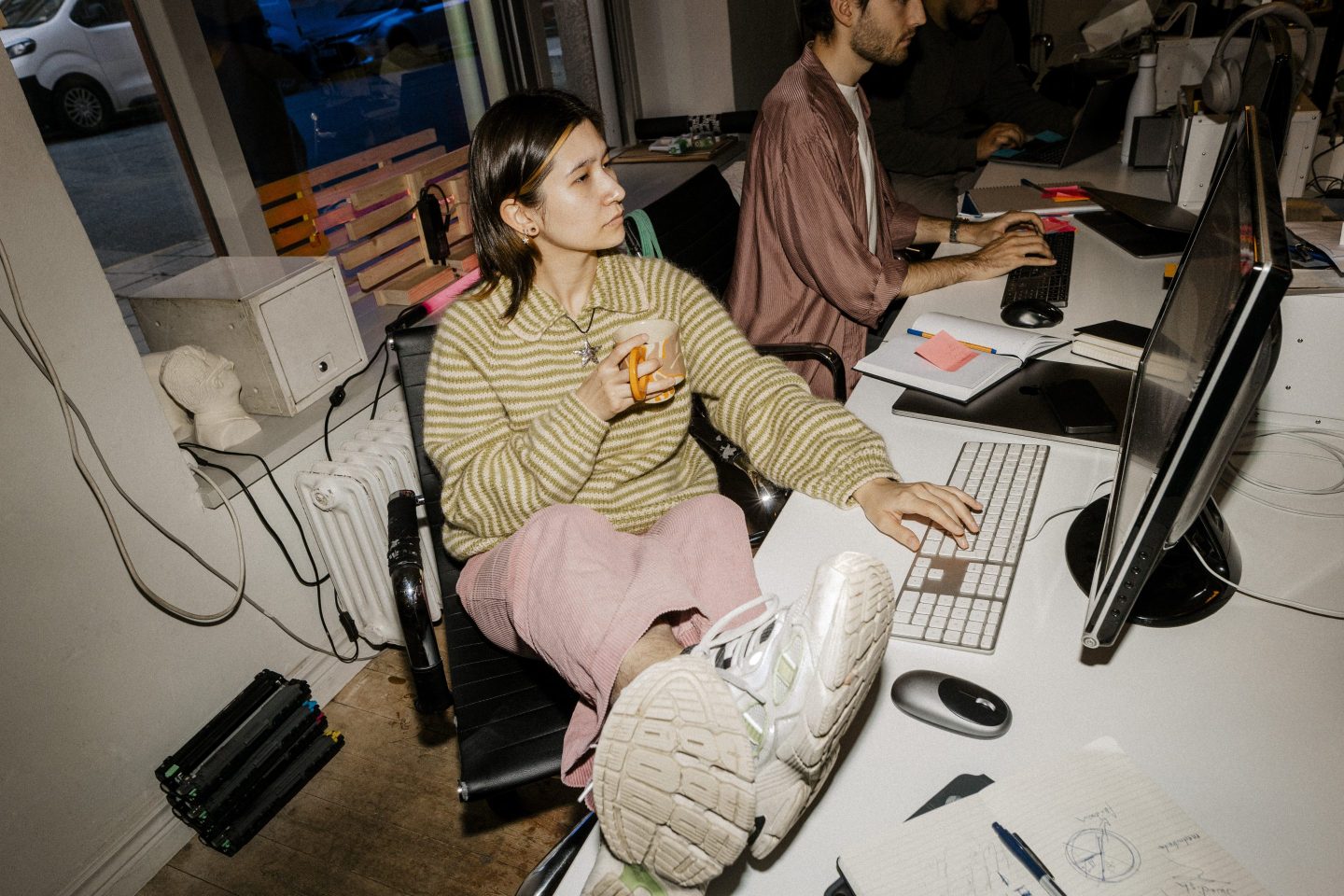
Hours of Zoom meetings and virtual conferences have become daily medicine for developed-world workers since the COVID-19 pandemic reshaped work and forced many to adopt an all-digital lifestyle. But as remote work persists, workers will increasingly want more face-time with humans away from video calls, Jefferies predicts.
“Workers will demand environments that are ‘human only’ to deepen their sense of belonging to a real – as opposed to virtual – community,” Jefferies predicted. “We will see a greater push from workers – not companies – to get back into the office and spend time with colleagues without technology.” Think of companies organizing retreats or other social gatherings that bring employees together in person, instead of through video conferencing.
Past studies have shown the value of face-to-face interactions from a social as well as professional standpoint. For instance, a 2020 report found that employees were more creative when they faced one another in a workplace. Even prominent CEOs including Goldman Sachs’ David Solomon have criticized the concept of remote work as it hurts the company’s culture.
While one set of employees will be jaded with technology, others will likely push back against it, Jefferies says. The benefits of A.I. could be great for companies, but perhaps not for all workers. It could spur conflicts between unions and management as workers fight to keep their jobs as A.I. threatens to take away part of the tasks.
“The U.S. will see a full reversal of its declining trends unionization (from 20.1% in 1983 to 10.1% in 2022), as workers will fear for their jobs. We are already seeing this in a range of industries, from airlines to Hollywood, less than a year since ChatGPT became public,” Jefferies wrote.
A.I. has been one of the clash points in the recent unionization drive in Hollywood among writers and directors. Last week, the directors union struck a deal with production studios to protect them from the influence of A.I. in the creative industry, including a guarantee that “generative A.I. cannot replace the duties performed by members.” Employees have also had concerns over a potential decrease in pay caused by A.I. doing certain tasks or jobs.
A.I. could be good and bad news for climate action
The use of A.I. in energy transition has led to key strides in finding energy-efficient solutions and capturing data related to different processes in the industry. Jefferies predicts that the role of this tech will be front-and-center moving forward.
“This acceleration will make the 2030s and 2040s a very exciting – and confusing – period in the energy transition, during which time the decarbonization options for companies and countries will increase tremendously,” Jefferies wrote. The bank also noted how A.I. could help one of the most complex power grids in the U.S. by generating only the amount of power that is required in different times of the day.
But on the flip-side, A.I. could also be bad news for climate change. The bank said that A.I.’s allure as the “next big thing” could draw people away from more urgent matters including those related to the climate.
“Growing attention to the potential threats from artificial intelligence will take focus away from climate change from policymakers, business leaders and the general population,” Jefferies wrote. “Even though many of the tools empowered by A.I. will help on climate, there is a major threat that the social pressures currently being placed on business and government around climate will dissipate.”
The idea of A.I. overpowering conversations is shared by prominent business figures. Much talk about the tech has been labeled as “hype” by billionaire hedge fund founder Ken Griffin. Even the founder of ChatGPT-maker OpenAI, Sam Altman, called the tech “wildly overhyped,” at least in the short term. But then again, Altman had also said its benefits and presence across the world could make it highly undervalued, even unappreciated.
The benefits of A.I.’s productivity boost like the ability to have three-day weekends can be tempting, but it’s also been predicted for close to a century—as has the discussion about new technology wiping away jobs. The range of Jefferies’ predictions, from the lengthening of the weekend to how a need for human interaction could end the remote work era, shows that we are entering a new era that will be full of surprises.