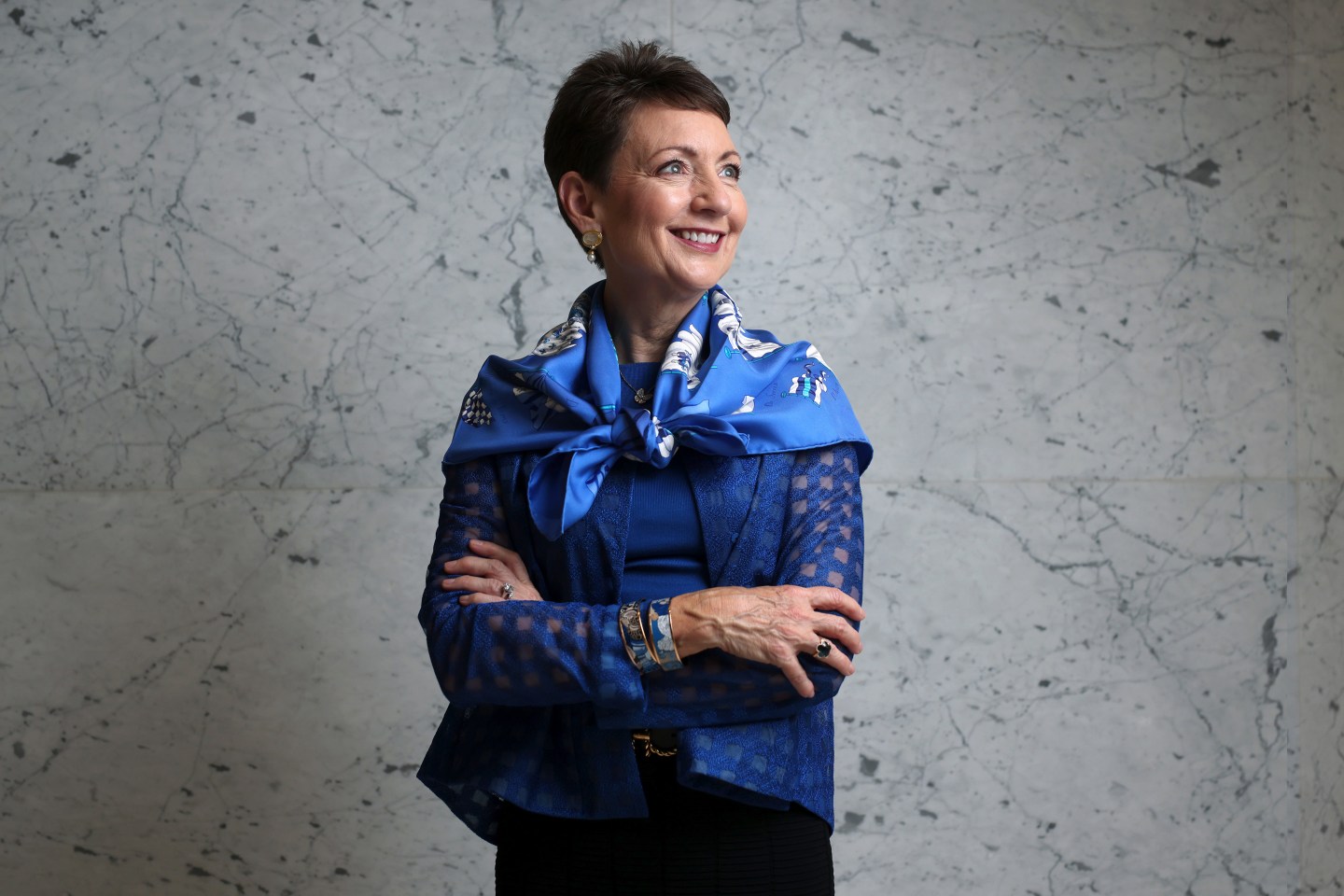
While the debate over the extent of climate change and how to counter its impact rages on in the U.S., Lynn Good is busy making sure Duke Energy, the company she’s run since 2013, is hitting emission reduction targets. She’s betting on renewable energy, seeing in that pursuit an ample business opportunity for the nation’s largest regulated utility.
The Charlotte-based company, serving 8.2 million customers in the Southeast and Midwest, now gets 8% of its power generation from renewable sources, up from 1% in 2005. But it’s still far from the 27% Good expects to reach by 2030. In contrast, coal now drives 17% of power generation, down from 60% in 2005, and is on its way to obsoletion in 12 years. Duke’s carbon emissions have dropped by almost half since 2005, the CEO notes.
Good is not interested in getting pulled into the hot political war of words around climate change—even less so in a society where its denial and related conspiracy theories run rampant. She prefers a pragmatic approach to addressing and extracting business from the issue. “The political winds change, and there will be different points of view. The U.S. doesn’t even have a comprehensive energy policy, but we can’t plan for a day when we all agree,” says Good.
This interview has been edited and condensed for clarity.
Fortune: You’ve been CEO of Duke for a decade now. What is the biggest difference in the sector compared to when you started?
The conversation around climate change and carbon emissions reduction has just escalated over my tenure. The good news is there’s a lot of alignment around the strategy for getting to this common goal in our industry. This single issue is so significant to our company that the entire business strategy is based on achieving those goals.
In your opinion, what will be the energy source of the future?
There’s never been a single source of energy for electricity generation. It’s always come from diverse sources, which will be the case in the future. Renewables will play a greater role, and battery technologies will play a greater role. There is also still a role for natural gas for some time. It’s a matter of putting that diverse set of resources together to hit our goals while maintaining reliability and affordability.
Does any source of energy disappear altogether?
Coal. It is set to disappear from our portfolio by 2035. There will be a sun setting, but there’ll also be an introduction of new technologies we don’t have today. That could be hydrogen, advanced nuclear power with storage capability, long-duration energy storage systems, carbon capture, and so on. We’re working on important technologies today to get us to net zero.
Climate change is such a politicized issue. Doesn’t that make bringing on more renewable energy difficult?
I’m running a company and making investment decisions that I want to be proud of not just this year but in 10, 20, 30 years. We have developed a clear-eyed view that we want to reduce carbon emissions and do so affordably. The political winds change, and there will be different points of view. The U.S. doesn’t even have a comprehensive energy policy, but we can’t plan for a day when we all agree.
But politics seem inevitable. You say coal will disappear from Duke’s portfolio, but coal is central to the economy in some parts of the country.
There is no question that when you talk about retiring coal, there will be an impact on communities and people’s livelihoods. So when we think about this, we think about engaging those communities in discussing our plans to create investment opportunities to protect their livelihood. That could be investing in a community college to recycle the workforce with new training or retiring the coal plant but building a solar plant or a storage facility for natural gas. Our carbon emissions are down 45% since 2005, and we’ve retired a lot of coal assets. In every instance, we’ve worked with local communities to be part of that transition.
You’ve said Duke can’t hit its emissions goals without nuclear energy. Isn’t there still widespread reticence about nuclear power?
I think ‘safety’ always has to go with the word ‘nuclear.’ Safety is always top of mind in our decision-making for these plants. You will find some reticence around safety, nuclear fuel, and storage. They represent opportunities to engage and talk about what we are doing. Nuclear is an extraordinarily valuable tool when we talk about carbon reduction. It runs 95% of the time and produces carbon-free energy. And we do have such a large nuclear footprint already.
How does the rising adoption of electric vehicles help Duke?
It creates a lot of opportunity. Our industry is being looked at to electrify many things, like transportation ports. We are currently working on infrastructure that enables charging and working with customers to simplify adoption. Can we put a charger in your home? Can we give you a subscription program so that you know you can charge your car anytime for a flat fee? We are also working actively with manufacturers, like battery makers. There are so many dimensions to this.
Is your car electric?
My car is not electric, but I’m in line for an electric car.
What do you make of the pushback against ESG criteria for investors? Some critics say ESG is about virtue signaling above all.
We can all agree that we need to take care of the environment, customers, and employees, and we want to have outstanding governance, so our investors know they can count on Duke Energy and its board. Sometimes, these conversations get pulled politically to the far left or the far right. Whether you call it ESG or not, these underlying principles are important to a sustainable corporation.
Before becoming CEO, you were Duke’s CFO. How has that helped you carry out your job?
What we’re trying to accomplish with the assets we build using our capital takes decades of investment. So there’s a lot of strategy that sits in the CFO office. Where are we going? What are we spending money on? What are we trying to accomplish? It allows you to think through a lot of the issues that affect the business.
Is being the CEO of a utility a thankless task for a customer base that just takes service for granted?
There’s an element of that. Most people see us as ‘I turn on the switch; does it work?’ They often don’t have any idea how we make it work. I think about the important role we play and how we enable everything else. But I do want policymakers to understand what it takes to make it all work.
Get to know Good:
- Good is No. 32 on Fortune’s Most Powerful Women list.
- She successfully fought back efforts in 2021 by activist investor Elliott Management to split Duke into three companies.
- Before entering the world of utilities in 2003, she worked at the accounting and management consulting firm Arthur Andersen.