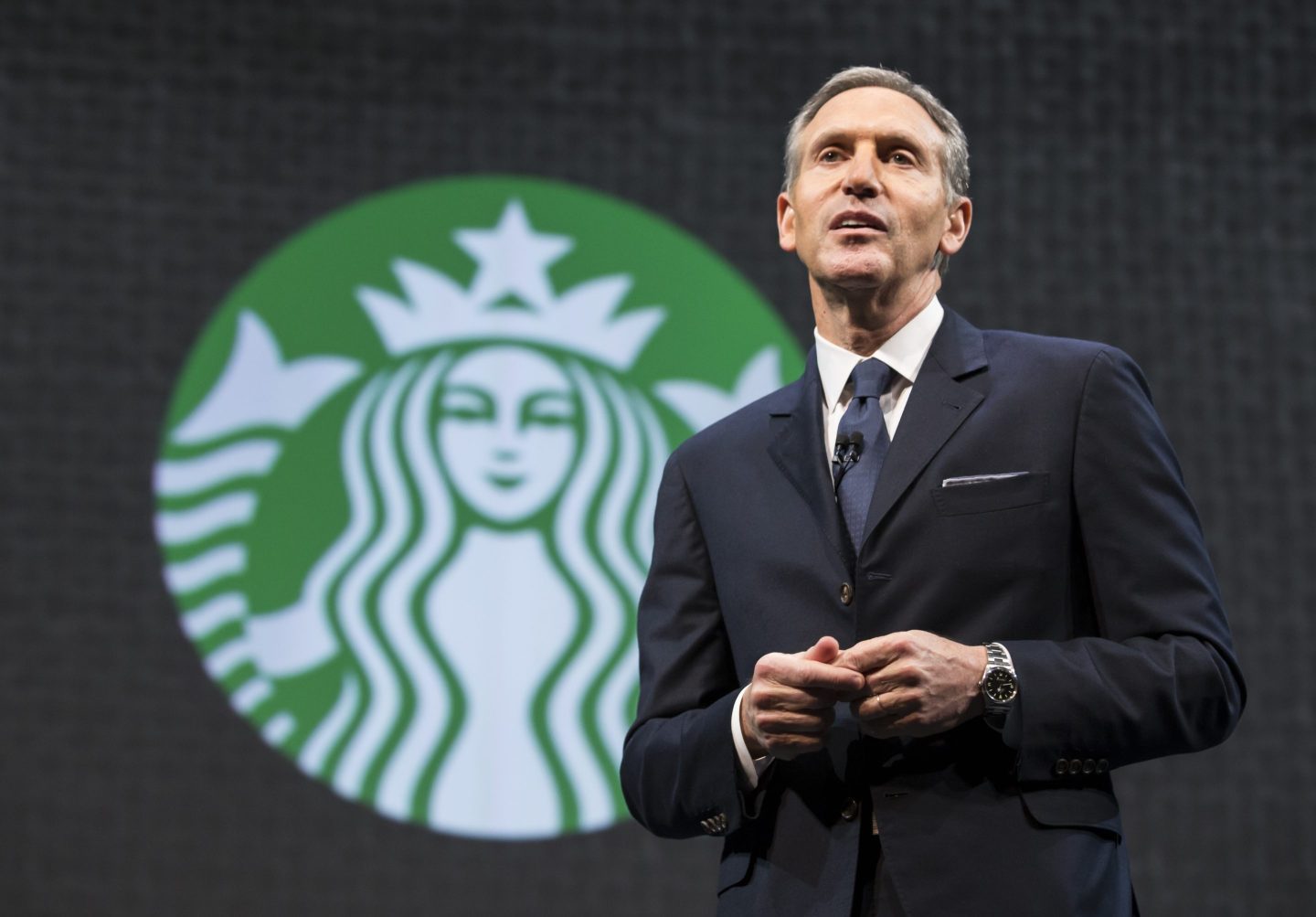
Starbucks’ outgoing CEO Howard Schultz has made it no secret that he doesn’t believe in labor unions—but now he has revealed he thinks the unionization movement gripping the coffee giant is a sign of wider social problems in America.
In an interview with CNN that aired on Tuesday, Schultz suggested the rise of labor organizations—which has also hit major corporations including Amazon, Apple, and Tesla—was a symptom of deeper societal issues.
“It’s my belief that the efforts of unionization in America are in many ways a manifestation of a much bigger problem,” he said. “There is a macro issue here that is much, much bigger than Starbucks. I’ve talked to thousands of Starbucks partners, and I was shocked, stunned to hear the loneliness, the anxiety, the fracturing trust in government, the fracturing trust in companies, fracturing trust in family, a lack of hope in terms of opportunity.”
Starbucks refers to its employees as partners.
Starbucks ‘lost its way culturally’
Schultz, who helped Starbucks embark on its rapid expansion in the 1980s and 1990s and almost ran for president in 2020, told CNN’s Poppy Harlow that he had returned to the company as interim CEO to restore its employees’ faith in the firm.
“I came back this past year because the company really did lose its way, and it lost its way culturally,” he admitted. “The unions showed up because Starbucks was not leading in a way that was consistent with its history in terms of being a values-based company, and I came back to basically restore those values.”
Schultz will “fully transition” out of the role of CEO next month, and told Harlow he would definitely be done leading the company once and for all when he stepped down.
However, he insisted that the labor issues which had plagued his third and final tenure at Starbucks would not damage his or the company’s legacy.
“The history of Starbucks has been that we have been a compassionate company,” he said. “The union issue is one of many issues that Starbucks faces.”
He added that the unionization movement was “not an existential threat” to the global coffee chain.
“I recognize that Starbucks partners have the right to unionize, but we have a right as a company to create the vision for the company, which the large, vast majority of Starbucks partners embraces,” he said.
Representatives for the labor union Starbucks Workers United were not immediately available for comment on Schultz’s interview when contacted by Fortune.
Starbucks’ union headache
Schultz returned to the helm of Starbucks for the third time last April as it faced an unprecedented unionization drive.
By the end of last year, more than 300 Starbucks stores across dozens of states had held union elections, with one unionized barista telling the Guardian in November that many workers joining the movement felt that the company did not “treat us like human beings.”
More than 260 of Starbucks’ 9,000 company-run stores have voted to unionize since the end of 2021, with members seeking things like better pay and benefits, paid sick leave, and improved health care coverage.
Schultz said in Tuesday’s interview that the company already offered “unprecedented benefits, not because a union told us to, but because [of] the conscience of the company.”
The firm’s employee benefits include paid parental leave, tuition reimbursement, health care coverage, and discounted company stock.
Schultz has made no secret of his feelings on unionization in the past, putting the company in direct opposition and arguing it functions better when it works directly with its staff.
“I’m not an anti-union person. I am pro-Starbucks, pro-partner, pro–Starbucks culture,” Schultz reportedly said at a town hall with employees last year. “We didn’t get here by having a union.”
In a letter to U.S. employees shortly after kicking off his third stint as CEO, Schultz urged staff to resist “colluding with outside union forces.”
“I do not believe conflict, division, and dissension—which has been a focus of union organizing—benefits Starbucks or our [employees],” he said.
Under Schultz’s leadership over the past 10 months, Starbucks has increasingly found itself at loggerheads with labor unions, with the coffee chain accused of retaliating against unionized workers by closing their stores or forcing them out of their jobs.
Despite negotiation efforts, more than 1,000 of the company’s American employees staged a three-day walkout at the end of last year—the second major strike at Starbucks within a month.
Earlier this month, Sen. Bernie Sanders, who chairs a committee on labor issues, and 10 other lawmakers, invited Schultz to testify at Congress about Starbucks’ compliance with federal labor laws. Schultz declined the invitation, but offered to send another executive in his place.
Learn how to navigate and strengthen trust in your business with The Trust Factor, a weekly newsletter examining what leaders need to succeed. Sign up here.