“I would bet 10% or more of our remote staff, especially programmers, have another full-time job! We need to stop this before it escalates and get everyone back to the office.”
That’s what the chair of the board of a Fortune 1000 tech company said when I met with the board to help them figure out the company’s plans for permanent post-pandemic work arrangements. Having helped 19 organizations determine their hybrid and remote work plans, I hear such sentiments all too often.
So, I asked him where he got his information. He told me he sits on other company boards: That’s what he heard from other board members, and he guesses the same thing goes on here.
“These People Who Work From Home Have a Secret: They Have Two Jobs,” screams a headline from the Wall Street Journal. “‘It’s the Biggest Open Secret Out There’: The Double Lives of White-Collar Workers With Two Jobs,” according to the Guardian. And according to Bloomberg, “Many Remote Workers Secretly Juggle Two Full-Time Jobs—or More.”
These articles, and many similar ones, mostly have a similar structure. The journalist interviews an anonymous remote employee, usually in tech-related fields, about how they managed to secure a second job working remotely. The employee speaks of the additional money they’re able to secure, which is worth the burdens of working many more hours. There are often exciting and dramatic escapades of how they just managed to avoid getting caught. At times, there are cautionary tales of workers who were found out—and fired.
These types of articles play to our narrative fallacy, a dangerous mental blind spot that causes us to understand the world through stories, rather than facts. Sure, stories can be useful illustrations of broader data points. But the danger stems from stories that speak to our feelings and intuitions, without regard for the actual evidence.
Such stories feed into our mind’s availability bias. This cognitive bias refers to the fact that we tend to pay attention to the information that’s most available in our memory. Such salience occurs because these story-based articles arouse our emotions, which are especially stimulated by the crime-like elements in these tales.
It’s no surprise that the more traditionalist executives and board members who read these narratives integrate these stories into their vision of reality. After all, one of our most fundamental cognitive biases is the confirmation bias, our mind’s predisposition to look for information that confirms our beliefs, regardless of whether the information matches the facts. They latch on to such stories and then repeat them in C-suite and board meetings, as did the aforementioned chair of the board of the Fortune 1000 tech company.
Working multiple jobs: the facts
To be clear, I have no personal stake in any specific outcome. My priority is getting the right information to serve my clients. That’s why my first source of information for external benchmarks on employment and similar economic data is FRED: Federal Reserve Economic Data.
FRED gathers a variety of economic data, mainly from U.S. government agencies as well as other high-quality sources, to provide long-term trends in the U.S. economy. FRED’s goals are to provide the most accurate information possible, so that everyone from the Federal Reserve to the executives at Fortune 1000 companies to the founders of startups can make the best business decisions, thus maximizing government tax revenue. FRED has no interest or stake in promoting in-office, hybrid, or remote work.
Let’s consider the data on multiple jobholders as a percentage of all employed members of the U.S. workforce since the year 2000.
As the graph below makes clear, we’re at a historically low point of employees holding multiple jobs. The high point was around the turn of the century, when 5.8 % of all workers held multiple jobs. Currently, about 4.8% do so. Just before the pandemic, 5.2% percent had more than one job.
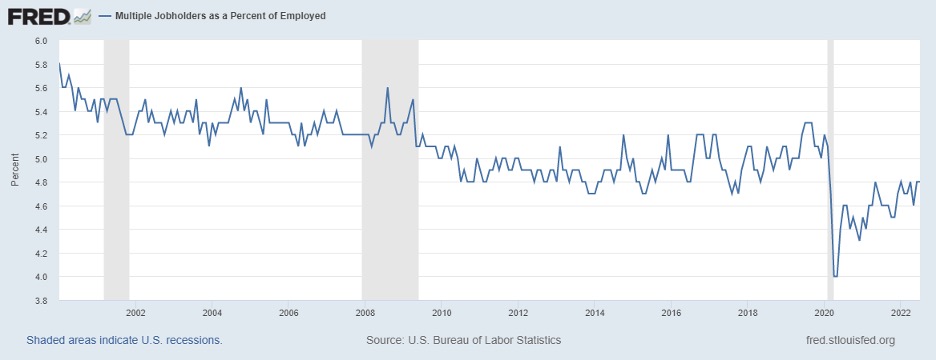
That data encompasses both full-time and part-time jobs. Perhaps the story is different for those holding down full-time jobs? Let’s see what FRED has to say.
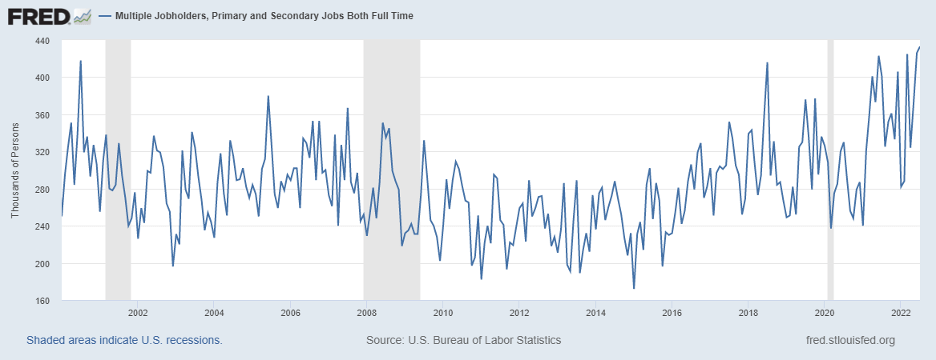
Not really. In July 2022, 438,000 workers had two full-time jobs, or 0.27% of the total working population of 163,500,000 this year. That compares to 418,000 in July 2000, or 0.3% of the total workforce of 138,800,000 that year. So while we’re not at a particularly historically low point of workers holding down two full-time jobs, we’re just about average, and the 10% theorized by the chair of the board is far too high.
But what about all the anecdotes?
What about all these anecdotes reflected in the headlines? Isn’t the plural of anecdote said to be data, the chair asked me.
It’s true that many more remote workers are holding down two full-time jobs than in the past. Yet it’s not because the proportion increased. It’s still under 0.3%. It’s because many more people are working remotely.
Before the pandemic, Stanford University research shows that 5% of all workdays were worked remotely. Two years into the pandemic, the comparable number is over 40% of all workdays.
That’s over eight times more! Thus, of the tiny fraction of all employees who hold down two full-time jobs, a much larger proportion will be remote. Unsurprisingly, we’ll certainly hear more stories about it.
The fact that more such incidents will occur will not change the fact that it’s under 0.3% percent of all workers. All those breathless headlines about two-timing remote workers—and the traditionalist executives who buy into them—ignore the underlying probabilistic base rate, meaning the actual likelihood of this scenario.
That’s a cognitive bias known as base rate neglect, where we focus on individual anecdotes and fail to assess the statistical likelihood of events. Similarly, even though traveling by plane is about 100 times safer than driving, the drama of breathless headlines surrounding plane crashes causes people to neglect statistics and travel by car, leading to many more fatalities.
Indeed, what executives often miss is that many of the employees who held down two full-time jobs before the pandemic did so from the office! Do you think people work a full eight-hour day when they come in? Far from it! Research finds that on average, employees work from 36% to 39% of the time they’re in the office. The rest is spent on things like making nonwork calls, reading social media and news websites, and even looking for—or working—other jobs.
Trust your staff
If you can’t trust a worker to work well remotely, you can’t trust them to work well in the office.
Recent research by Citrix on knowledge workers—employees whose job can be done full-time remotely—shows that knowledge workers forced to come to the office full-time show the least amount of trust in their employers, compared to hybrid or full-time remote workers. No wonder: Their bosses are showing deep-rooted mistrust of their employees by forcing them to come to the office full-time when their job can be done mostly or even fully remotely.
If mutual trust between employer and employee is absent, the employee will disengage. A Gallup survey on hybrid and remote work revealed that when employees are required to work on site but they both can and would prefer to do their job in a remote or mostly remote manner, the result is significantly lower engagement and well-being—and significantly higher levels of burnout and intent to leave.
In fact, if the employer took away the option of remote work, 54% of those working remotely would likely look for another job. Altogether, over three-fourths of all respondents want to work less than three days per week in the office.
Internal surveys from my clients align with these external surveys. For example, the University of Southern California’s Information Sciences Institute (ISI), a research institution with over 400 staff, originally decided in the summer of 2021 on a policy of three days in the office. Once the ISI leadership learned about my work and hired me as a consultant, they shifted in the fall of 2021 to a trust-based, flexible, team-led model, with individual team leaders deciding together with their team members what worked best for each team.
A survey we conducted in August 2022 showed that compared to the previous policy, 73% of the employees at ISI believed that the team-led model is “much better,” and 15% felt it’s “better.”
These responses show a much higher degree of employee satisfaction and engagement through flexibility and trust. The same goes for retention and recruitment, on a survey question that research shows reveals this issue—namely whether survey respondents would recommend working at ISI to their peers—56% said the team-led model makes it “much more likely” that they would make this recommendation, and 18% said it would make them “more likely.”
In the end, the chair of the board of the Fortune 1000 tech company agreed that the best practice for the future of work is a collaborative, trust-based approach. Show trust to your employees, and they will trust you in return. Accommodate their working styles and preferences, and they will repay you with higher engagement, productivity, and loyalty. And make decisions using data, not stories.
Gleb Tsipursky, Ph.D., helps executives use hybrid work to improve retention and productivity while cutting costs. He serves as the CEO of the boutique future-of-work consultancy Disaster Avoidance Experts. He is the best-selling author of seven books, including Never Go With Your Gut: How Pioneering Leaders Make the Best Decisions and Avoid Business Disasters and Leading Hybrid and Remote Teams: A Manual on Benchmarking to Best Practices for Competitive Advantage. His expertise comes from over 20 years of consulting for Fortune 500 companies from Aflac to Xerox and over 15 years in academia as a cognitive scientist at UNC-Chapel Hill and Ohio State.
The opinions expressed in Fortune.com commentary pieces are solely the views of their authors and do not necessarily reflect the opinions and beliefs of Fortune.
More must-read commentary published by Fortune:
- Will the U.S. and Europe slide into recession in 2023? Here’s how to look out when economic outlooks don’t
- Biden crowned world energy czar as diplomacy triumphs over Putin’s tantrums
- 2023 will be the year of digital assassination. Are you ready for the 2-hour internet day?
- Could Kanye West be placed under Kim Kardashian’s conservatorship?
Our new weekly Impact Report newsletter examines how ESG news and trends are shaping the roles and responsibilities of today's executives. Subscribe here.